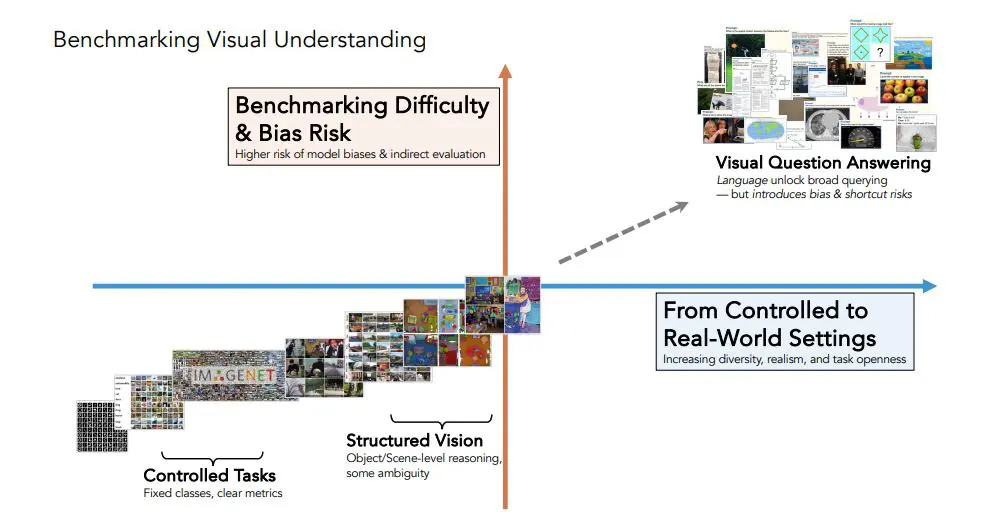
Multimodal large language models (MLLMs) require rigorous testing, yet current benchmarks often fail to truly assess visual understanding, instead allowing models to exploit linguistic shortcuts and biases. Ellis Brown, Jihan Yang, Shusheng Yang, Rob Fergus, and Saining Xie, all from New York University, demonstrate that many benchmarks can be successfully completed without strong visual reasoning, highlighting a critical flaw in current evaluation methods. Their work introduces a novel approach to benchmark design, advocating that designers actively attempt to “game” their own tests to identify and mitigate these exploitable weaknesses. The team achieves this through a “Test-set Stress-Test” methodology, which involves training models on the textual components of the test set itself, and an “Iterative Bias Pruning” procedure to filter out problematic samples, ultimately creating more robust and reliable benchmarks, exemplified by the creation of VSI-Bench-Debiased. This research represents a significant step towards accurately evaluating the true visual capabilities of MLLMs and ensuring their development prioritises genuine understanding, rather than superficial pattern recognition.
Detecting and Removing VQA Benchmark Bias
This research details a methodology for improving visual question answering (VQA) benchmarks, specifically VSI-Bench and CV-Bench. The central argument is that many benchmarks contain unintended shortcuts, allowing models to answer questions without truly understanding the visual content. The authors propose a two-step approach: detecting these shortcuts and removing the samples that exploit them, creating a more challenging and reliable evaluation. The core of the detection process is a Test-Time Shortcut Testing (TST) diagnostic, which uses a Random Forest model trained directly on the test set to predict answers.
High accuracy of this model indicates the presence of exploitable shortcuts, and the model’s feature importances reveal which cues are being used. This allows researchers to pinpoint the source of the bias. An Iterative Bias Pruning (IBP) algorithm then systematically removes samples identified as biased, controlling the removal process to maintain a balanced benchmark. Analysis of the VSI-Bench dataset, focusing on object size estimation, revealed that the primary shortcut was predicting size based solely on object category. Objects with consistent sizes, such as dishwashers or beds, were particularly vulnerable.
The obj_val_log_mean feature, representing the average size of an object category, proved to be the most important feature in the diagnostic model, confirming this shortcut. This insight provides a clear path for improving the benchmark by either removing questions about low-variance objects or ensuring greater size diversity within each category. This work delivers a robust methodology for creating more challenging and reliable VQA benchmarks, offering interpretability by revealing the sources of bias and providing actionable insights for benchmark design.
Test-Set Stress-Test Reveals Multimodal Bias
This study pioneers a novel methodology for evaluating multimodal large language models, addressing the critical issue of superficial pattern exploitation in benchmark datasets. Researchers developed a “Test-set Stress-Test” (TsT) to systematically identify and quantify non-visual biases within existing benchmarks, moving beyond simple tests that only reveal whether vision is unnecessary. This approach directly probes the test set itself, training diagnostic models exclusively on non-visual, textual inputs to uncover exploitable patterns and assign a bias score to each sample. The TsT methodology employs two complementary techniques.
Scientists fine-tuned a large language model via k-fold cross-validation, utilizing LoRA adaptation to efficiently train on the textual components of the test set. This reveals shortcut performance and generates a quantitative, sample-level bias score, denoted as s(x). Complementing this, the team implemented a lightweight Random Forest-based diagnostic, trained on hand-crafted features, to enable rapid auditing and interpretable bias analysis. This dual approach provides both a comprehensive and efficient means of assessing benchmark vulnerability. To further refine benchmark robustness, researchers introduced an “Iterative Bias Pruning” (IBP) procedure.
This technique systematically filters samples identified as highly biased according to the s(x) score, effectively reducing the prevalence of non-visual shortcuts within the dataset. The team applied this framework to four prominent benchmarks, VSI-Bench, CV-Bench, MMMU, and VideoMME, uncovering substantial and pervasive non-visual biases across all datasets. As a case study, they created VSI-Bench-Debiased, demonstrating a marked reduction in non-visual solvability and a significantly wider vision-blind performance gap compared to the original benchmark, confirming the effectiveness of their diagnostic and debiasing procedures.
Test Sets Reveal Superficial Multimodal Reasoning
Researchers have developed a robust framework for evaluating multimodal benchmarks, revealing a critical vulnerability in current methods. The work demonstrates that many benchmarks can be successfully completed by models without genuine visual understanding, instead exploiting biases, linguistic shortcuts, and superficial patterns within the data. This poses a significant challenge to accurately assessing the true multimodal reasoning capabilities of artificial intelligence systems. The team’s approach, termed Test-set Stress-Testing (TsT), directly probes the intrinsic vulnerabilities of a benchmark’s test set through k-fold cross-validation.
By training diagnostic models exclusively on non-visual, textual inputs, scientists can quantify the extent to which questions can be answered without any visual information. Applying this methodology across four benchmarks, VSI-Bench, CV-Bench, MMMU, and VideoMME, the study uncovered pervasive non-visual biases. As a case study, the team created VSI-Bench-Debiased, demonstrating a reduction in non-visual solvability and a wider performance gap between vision-enabled and vision-blind configurations. Specifically, after fine-tuning on VSI-Train-10k, blind accuracy increased from 25. 9% to 44.
7%, a substantial gain of 18. 8 percentage points. Remarkably, the vision-enabled model’s performance improved by a nearly identical margin of 20. 4 points, resulting in only a minimal widening of the vision-blind gap, just 1. 6 points.
This confirms that models are learning statistical shortcuts that benefit all configurations equally, bypassing the need for actual visual reasoning. The TsT framework delivers two key outputs: overall TsT accuracy, providing a global estimate of non-visual solvability, and a sample-level bias score, s(x), representing the diagnostic model’s confidence in the ground truth answer without visual input. These scores enable targeted mitigation strategies and provide a more accurate assessment of multimodal AI capabilities. The work highlights the need for rigorous benchmark design and diagnostic procedures to ensure that progress in multimodal AI reflects genuine advancements in visual reasoning, rather than exploitation of superficial patterns.
TsT Reveals Benchmark Exploitation Through Text
Multimodal benchmarks are essential for measuring advances in artificial intelligence, yet research demonstrates these benchmarks are vulnerable to exploitation via non-visual shortcuts rather than genuine visual understanding. Models can achieve high scores by learning patterns within the textual components of the benchmarks, creating an illusion of progress that may misdirect research efforts. To address this, scientists developed a diagnostic framework called Test-set Stress-Test (TsT) which quantifies how easily benchmarks can be exploited without utilizing visual information. The TsT framework employs a method of training models exclusively on the textual inputs of the test set, assigning each sample.
🗞 Benchmark Designers Should “Train on the Test Set” to Expose Exploitable Non-Visual Shortcuts
🧠 ArXiv: https://arxiv.org/abs/2511.04655