

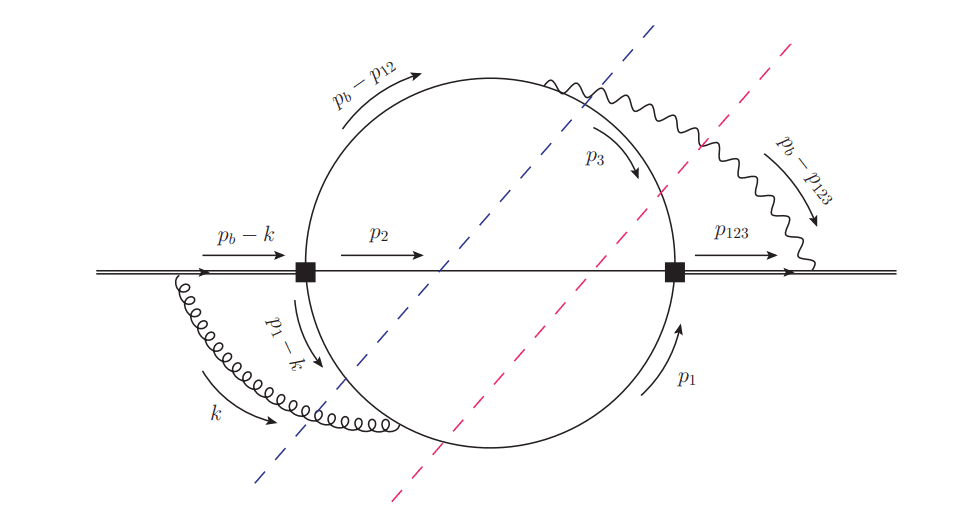
The precise calculation of particle decays remains a cornerstone of testing the Standard Model of particle physics, and recent years have seen significant advances in calculating these decays to very high precision. Kevin Brune, Tobias Huber, and Lars-Thorben Moos, all from the Universität Siegen, now complete a crucial piece of this puzzle by calculating previously unknown contributions to the decay rate of particles. Their work focuses on complex, multi-parton interactions, formally at Next-to-Leading Order in perturbative calculations, which had remained a theoretical challenge. By employing advanced mathematical techniques to handle intricate calculations involving multiple particles, the team provides a complete analytical description of these corrections, ultimately refining our understanding of particle decay processes and improving the accuracy of theoretical predictions.
B Meson Decay Calculations With QCD Perturbation Theory
This extensive work details a highly complex physics calculation concerning B meson decays and the determination of fundamental parameters like the CKM matrix elements. The calculation formally completes the purely perturbative contributions to the ̄B →Xsγ decay at next-to-leading order (NLO) in quantum chromodynamics (QCD), providing a more complete theoretical understanding of this process. This decay is particularly sensitive to potential new physics beyond the Standard Model, making precise calculations essential. The work focused on calculating previously unknown contributions from multi-parton final states involving four-body decays of b quarks into strange quarks, quark-antiquark pairs, and a photon, supplemented by five-body decays including a gluon.
The team computed these complex contributions using advanced techniques of integral reduction and evaluation of master integrals, essential for handling the intricate mathematical expressions arising from the calculations. A key aspect of the work involved carefully treating the γ5 matrix within the framework of dimensional regularisation, a mathematical tool used to manage infinities that arise in quantum field theory. The resulting analytic expressions were subjected to ultraviolet renormalisation and infrared subtraction to ensure finite and physically meaningful results. The numerical impact of these multi-parton corrections on the ̄B →Xsγ decay rate was found to be small, owing to partial cancellation between leading-order and next-to-leading order contributions. This formally completes the NLO calculation, paving the way for even more precise theoretical predictions to match the increasing precision of experimental measurements at facilities like Belle II.
Rare B Meson Decay Calculations Completed
Scientists have formally completed the calculation of purely perturbative contributions to the rare decay of B mesons into a photon and other particles, known as ̄B →Xsγ, at next-to-leading order (NLO) in quantum chromodynamics (QCD). This achievement represents a significant step towards increasing the precision of theoretical predictions for this important decay, which serves as a sensitive probe for new physics beyond the Standard Model. The team computed these contributions by employing advanced techniques for simplifying complex integrals and evaluating master integrals. The researchers successfully integrated over the four and five-particle phase space using a combination of reverse unitarity and differential equations. Achieving this level of precision is vital as experiments continue to improve, demanding increasingly accurate theoretical counterparts.
Multi-Parton Corrections to B Meson Decay
This research successfully calculates previously unknown contributions to the decay rate of a specific particle decay, completing the perturbative calculations at a given order of accuracy. Scientists addressed missing components arising from multi-parton final states in the decay of a B meson into a strange quark, a photon, and additional quarks. The results demonstrate that these multi-parton corrections have a small numerical impact on the overall decay rate, owing to cancellations with existing calculations. This completion of the perturbative calculations is significant because it enhances the precision of theoretical predictions for this particular decay process, which serves as a crucial test of the Standard Model of particle physics and a means of searching for new physics.
👉 More information
🗞 Multi-parton contributions to at NLO
🧠 ArXiv: https://arxiv.org/abs/2509.22564


