Forecasting complex systems, such as weather patterns or fluid dynamics, relies on accurately predicting how variables change over time, a task that becomes exceptionally difficult with high-dimensional data. Makoto Takagi, Ryuji Kokubo, and Misato Kurosawa from Waseda University, along with colleagues, present a novel forecasting method that combines classical machine learning with quantum computation to address this challenge. Their approach efficiently represents spatial data by focusing on key locations, then uses a specially designed quantum algorithm to predict future states, and reconstructs the full picture with a learned decoder. This hybrid method, employing multi-parallelized quantum long short-term memory and gated recurrent unit networks, demonstrably improves forecasting accuracy, achieving a 1.5% reduction in test loss compared to traditional methods and exhibiting exceptional precision when tested against independent semiconductor pressure measurements. The research signifies a step forward in applying quantum computing to practical forecasting problems, potentially enhancing our ability to model and predict complex phenomena.
Quantum Speedup for Spatial Time-Series Forecasting
Forecasting the Future with Quantum-Enhanced Spatial Data Analysis Accurate time-series forecasting is crucial across diverse fields, from healthcare and weather prediction to finance and energy management. Traditionally, methods have ranged from statistical models to increasingly sophisticated machine learning approaches like recurrent neural networks. These networks excel at identifying patterns in large datasets, but struggle with the computational demands of high-dimensional data, hindering progress in areas like fluid dynamics and seismic analysis. Recent advances in quantum computing offer a potential solution.
Quantum machine learning promises to enhance data analysis and computation, with researchers exploring quantum LSTM (QLSTM) and quantum GRU (QGRU) architectures. Ongoing research focuses on optimizing these architectures and unlocking their full potential, particularly in terms of learning capability. Applying these quantum-enhanced methods to high-dimensional spatial data presents a significant challenge, as processing such large volumes of information is computationally expensive. A dedicated forecasting method tailored for this type of data remained elusive, until now. Researchers have developed a novel time-series forecasting method specifically designed for high-dimensional spatial data. Their technique combines optimal selection of sparse sensor positions with multi-parallelized quantum LSTM (MP-QLSTM) and multi-parallelized quantum GRU (MP-QGRU) models. By strategically choosing where to collect data and utilizing these quantum networks, the researchers achieve improved forecasting accuracy and efficiency, demonstrating a reduction in test loss compared to classical models and a remarkably low root mean squared percentage error when tested against semiconductor pressure sensor measurements.
Minimal Data Selection Boosts Quantum Forecasting
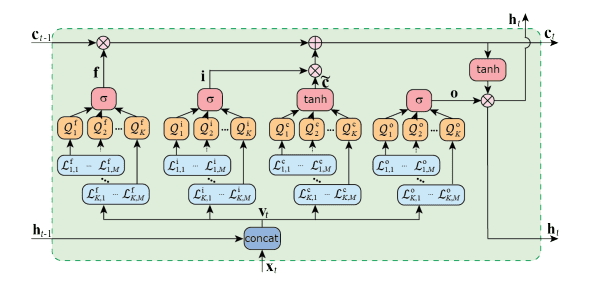
Researchers have developed a new method for forecasting complex, high-dimensional data, such as fluid dynamics or solar power generation, by strategically combining data selection, advanced forecasting techniques, and data reconstruction. The approach centers on identifying a minimal set of key measurement points that effectively represent the entire system, significantly reducing computational demands without sacrificing accuracy. The core of the forecasting relies on enhanced versions of established machine learning models, specifically multi-parallelized quantum long short-term memory (MP-QLSTM) and gated recurrent units (MP-QGRU). These models build upon existing quantum-inspired techniques, but crucially, they fully utilize the potential of their quantum components by measuring all available data, unlike previous iterations that only sampled a portion.
This complete measurement process allows for a more expressive and accurate representation of the underlying data patterns. Testing against traditional methods, MP-QLSTM and MP-QGRU demonstrated a consistent improvement in forecasting accuracy, achieving test losses approximately 1.5% lower than standard LSTM and GRU models. In one application, forecasting pressure distributions from limited sensor data, MP-QLSTM achieved a root mean squared percentage error of just 0.256%, demonstrating its ability to reconstruct complex spatial data from sparse measurements. Notably, the method proved effective across diverse datasets, consistently outperforming conventional approaches by margins of 3% to 10%. Further investigation revealed that MP-QLSTM excels at forecasting data containing significant noise, while standard LSTM performs better with cleaner data, suggesting that the optimal choice of model depends on the specific characteristics of the data being analyzed. This adaptability, combined with the method’s ability to accurately forecast high-dimensional data from a limited number of sensors, represents a significant step forward in predictive modeling for complex systems.
Sparse Sensing with Variational Quantum Recurrence
This research presents a novel time-series forecasting method specifically designed for high-dimensional spatial data. The method efficiently represents complex spatial distributions by strategically selecting a sparse set of sensor positions, forecasting time-series data at these points, and then reconstructing the complete spatial distribution using a learned decoder. Crucially, the team developed multi-parallelized quantum long short-term memory (MP-QLSTM) and gated recurrent unit (MP-QGRU) models, which improve forecasting performance by fully utilizing the capacity of variational quantum circuits. The results demonstrate that MP-QLSTM and MP-QGRU achieve approximately 1.5% lower test loss compared to classical LSTM and GRU models, and a root mean squared percentage error of just 0.256% when validated against independent semiconductor pressure sensor data. This indicates the method’s accuracy in forecasting high-dimensional data, even when reconstructing complete spatial distributions from forecasts at only a few selected points. The authors acknowledge that the performance of MP-QLSTM is particularly advantageous when forecasting noisy data, while classical LSTM may be preferable in low-noise scenarios, suggesting a need for careful method selection based on data characteristics.
👉 More information
🗞 Time-series forecasting for nonlinear high-dimensional system using hybrid method combining autoencoder and multi-parallelized quantum long short-term memory and gated recurrent unit
🧠 DOI: https://doi.org/10.48550/arXiv.2507.10876