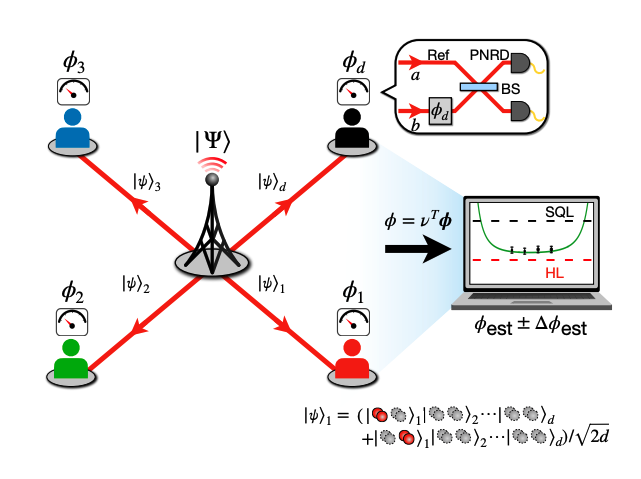
Distributed quantum sensing, which allows for the estimation of global parameters across multiple distant locations, holds immense potential for advancements in imaging, sensor networks, and precise timekeeping. Dong-Hyun Kim from the Korea Institute of Science and Technology (KIST), Seongjin Hong from Yonsei University, and Yong-Su Kim from KIST, alongside their colleagues, now demonstrate a significant step forward in this field by successfully implementing a distributed sensing scheme using multi-mode quantum states. Their research establishes that these states can achieve Heisenberg-limited precision, representing a substantial improvement over traditional methods, and opens the door to entanglement-enhanced sensor networks with unprecedented sensitivity. By experimentally estimating spatially distributed phases with a four-mode state, the team achieves a 2. 74 dB sensitivity enhancement, confirming the theoretical predictions and highlighting the promise of this approach for future quantum technologies.
Researchers are now exploring multi-mode N00N states, a sophisticated quantum resource, to enhance the precision of these sensing networks. These states offer increased flexibility and capability compared to traditional single-parameter estimation schemes, allowing simultaneous estimation of several parameters and potentially improving efficiency. This research investigates the theoretical foundations and practical implications of utilising multi-mode N00N states, focusing on the challenges and opportunities associated with their generation, distribution, and measurement in realistic network environments.
Entangled Photons Enhance Phase Estimation Precision
This research demonstrates a significant advancement in distributed quantum sensing and multiple phase estimation. Distributed quantum sensing involves using entangled quantum states, like photons, distributed across a network to achieve more precise measurements than classical sensors. The team demonstrates that using multi-mode N00N states significantly improves the precision of distributed quantum sensing, especially when estimating multiple phases. A crucial finding is that optimal sensitivity can be achieved with fewer photons than previously thought, a major practical advantage as generating and detecting photons often limits quantum technologies.
The research also addresses practical limitations by developing strategies to make the sensing scheme more robust to photon loss, a common problem in real-world environments. They identified an optimal strategy for multiple-phase estimation that works well even with significant photon loss, demonstrating that a quantum advantage can be maintained. The team also suggests that nonlocal metasurfaces could be used to create high-N00N states, potentially miniaturizing and scaling up the sensing system.
Multi-Mode Quantum States Enhance Distributed Sensing
Researchers have developed a novel approach to distributed quantum sensing, achieving enhanced sensitivity by utilising multi-mode quantum states of light. This technique addresses the challenge of precisely measuring global parameters across multiple, distant locations, a crucial capability for applications like imaging, environmental monitoring, and synchronizing networks. The core of this advancement is the creation and distribution of specially prepared quantum states, known as multi-mode N00N states, which exhibit strong quantum correlations enabling a level of precision that classical methods cannot achieve. Theoretical analysis demonstrates that this approach reaches the Heisenberg scaling limit, representing a fundamental bound on measurement precision. In experiments, the team successfully estimated the average of two unknown phases using a four-mode state, achieving a 2. 74 dB sensitivity enhancement compared to the standard quantum limit, demonstrating the practical viability of the technique and opening new avenues for highly sensitive sensor networks.
Heisenberg Scaling Boosts Distributed Sensing Precision
This research demonstrates the potential of multi-mode states to significantly enhance the precision of distributed sensing, where a global parameter is estimated across multiple distant locations. By theoretically examining and experimentally verifying the performance of these states, the team shows they can achieve the Heisenberg scaling, where precision improves proportionally to the number of entangled particles used. In a practical demonstration, the researchers estimated the average of two spatially separated phases using a four-mode state, achieving a 2. 74 dB improvement in sensitivity compared to standard methods.
The findings contribute to a deeper understanding of quantum-enhanced multiple-parameter estimation and pave the way for advanced distributed quantum sensor networks. While the current experiments employed post-selection, the core principle of enhanced sensitivity remains valid. Future work could focus on extending these techniques to higher-mode states and exploring methods to overcome the limitations imposed by decoherence in real-world applications. Recent advances in metasurface technology offer a promising route to generating the high-photon-number multi-mode states needed to scale up these systems.
🗞 Distributed quantum sensing with multi-mode states
🧠 ArXiv: https://arxiv.org/abs/2508.02070