Magnetic resonance imaging-guided linear accelerators represent a significant advance in cancer treatment, enabling clinicians to visualise soft tissues during radiotherapy and adapt treatment plans accordingly. Mingyan Li, Ewald Weber, and David E. J. Waddington, along with colleagues including Shanshan Shan, Paul Liu, and Bin Dong, have addressed a key limitation of the 1. 0 Tesla Australian MRI-Linac system, which currently relies on a relatively distant radiofrequency coil. The team designed and constructed a dedicated, flexible eight-element radiofrequency coil specifically tailored to the system’s geometry and treatment requirements. This new coil array demonstrably improves signal-to-noise ratio, achieving up to threefold enhancement at the centre of the image and eightfold improvement in superficial regions, and enables faster imaging crucial for real-time tumour tracking while maintaining the necessary radiolucency for accurate beam delivery.
Inline MRI-Linac Prototype and Initial Tests
This research details the development and experimental results of a prototype high-field inline MRI-linac, integrating magnetic resonance imaging with radiation therapy delivery in a single system to enable real-time adaptive radiotherapy. The system features a 1. 5 Tesla magnet for improved image quality and an inline design where the patient lies within the MRI bore during radiation delivery, allowing continuous anatomical visualization. A crucial component is a dedicated, radiation-transparent radiofrequency coil for MRI signal reception within the radiation field, which the researchers designed and evaluated.
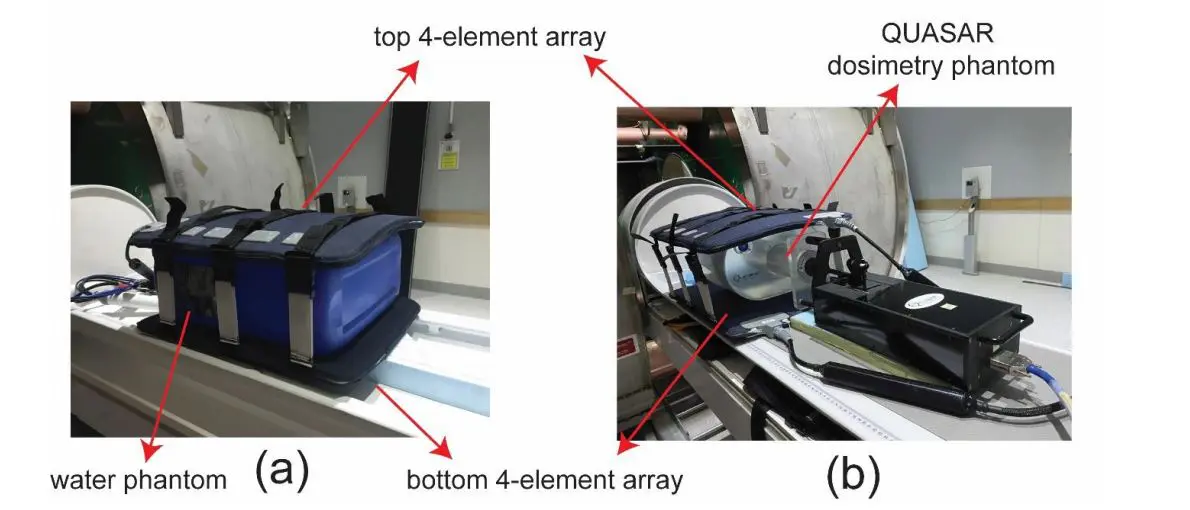
The system’s performance was validated using a realistic phantom, simulating a patient undergoing treatment. Experiments demonstrate the ability to acquire diagnostic-quality MRI images during simulated radiation delivery, with acceptable signal-to-noise ratio for diagnostic imaging. The radiofrequency coil exhibits sufficient radiation transparency for effective radiation delivery and demonstrates good geometric accuracy, crucial for precise radiation targeting. These results pave the way for real-time adaptive radiotherapy, where treatment plans can be adjusted based on tumour response and anatomical changes, improving treatment precision by minimizing damage to healthy tissues and enabling personalized treatment approaches. 0 Tesla MRI-Linac system. This innovative coil design demonstrably improves signal-to-noise ratio and enables accelerated, high-resolution imaging during treatment. Bench measurements confirm effective tuning and decoupling of all channels. Phantom imaging experiments demonstrate a substantial improvement in signal-to-noise ratio with the new coil array.
Specifically, the torso coil achieves approximately three-fold signal-to-noise ratio improvement at the centre of the imaged volume and an impressive eight-fold improvement in superficial regions, compared to the standard whole-body coil. Investigations into imaging at various treatment angles, simulating patient rotation during therapy, confirm the coil’s robustness, preserving overall image quality even with rotation.
Torso Coil Boosts MRI Signal in Radiotherapy
This work demonstrates a new eight-element radiofrequency coil array designed for the Australian 1. 0 Tesla MRI-Linac system, significantly improving image quality during radiotherapy. The researchers successfully designed and manufactured a torso coil that delivers approximately three-fold higher signal-to-noise ratio at the centre of the imaging area and an eight-fold improvement in superficial regions, compared to the standard whole-body coil. This enhanced signal quality translates to clearer anatomical detail and sharper tissue boundaries in images acquired during treatment. The improved signal-to-noise ratio also allows for faster imaging techniques, potentially reducing scan times. Dosimetry measurements confirmed the coil array maintains effective radiolucency, meaning it does not interfere with the delivery of radiation therapy. The authors suggest future work could explore integration with advanced algorithms to further enhance real-time tumour tracking capabilities.
🗞 Design and Construction of a Dedicated Radiolucent 8-element Flexible Radiofrequency (RF) Torso Coil for the 1.0T Australian MRI-Linac System
🧠 ArXiv: https://arxiv.org/abs/2511.22879