

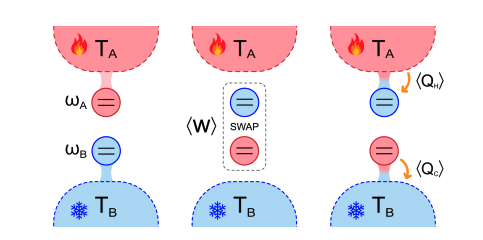
The pursuit of ever-more-efficient engines drives innovation in thermodynamics, and recent research challenges fundamental limits on how much work engines can extract from heat. Dimitris Moustos and Obinna Abah, both from Newcastle University, investigate how motion affects energy conversion at the quantum level, revealing a pathway to surpass the long-established Carnot efficiency. Their work centres on a heat engine powered by quantum bits experiencing relativistic motion, demonstrating that this movement alters how the qubits perceive temperature. The team shows that by harnessing these motion-induced temperature shifts, the engine’s performance increases, exceeding the efficiency traditionally dictated by the temperatures of stationary systems, and establishing a new framework for understanding energy transfer in moving quantum systems.
Detectors Perceiving Temperature in Motion
Moving Detectors and Perceived Temperature Differences
Relativistic Effects on Quantum Temperature Perception
This research explores how a moving quantum detector perceives temperature differently than a stationary observer in a thermal environment. This difference arises from relativistic effects and the detector’s interaction with the quantum field, influencing the effective temperature it experiences. Understanding this distinction is crucial for developing a deeper understanding of quantum thermodynamics in relativistic settings and investigating phenomena like the Unruh effect, which predicts a thermal bath even in a vacuum. The study centers on the Unruh-DeWitt (UDW) detector, a theoretical model used to probe quantum fields and examine how motion affects temperature perception.
Researchers calculate the effective temperature experienced by the detector, which isn’t necessarily the same as the surrounding environment’s actual temperature, based on its transition rates, the probability of it absorbing or emitting energy. This work provides a rigorous mathematical foundation for understanding the relationship between motion, temperature, and quantum fields, with implications for quantum thermodynamics, relativistic quantum information, and cosmology. In essence, this research offers a detailed exploration of how motion alters the thermal experience of a quantum detector, providing valuable insights into the foundations of quantum physics.
Engineering Efficiency with Quantum Motion
Relativistic Quantum Engine Efficiency via Motion
Modeling Efficiency Using Moving Quantum Detectors
Researchers have developed a new approach to understanding heat engine efficiency by investigating systems operating under relativistic conditions. Unlike traditional heat engines studied at rest, this work considers a system comprised of quantum detectors in constant motion, mimicking effects predicted by the theory of relativity. This innovative setup allows exploration of how motion alters the perception of temperature for quantum systems, creating opportunities to enhance energy conversion. The methodology centers on a two-qubit engine where each qubit acts as a detector sensitive to a scalar field, and these detectors are subjected to high-speed motion.
This motion induces a relativistic effect, causing the qubits to experience temperatures different from a stationary observer, effectively creating a temperature gradient that drives the engine. By carefully controlling the velocity of these qubits, researchers can manipulate this temperature difference and harness it to improve the engine’s performance. This research develops a generalized second law of thermodynamics tailored for moving systems, acknowledging that standard thermodynamic bounds may not apply when dealing with relativistic motion. The team demonstrated that by leveraging the relativistic temperature shift, specifically the velocity of the qubits, they could significantly boost both the work output and the efficiency of the engine at its optimal operating point. This represents a departure from conventional heat engine design, exploring the thermodynamic possibilities inherent in relativistic motion and quantum field interactions.
Relativity Breakthroughs Beyond Carnot Limits
Relativistic Heat Engine Boosts Efficiency Significantly
Boosting Efficiency Beyond Theoretical Limits
Researchers have demonstrated a novel heat engine that harnesses the principles of relativity to achieve enhanced performance, potentially exceeding the limitations of conventional designs. This engine utilizes quantum effects and the motion of its components to manipulate energy flow in a unique way, offering a pathway towards more efficient thermal devices. The team designed an engine where quantum bits, acting as the working substance, are subjected to motion, causing them to perceive temperatures different from a stationary observer. This relativistic temperature shift, whether hotter or colder, becomes a resource for boosting the engine’s work output and efficiency at maximum power.
Remarkably, simulations show this engine can surpass the Carnot limit, the theoretical maximum efficiency for any heat engine, without violating fundamental laws of thermodynamics. This breakthrough stems from the fact that the moving quantum bits experience altered temperatures, effectively ‘seeing’ a different thermal landscape than their surroundings. This allows the engine to extract more work from the same temperature difference, improving its overall performance. The results suggest that incorporating relativistic effects into the design of quantum thermal devices opens up exciting possibilities for manipulating energy and creating more efficient technologies.
Relativistic Motion Boosts Quantum Engine Efficiency
This research demonstrates that the relativistic motion of a quantum thermal engine’s working medium can enhance its performance, potentially exceeding the conventional Carnot limit. The team investigated a heat engine powered by qubits experiencing motion, revealing that this motion alters the effective temperatures perceived by the qubits. This shift in effective temperature, stemming from the principles of relativity, allows for increased work output and efficiency at maximum power without violating fundamental thermodynamic laws. The findings highlight a pathway to manipulate energy flow in quantum devices by harnessing relativistic effects, opening possibilities for designing more efficient thermal engines. While the study acknowledges that the results are specific to the considered engine model, the underlying principle, that motion can alter perceived temperatures, suggests broader implications for quantum thermodynamics. Future research could explore the application of these principles to different engine designs and investigate the potential for experimental realization of such devices.
🗞 Surpassing Carnot efficiency with relativistic motion
🧠 ArXiv: https://arxiv.org/abs/2508.11554


