

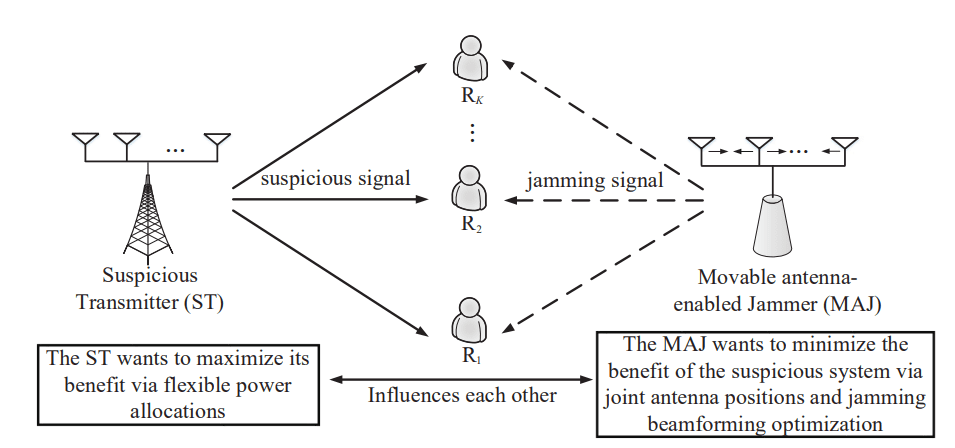
Wireless communication security faces a new challenge as researchers investigate methods to disrupt potentially harmful transmissions, and a team led by Guojie Hu, Qingqing Wu, and Lipeng Zhu, from their respective institutions, now demonstrates a novel approach using movable antenna technology. The team develops a system where a jammer equipped with a movable antenna actively subverts communications between a suspicious transmitter and multiple receivers, effectively minimising the benefits of their exchange. This research is significant because it addresses the dynamic nature of modern wireless systems, where transmitters can adapt to interference, and the team overcomes this challenge by first predicting the transmitter’s response to jamming, then optimising both antenna positioning and jamming signals. Through innovative algorithms and analysis, the researchers reveal key principles for deploying these movable antennas, ultimately achieving superior performance compared to traditional fixed systems and establishing a benchmark for future secure communication designs.
system performance. In this work, researchers exploit the capabilities of a movable antenna-enabled legitimate jammer to disrupt suspicious multiuser downlink communications involving a transmitter and multiple receivers. The objective is to minimize the benefit gained by these suspicious communications by jointly optimizing antenna positions and the jamming beamforming at the jammer. A key challenge lies in the transmitter’s ability to reactively adjust its power allocations to mitigate the jamming interference, necessitating a carefully considered approach to ensure effective disruption of targeted communications.
Movable Antennas Enhance Wireless Capacity and Coverage
This document presents a comprehensive survey of research concerning movable antenna systems, also known as fluid antennas. The central idea is that physically moving antennas, changing their position and/or orientation, can significantly enhance wireless communication performance, offering an alternative to traditional fixed-antenna systems. The research explores how movable antennas can improve capacity and throughput by optimizing antenna placement to manage signal strength and interference, leading to higher data rates. They can also extend the range of wireless networks, reduce transmission power requirements through optimized positioning, and integrate communication with sensing capabilities.
Furthermore, movable antennas enhance security through physical layer techniques. The document covers a wide range of research directions, including the development of algorithms to determine optimal antenna positions and orientations, exploring both discrete and continuous positioning scenarios. Researchers employ techniques like gradient descent and graph-based approaches for antenna placement, creating mathematical models to accurately represent the behavior of these systems. Channel modeling plays a crucial role in understanding how the wireless channel changes as antennas move, while resource allocation focuses on optimizing power and bandwidth.
Integration with technologies like reconfigurable intelligent surfaces, mobile edge computing, wireless energy transfer, and sensing is also explored. Specific system architectures, such as MIMO systems for improved capacity and reliability, broadcasting scenarios, and UAV networks for flexible coverage, are investigated. The research utilizes statistical channel state information to guide antenna movement, employing alternating optimization techniques to solve complex problems. The use of six-degree-of-freedom movable antennas and applications in near-field communications are also examined. The document highlights a growing research area with significant potential for improving wireless communication systems, trending towards more flexible and adaptable networks. Integration of multiple technologies and the development of intelligent, autonomous networks are key areas of focus. Movable antenna systems are seen as a key enabler for future wireless networks, including 5G and beyond, offering a valuable resource for researchers and engineers in the field.
Movable Antenna Jammer Suppresses Wireless Threats
This work presents a breakthrough in secure wireless communications by introducing a movable antenna-enabled jammer designed to suppress suspicious multiuser communications. Researchers developed a system where a jammer, equipped with movable antennas, strategically adjusts its position and jamming beamforming to minimize the benefit gained by a suspicious transmitter and multiple suspicious receivers. The core innovation lies in addressing the dynamic interplay between the jammer and the transmitter, acknowledging that the transmitter can adapt its power allocations to mitigate jamming interference. The team first determined the optimal behavior of the suspicious transmitter given the jammer’s actions, then used this information to simplify the optimization problem and develop effective algorithms for solving it.
Focusing on a specific scenario with two receivers, the study revealed key insights into the optimal deployment rules for the jammer’s antennas. Experiments demonstrate the effectiveness of the proposed schemes compared to conventional fixed-position antenna systems and other competitive benchmarks. The research establishes a significant advancement in secure communications by leveraging the additional spatial degree of freedom offered by movable antennas, enabling proactive reconfiguration of wireless channels and maximizing the potential of jamming beamforming. This approach allows for a more robust and adaptable defense against suspicious communications in dynamic wireless environments.
Antenna Control Disrupts Reactive Wireless Signals
This research demonstrates a novel approach to disrupting suspicious wireless communications through the strategic deployment and control of movable antennas. Scientists have developed a system where a legitimate jammer, equipped with movable antennas, can effectively minimize the benefits gained by potential malicious transmitters and receivers. The team achieved this by jointly optimizing both the physical positioning of the antennas and the characteristics of the jamming signal itself. A key aspect of this work involved anticipating and accounting for the reactive behaviour of the suspicious transmitter, which can adjust its power allocation to counteract the jamming.
The researchers formulated algorithms to determine the optimal strategies for both the jammer and the transmitter, leading to simplified problems that could be solved iteratively. Through analysis of a specific scenario involving two receivers, they identified valuable rules for antenna placement that maximize the effectiveness of the jamming. Furthermore, the study defines an ideal antenna deployment scheme representing a lower bound on achievable performance. Numerical results confirm that this movable antenna system outperforms conventional fixed-position antenna systems and other benchmark approaches.
👉 More information
🗞 Subverting Flexible Multiuser Communications via Movable Antenna-Enabled Jammer
🧠 ArXiv: https://arxiv.org/abs/2510.15298