

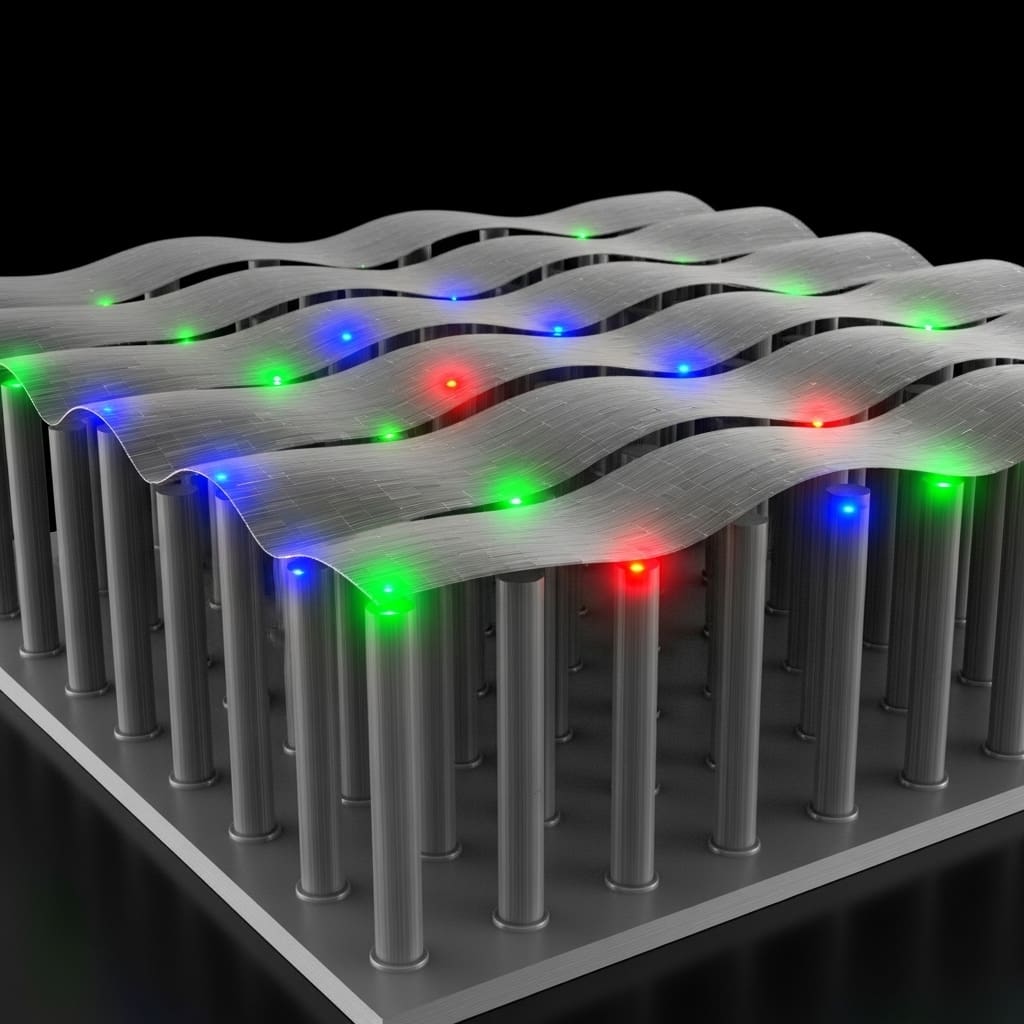
Researchers are increasingly focused on harnessing two-dimensional semiconductors as compact light sources for integrated photonics. Abderrahim Lamrani Alaoui, Álvaro Moreno, and Maximilian Heithoff, from Université Côte d’Azur and ICFO, alongside et al., have investigated localized emission within monolayer molybdenum diselenide (MoSe₂) grown on gallium nitride (GaN) nanopillars, a structure commonly used to create these emitters. This study is significant because it challenges the prevailing understanding that strain alone dictates the formation and positioning of these light-emitting states, demonstrating instead that the interplay between strain and the dielectric environment at the pillar interfaces is crucial. By combining advanced photoluminescence mapping with atomic force microscopy, the team reveals that deterministic emitter positioning benefits from carefully co-engineering both strain gradients and nanoscale dielectric differences, offering a new pathway for controlling light emission in 2D materials.
The study addresses a fundamental question in the field: does strain alone explain emitter formation and placement in MoSe₂, or is dielectric contrast at suspended-supported interfaces also crucial.
Contrary to expectations, localized states frequently appear at these interfaces around the pillar apex, spanning a broad range of strain values without a clear activation threshold, and are notably scarce along areas of high strain ripples. This finding suggests that the interplay between strain and dielectric environment is more complex than previously thought, and that precise control over both is essential for creating robust and predictable quantum emitters. This research establishes a combined optical-mechanical characterization approach as a general framework for mapping structure-property relationships in 2D quantum materials at the single-emitter level. By correlating photoluminescence with AFM data, the scientists were able to visualize the nanoscale landscape of strain and dielectric properties, revealing the intricate relationship between material structure and quantum emission.
The work opens new avenues for designing and fabricating advanced quantum photonic devices, potentially leading to more efficient and controllable sources of single photons for applications in quantum computing, secure communication, and metrology. The ability to precisely position and tune quantum emitters is a critical step towards realizing scalable and integrated quantum photonic architectures. Furthermore, the study’s findings have implications beyond MoSe₂, suggesting that similar co-engineering strategies could be applied to other transition-metal dichalcogenides and 2D materials to enhance quantum emitter performance and control. The high-resolution mapping of strain and dielectric contrast provides a valuable tool for understanding the fundamental physics of quantum confinement in these materials, paving the way for the development of novel quantum technologies. The researchers demonstrated the formation of localized emission in MoSe₂ monolayers on GaN nanopillars, utilizing superlocalization methods to quantify emitter positions relative to the strain landscape with exceptional precision, achieving resolutions down to the nanometre scale.
MoSe2 Emitter Mapping via Strain and Dielectric Context
Scientists are increasingly focused on solid-state emitters in two-dimensional semiconductors as compact, chip-compatible sources for photonics. Researchers addressed the question of whether strain alone explains the formation and placement of emitters in MoSe₂, or if dielectric contrast at suspended-supported interfaces also plays a crucial role. The team engineered a nonstandard sample architecture, transferring an exfoliated monolayer of MoSe₂ onto high-quality GaN nanopillar arrays. These arrays were fabricated using e-beam lithography and dry etching, creating ∼150nm-high GaN pillars with ∼160nm diameter on a 100nm AlN template atop a Si(111) substrate.
Researchers chose epitaxial GaN, grown by molecular beam epitaxy, instead of amorphous SiO₂ because it suppresses spectral diffusion and blinking in TMD quantum emitters, while also maximizing dielectric contrast. The system delivers optical transparency in the relevant spectral range (excitation at 633nm and emission at 750, 800nm), enabling efficient optical access for analysis. Experiments employed low-force AFM to reveal that the MoSe₂ monolayer conforms to the nanopillars, forming suspended regions and ripples connecting neighboring pillars. These features arise from the competition between adhesion to the substrate and membrane bending, with the morphology indicating relatively strong adhesion.
The pillar pitch and aspect ratio were carefully selected to prevent full-span suspension and minimize the risk of membrane piercing. Hyperspectral micro-photoluminescence (μ-PL) was performed at 2.8 K, and spectra acquired off-pillar displayed characteristic MoSe₂ responses, including a neutral exciton (X₀) near 1.657 eV and a charged exciton (X⁻) red-shifted by approximately 50 meV. At pillar sites, the technique reveals multiple narrow, bright lines (sub-meV linewidth) red-shifted from the excitonic features, identified as localized states (LS). These LS disappear above 20 K, consistent with thermal detrapping of excitons in TMD quantum emitters.
MoSe2 Localized States Mapped with Nanoscale Precision
Scientists achieved super-localization of emitters in MoSe₂ with a resolution of σx ≈51nm and σy ≈86nm, significantly below the diffraction limit of 600nm laser spot size. The team measured frame-to-frame displacement during repeated mapping, finding a peak at ∼17nm, closely matching the single-step increment of the translation stage used in the experiment. These measurements confirm the robustness and precision of the super-localization method, enabling accurate mapping of localized states at the nanoscale. Numerical simulations further validated the accuracy, demonstrating minimal impact from signal-to-noise and blinking effects on the localization precision.
Experiments revealed that localized states (LS) consistently appear near the apex of GaN pillars supporting the MoSe₂ material, frequently along the crown-shaped circumference formed during the etching process. The team correlated super-localized emitter positions with AFM topography, discovering no systematic correlation between emitter position and emission energy within the pillar region, aligning with previous research. Results demonstrate that exciton diffusion is unlikely to significantly shift the apparent emitter location, as the negligible contribution of strain funneling along ripples makes substantial exciton migration improbable. The absence of localized states along high-strain ripples suggests that strain magnitude alone is insufficient for localization, indicating a more complex mechanism at play.
Statistical analysis revealed an enrichment factor of ∼1.8 for emitters within the top 90th percentile of bending strain, with a probability of only ∼3% for this clustering to occur randomly, confirming a non-random spatial distribution correlated with the local environment. Scientists recorded 9 emitters within the top 90th strain percentile (ε 1.47%), while a uniform random distribution would predict approximately 5, providing strong evidence against a stochastic formation process. The breakthrough delivers a combined optical-mechanical characterization approach, providing a general framework for mapping structure-property relationships in 2D materials at the single-emitter level.
Strain and Dielectric Control of MoSe2 States
Contrary to expectations, localized states frequently occur at suspended-supported interfaces around the pillar apex, spanning a broad strain range without a clear threshold, and are scarce along high-strain ripples. The authors propose a co-design strategy for deterministic emitters in Mo-based TMDs, focusing on jointly engineering strain gradients and dielectric contrast through pillar geometry, apex roughness, and controlled spacer layers. Acknowledging limitations, the study notes that further investigation is needed to clarify the roles of defects, curvature, and screening in influencing brightness, lifetime, and indistinguishability of the emitters. Future research directions include correlating maps with nanoscale probes of defect states, implementing tunable screening with materials like hexagonal boron nitride, and performing antibunching measurements under pulsed excitation, all aimed at advancing scalable integrated quantum photonic platforms.
👉 More information
🗞 Localized emission in MoSe monolayers on GaN nanopillars
🧠 ArXiv: https://arxiv.org/abs/2601.15852
