Understanding the behaviour of strongly correlated states, crucial to fields like the fractional Hall effect and spin liquids, often requires complex wave functions that account for interactions between multiple particles. Koyena Bose from the Institute of Mathematical Sciences and Homi Bhabha National Institute, Steven H. Simon, and Ajit C. Balram et al. present a new method for calculating key properties of these states, such as energies and correlations, using Monte Carlo techniques. This approach circumvents a significant obstacle in the field, the computationally expensive process of explicitly accounting for particle symmetry or antisymmetry, which typically scales factorially with system size. Consequently, the team’s framework enables researchers to investigate systems previously inaccessible to conventional computational methods like exact diagonalization, opening new avenues for exploring complex quantum phenomena.
This work addresses a significant challenge in studying complex systems such as those found in the fractional quantum Hall effect and spin liquids, where wave functions are often constructed by dividing particles into clusters and then (anti)symmetrizing across them. The team recognized that explicitly performing this (anti)symmetrization leads to computational demands that scale rapidly with the number of particles, restricting calculations to very small systems. This involved dividing particles into two clusters, each forming a Laughlin state, and then applying a symmetrization procedure. The method allows for the evaluation of quantities of interest for Read-Rezayi states, which are crucial for understanding certain fractions observed in the second Landau level and potentially underpinning fault-tolerant topological quantum computation. The team focused on improving the accuracy of calculations by carefully managing the number of terms included in the process, defining a parameter to control the precision of each exchange term. Experiments revealed that for a system of twenty particles, choosing a specific value for this parameter significantly reduced errors in calculations, increasing the number of ratios computed. Comparative tests, using a dual processor system, demonstrated that the refined method, while computationally intensive per step, converged faster than naive methods and benefited substantially from parallelization.
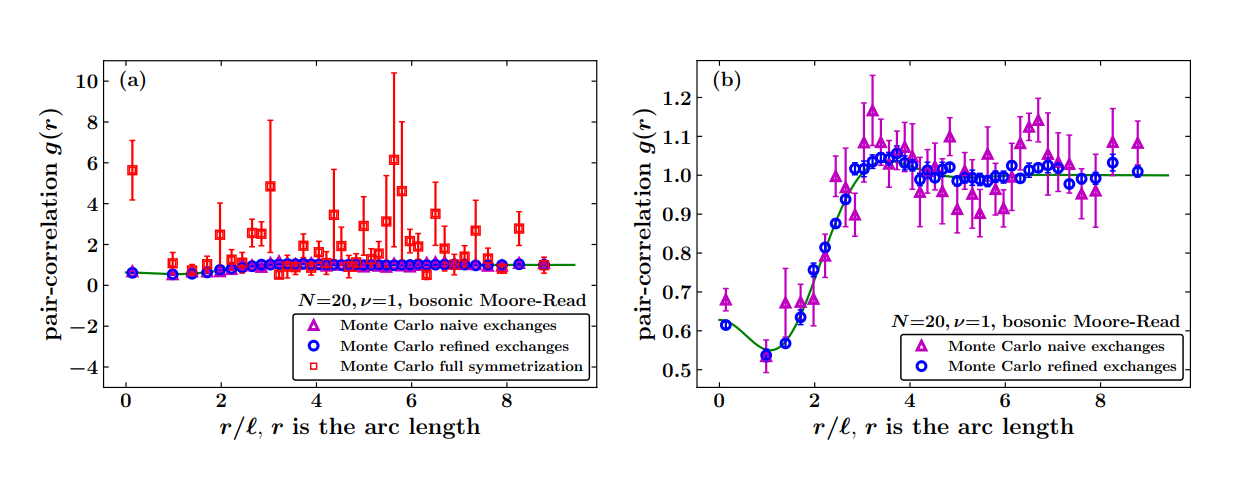
Results show the pair-correlation function for twenty bosons, confirming the improved accuracy of the refined method compared to both naive calculations and full symmetrization. Further investigations extended this approach to the Read-Rezayi 3 (RR3) state, which supports more complex quantum computations. Scientists successfully adapted the method to handle the three-cluster structure of the RR3 state by utilizing set partitions and doubly stochastic matrices to identify unique matrix elements. These states are often described using complex wave functions involving multiple particles, and traditional computational approaches struggle with the inherent mathematical complexity of accurately representing these systems. This advancement enables the study of systems previously inaccessible to exact diagonalization techniques, offering a pathway to explore the subtle differences between competing quantum states.
Specifically, the researchers investigated the competition between two
Specifically, the researchers investigated the competition between two prominent states, the Read-Rezayi and Jain states, finding evidence consistent with theoretical predictions regarding their stability. Furthermore, the method provides a means to investigate topological properties, such as braiding statistics, and confirms that excitations within the studied state behave as Fibonacci anyons, which are crucial for topological quantum computation. The authors acknowledge that future work could improve efficiency through more advanced sampling methods and suggest applying this approach to other complex quantum states, including those requiring full symmetrization, and exploring the competition between different states at other fractional fillings.
🗞 Monte Carlo Sampling for Wave Functions Requiring (Anti)Symmetrization
🧠 ArXiv: https://arxiv.org/abs/2510.20577