
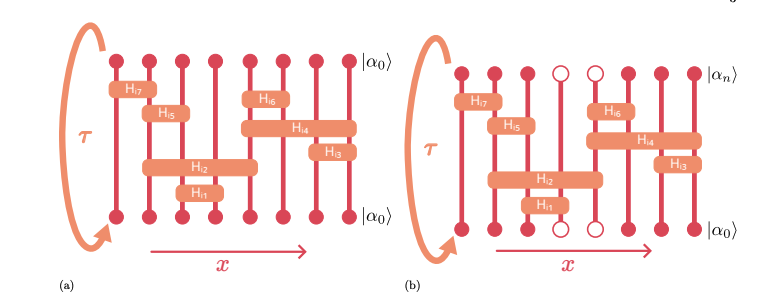
Identifying the strongest relationships between components within complex systems presents a significant challenge in modern physics, but researchers are now developing new tools to tackle this problem. Aditya Chincholi, Sylvain Capponi, and Fabien Alet, all from the Université Toulouse and CNRS Laboratoire de Physique Théorique, introduce a computational method that automatically detects the most dominant correlations within a system without needing prior assumptions about what those relationships might be. Their approach utilises a ‘correlation density matrix’ and employs Monte Carlo simulations to analyse interactions between small parts of a larger sample, effectively mapping out the strongest connections. This technique, demonstrated on various magnetic models, promises a systematic way to uncover hidden order and identify previously unknown properties in complex physical systems accessible to computational study.
Subsystems embedded within a full, large sample require robust benchmarking procedures. To this end, researchers investigate zero-temperature quantum phase transitions in both one- and two-dimensional quantum Ising models, as well as the two-dimensional bilayer Heisenberg antiferromagnet. This method paves the way for a systematic identification of unknown or exotic order parameters in unexplored phases of large systems accessible to quantum Monte Carlo methods.
Correlation Density Matrix Singular Value Analysis
Researchers have developed a technique to analyse the ground state properties of quantum systems, focusing on understanding phase transitions and identifying the key characteristics of different states of matter. The core idea involves calculating a “correlation density matrix,” which captures how different parts of the system are connected, and then using a mathematical process called Singular Value Decomposition to extract the most important correlations. This approach offers an alternative to traditional methods for studying complex quantum systems. The correlation density matrix distills information about how subsystems are entangled or correlated, and Singular Value Decomposition breaks down this matrix, revealing the dominant modes of correlation and their strengths.
This allows researchers to identify the most important relationships within the system. The research employs Monte Carlo simulations to generate configurations of the quantum system, and a bootstrap method is used to estimate the uncertainty in their results. Conserving the symmetries of the system is important when sampling the correlation density matrix, and asymmetric deviations can lead to high variance in the results. This technique provides an alternative way to analyse quantum systems, which is useful when traditional methods are difficult to apply. The operator decomposition helps identify the relevant degrees of freedom, providing insights into the underlying physics. It can be used to understand phase transitions and identify the order parameter, with potential applications to quantum magnetism and condensed matter physics.
Dominant Correlations Reveal Quantum System Order
Researchers have developed a new method for identifying the dominant correlations within complex quantum systems, even without prior knowledge of the system’s underlying order. This technique focuses on analysing the relationships between small, interconnected parts of a larger system to reveal crucial information about its overall behaviour. The approach utilises advanced computational techniques to measure a “correlation density matrix,” which effectively maps the connections between these subsystems. Results demonstrate the ability to accurately pinpoint the most important correlations driving the system’s behaviour, even in scenarios where these correlations are not immediately obvious.
In one instance, the technique successfully identified the key factors governing a quantum phase transition in a bilayer Heisenberg model, a notoriously difficult problem to solve. A key strength of this approach lies in its ability to automatically extract the most significant patterns from the data, bypassing the need for researchers to manually search for them. By decomposing the correlation density matrix, the method reveals the dominant “operators”, mathematical descriptions of the system’s behaviour, and their associated strengths. Furthermore, the technique exhibits a significant advantage in reducing computational errors by leveraging the inherent symmetries within the system. This is achieved through a carefully designed process that minimizes statistical noise and enhances the accuracy of the correlation density matrix. The method represents a powerful new tool for exploring the complex world of quantum materials and uncovering hidden patterns in their behaviour, potentially leading to breakthroughs in materials science and fundamental physics.
Identifying Dominant Correlations in Complex Systems
This research presents a new Monte Carlo method for identifying dominant correlations within complex systems, without requiring prior knowledge of those correlations. The method focuses on measuring and analysing the correlation density matrix between small subsystems embedded within a larger sample, effectively pinpointing the most significant relationships between parts of the system. The technique was demonstrated using several established models, including the one- and two-dimensional Ising model, and the two-dimensional bilayer Heisenberg antiferromagnet, allowing for validation against known results. The significance of this approach lies in its potential to systematically identify previously unknown or exotic order parameters in complex systems accessible to Monte Carlo simulations.
By focusing on local correlations, the method offers a way to explore phases of matter and physical phenomena where the governing order is not immediately apparent. The authors acknowledge that the method currently focuses on systems where the subsystems being analysed are relatively small, due to computational limitations. Future work could focus on optimising the method to handle larger subsystems or developing complementary techniques to extend its reach.
👉 More information
🗞 Detecting the Largest Correlations using the Correlation Density Matrix: a Quantum Monte Carlo Approach
🧠 ArXiv: https://arxiv.org/abs/2507.21697