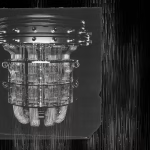
NASA is set to test a novel solution for radiation-tolerant computing in space through its Radiation Tolerant Computer payload, developed by researchers at Montana State University in Bozeman. The technology demonstration, led by the university, aims to mitigate the effects of ionizing solar and cosmic radiation on onboard computers, which are crucial for nearly every spacecraft function.
Dennis Harris, who manages the payload for NASA’s Commercial Lunar Payload Services initiative, notes that this mission will verify a radiation-tolerant computer option that could make future Moon to Mars missions safer and more cost-effective. The Radiation Tolerant Computer will be carried to the Moon’s surface by Firefly Aerospace’s Blue Ghost 1 lunar lander, with the goal of demonstrating computer recovery from faults caused by single event effects of ionizing radiation.
The project is part of NASA’s broader effort to invest in commercial delivery services to the Moon, with companies like Firefly Aerospace playing a key role in enabling industry growth and supporting long-term lunar exploration.
Introduction to Radiation-Tolerant Computing in Space
The exploration of space is heavily reliant on onboard computers that control and navigate spacecraft systems, including propulsion, navigation, life support technology, science data retrieval and analysis, communications, and reentry. However, these computers are susceptible to ionizing solar and cosmic radiation, which can cause minor data errors leading to cascading malfunctions, system crashes, and permanent damage. To mitigate the effects of radiation on computers, NASA has been seeking cost-effective solutions to ensure mission safety and success.
One such solution is the Radiation Tolerant Computer (RadPC) technology demonstration, developed by researchers at Montana State University in Bozeman. RadPC aims to demonstrate computer recovery from faults caused by single event effects of ionizing radiation. The computer is designed to gauge its own real-time state of health by employing redundant processors implemented on off-the-shelf integrated circuits called field programmable gate arrays (FPGAs). These tile-like logic blocks are capable of being easily replaced following a confirmed ionizing particle strike.
The RadPC technology demonstration will be carried to the Moon’s surface by Firefly Aerospace’s Blue Ghost 1 lunar lander as part of NASA’s Commercial Lunar Payload Services (CLPS) initiative. The CLPS model allows NASA to invest in commercial delivery services to the Moon, enabling industry growth and supporting long-term lunar exploration. As a primary customer for CLPS deliveries, NASA aims to be one of many customers on future flights.
The RadPC payload is one of 10 NASA payloads set to fly aboard the next lunar delivery for the CLPS initiative. The technology demonstrator will undergo its biggest trial in transit to the Moon, passing through the Earth’s Van Allen radiation belts, and during its roughly two-week mission on the lunar surface. This mission will provide valuable insights into the effectiveness of RadPC in mitigating radiation effects on computers, which is crucial for future Moon to Mars missions.
Radiation Effects on Computers in Space
Ionizing solar and cosmic radiation can cause significant damage to onboard computers in space. High-energy particles can trigger single event effects, leading to minor data errors that can cascade into malfunctions, system crashes, and permanent damage. The Earth’s Van Allen radiation belts, which the RadPC payload will pass through on its way to the Moon, are particularly hazardous for electronic systems.
The effects of radiation on computers can be mitigated using various techniques, including shielding, error correction codes, and redundant systems. However, these methods can add significant weight, power consumption, and complexity to spacecraft systems. The RadPC technology demonstration aims to provide a cost-effective solution by employing FPGAs that can be easily replaced following a confirmed ionizing particle strike.
The use of FPGAs in RadPC allows for the implementation of redundant processors that can gauge the computer’s real-time state of health. In the event of a radiation strike, RadPC’s patented recovery procedures can identify the location of the fault and repair the issue in the background. This approach enables the computer to continue operating without interruption, ensuring mission safety and success.
The RadPC payload also carries three dosimeters to measure varying levels of radiation in the lunar environment. These dosimeters will continuously measure the interaction between Earth’s magnetosphere and the solar wind during its journey to the Moon. The data collected by these dosimeters will provide valuable insights into the radiation environment on the lunar surface, which is essential for safeguarding future Artemis astronauts.
Commercial Lunar Payload Services (CLPS) Initiative
The CLPS initiative is a key component of NASA’s strategy for returning humans to the Moon by 2024. The program aims to invest in commercial delivery services to the Moon, enabling industry growth and supporting long-term lunar exploration. As a primary customer for CLPS deliveries, NASA aims to be one of many customers on future flights.
The CLPS model allows NASA to partner with private companies to develop and demonstrate lunar landers that can carry payloads to the Moon’s surface. Firefly Aerospace’s Blue Ghost 1 lunar lander is one such example, which will carry the RadPC payload to the Moon as part of the CLPS initiative. The partnership between NASA and private companies like Firefly Aerospace enables the development of cost-effective solutions for lunar exploration.
The CLPS initiative also provides opportunities for scientific research and technology demonstration on the lunar surface. The RadPC payload is an example of a technology demonstration that can provide valuable insights into the effectiveness of radiation-tolerant computing in space. The data collected by the RadPC payload will inform future mission designs and enable the development of more robust and reliable spacecraft systems.
Future Moon to Mars Missions
The success of the RadPC technology demonstration is crucial for future Moon to Mars missions. As NASA plans to return humans to the Moon and eventually send them to Mars, the need for reliable and robust spacecraft systems becomes increasingly important. The radiation environment on the lunar surface and in deep space poses significant challenges to electronic systems, which must be mitigated using cost-effective solutions like RadPC.
The development of radiation-tolerant computing technologies like RadPC is essential for ensuring mission safety and success. The use of FPGAs and redundant processors enables the creation of robust and reliable spacecraft systems that can operate in harsh radiation environments. The data collected by the RadPC payload will inform future mission designs and enable the development of more effective radiation mitigation strategies.
The CLPS initiative provides a framework for partnering with private companies to develop and demonstrate lunar landers and other technologies necessary for future Moon to Mars missions. The success of the RadPC technology demonstration is a significant step towards achieving NASA’s goals for lunar exploration and beyond.
Conclusion
In conclusion, the Radiation Tolerant Computer (RadPC) technology demonstration is a crucial step towards developing cost-effective solutions for mitigating radiation effects on computers in space. The use of FPGAs and redundant processors enables the creation of robust and reliable spacecraft systems that can operate in harsh radiation environments. The CLPS initiative provides a framework for partnering with private companies to develop and demonstrate lunar landers and other technologies necessary for future Moon to Mars missions.
The success of the RadPC technology demonstration will inform future mission designs and enable the development of more effective radiation mitigation strategies. As NASA plans to return humans to the Moon and eventually send them to Mars, the need for reliable and robust spacecraft systems becomes increasingly important. The development of radiation-tolerant computing technologies like RadPC is essential for ensuring mission safety and success.
External Link: Click Here For More