Integrated photonics, the science of manipulating light on tiny chips, promises revolutionary advances in computing and communication, but creating versatile and efficient photonic circuits remains a significant challenge. Researchers led by Zizheng Li, Bruno Lopez-Rodriguez, and Naresh Sharma, from Delft University of Technology and collaborating institutions, now demonstrate a powerful new approach by successfully combining amorphous silicon carbide (a-SiC) with silicon nitride (SiN) in a single integrated platform. This innovative integration overcomes limitations inherent in each material – SiN’s low loss but limited tunability, and a-SiC’s strong light-matter interaction but fabrication challenges – resulting in a platform with over 4,400 times greater integration density and a remarkable 27-fold increase in tuning efficiency. The team achieves this with minimal signal loss, demonstrating an on-chip interconnection loss of just 0.32 dB, and opens up exciting possibilities for more compact, programmable, and energy-efficient photonic devices.
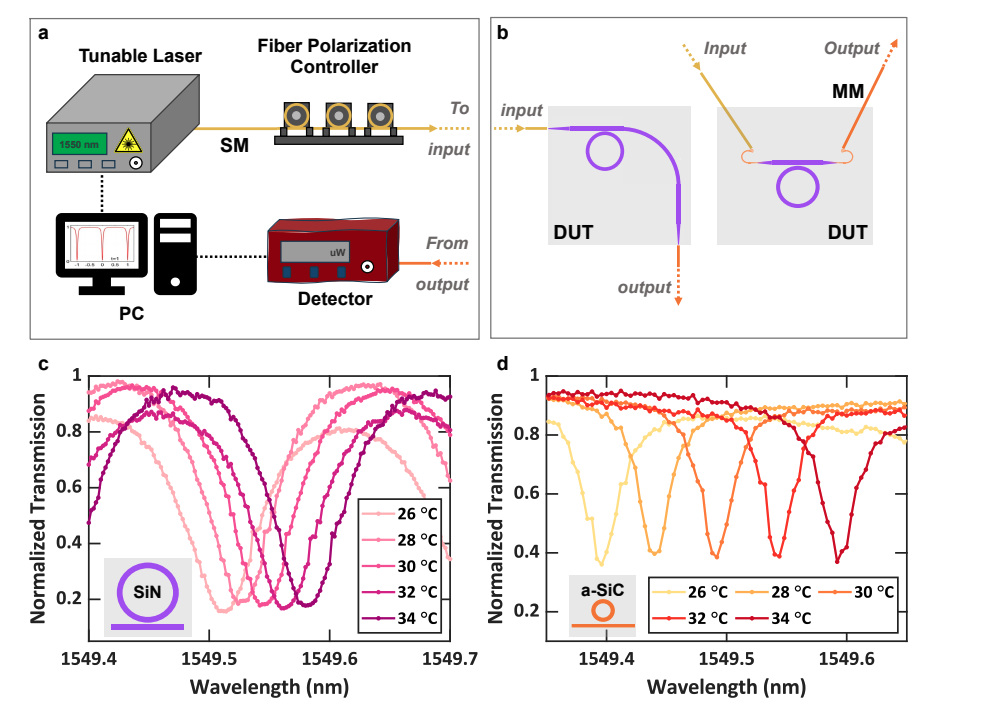
Silicon and silicon nitride are leading materials for building photonic integrated circuits (PICs), offering miniaturisation and potential for high-volume manufacturing for applications like data processing and medical imaging. While silicon photonics benefits from established fabrication techniques, its susceptibility to light absorption limits scalability. Silicon nitride offers lower loss, but its relatively low refractive index can compromise integration density. Researchers are now combining amorphous silicon carbide (a-SiC) and silicon nitride to leverage the strengths of both materials, creating a platform with ultra-low loss and enhanced tunability. This new platform combines the wide transparency and low loss of silicon nitride with the efficient thermo-optic tunability of a-SiC. The team successfully characterised a method for interconnecting these materials, demonstrating a significant improvement in tunability – a-SiC exhibits a thermo-optic response 27 times greater than silicon nitride. This allows for highly programmable photonic circuits while maintaining efficient light transmission.
Efficient interconnection is achieved through carefully designed couplers that gradually convert light between the materials, achieving a coupling loss of just 0.32 dB. The platform also addresses the challenge of coupling light from optical fibres to the chip. By employing inverted taper edge couplers, the researchers achieved a 55-fold improvement in coupling efficiency, demonstrating the potential for high-efficiency fibre-to-chip connections. Furthermore, the platform supports both grating-coupling and edge-coupling techniques, offering greater flexibility for diverse applications. Silicon nitride’s inherent low loss extends to visible wavelengths, making it suitable for versatile photonic devices, while a-SiC’s large Kerr coefficient enhances its potential for nonlinear optical applications. The a-SiC/SiN platform achieves an impressive integration density of 4,444 devices per square millimeter, alongside a waveguide loss of just 0.001 dB per centimeter. This combination of properties, alongside efficient thermo-optic tuning and strong nonlinearity, positions the platform as a compelling candidate for advanced applications in integrated and quantum photonics. The platform’s performance metrics demonstrate significant advantages over other material platforms, offering a balance of high integration density, low loss, efficient tuning, and reasonable fabrication costs. This research outlines a feasible path towards leveraging the strengths of both silicon nitride and amorphous silicon carbide, paving the way for the next generation of photonic integrated circuits.
👉 More information🗞Heterogeneous integration of silicon nitride and
🗞 Heterogeneous integration of silicon nitride and amorphous silicon carbide photonics
🧠 DOI: https://doi.org/10.48550/arXiv.2507.10312