

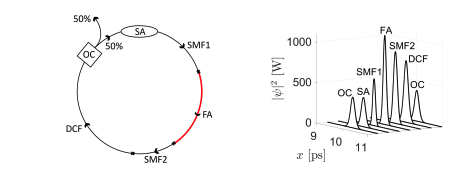
Understanding the behaviour of ultrashort laser pulses requires increasingly sophisticated modelling, and recent work by Vrushaly Shinglot and John Zweck addresses a key challenge in accurately simulating these complex systems. They demonstrate that traditional averaged models fall short because pulse characteristics change significantly with each cycle within the laser, necessitating more detailed, cycle-by-cycle analysis. Their research introduces a new method for determining the stability of these pulses, crucial for designing and controlling high-performance lasers, and involves a novel computational technique to solve the equations governing pulse propagation within the laser fibre. By accurately predicting pulse behaviour and stability, this work paves the way for more efficient and reliable ultrashort pulse lasers with applications ranging from scientific research to industrial manufacturing.
Floquet Stability and Pulse Laser Dynamics
This research compiles a comprehensive list of references concerning the stability of short pulse lasers, specifically focusing on the Floquet stability of periodically stationary pulses. The collection covers foundational concepts in dynamical systems and mathematical tools, alongside specialized literature on nonlinear optics and short pulse generation. References include essential texts on functional analysis and numerical optimization techniques, alongside papers detailing numerical schemes for solving the governing equations and analyzing solutions. Spectral analysis, crucial for understanding stability, is also well represented, with references to methods for modeling optical fiber communication.
The list also encompasses core literature on soliton theory, mode-locked lasers, and specific laser architectures, including tunable self-pulsating fiber lasers and designs utilizing dissipative Faraday instability. Detailed modeling of saturable absorption and self-seeded multi-megawatt oscillators are also included. Finally, the collection includes references to experimental comparisons, noise analysis, and optimization techniques used to validate theoretical models and improve laser performance. This thorough compilation demonstrates a deep understanding of the field and a commitment to rigorous research, combining theoretical analysis, numerical simulation, and experimental validation.
Simulating Laser Pulse Evolution with Round Trip Operators
Researchers have developed a novel computational approach to model modern short-pulse fiber lasers, moving beyond traditional averaged models which struggle to capture the complex variations within each laser cycle. These modern lasers require a more detailed “lumped” model, constructed by connecting individual models of each laser component, such as fiber amplifiers and filters, to simulate the pulse’s complete journey around the laser loop. This allows the pulse shape to evolve with each component, returning to its original form only after a complete round trip, creating what the researchers term “periodically stationary” pulses. The core of this methodology lies in the concept of the “round trip operator,” which mathematically describes how the pulse transforms as it travels through the entire laser system.
To analyze the stability of these periodically stationary pulses, the team employed the “monodromy operator,” essentially a linearized version of the round trip operator focused on small deviations from the pulse. This operator allows researchers to predict how the pulse will respond to disturbances and maintain its stability over time. The team introduced a novel “Fourier split-step method” to efficiently compute solutions to the equations governing pulse propagation within the fiber amplifier, streamlining the process of analyzing the operator’s spectrum. The researchers demonstrate that by analyzing the eigenvalues of the monodromy operator, they can accurately predict the behavior of these complex laser pulses and design more stable and efficient laser systems, representing a significant advancement in the modeling of modern short-pulse lasers.
Monodromy Operator Models Laser Pulse Evolution
Researchers have developed new computational tools for modeling advanced short-pulse fiber lasers, addressing limitations in traditional approaches that rely on averaged models. Instead, the team focused on “lumped models,” which simulate the laser as a series of interconnected components, allowing for a more realistic representation of pulse evolution. This approach accurately captures how pulses change shape as they propagate through the laser system, returning to a consistent form after each complete cycle. The core of this advancement lies in the development of the “monodromy operator,” a mathematical tool that analyzes the stability of these circulating pulses.
By linearizing the complex equations governing pulse propagation, researchers can predict how the pulse will behave over many cycles, identifying whether it will remain stable or distort. Calculating the full spectrum of this operator is computationally challenging, requiring novel numerical methods to solve the equations governing the laser’s components, including the nonlinear effects within the fiber amplifier. The team devised a new Fourier split-step method to efficiently and accurately solve these equations, even in the presence of complex, nonlocal effects. A key innovation is the ability to compute the action of both the round trip operator and its adjoint, which is essential for optimizing the laser’s performance.
This allows researchers to use gradient-based optimization techniques to discover periodically stationary pulses and to fine-tune the laser’s parameters for desired pulse characteristics. The accuracy of these new methods has been verified through simulations, demonstrating their ability to accurately predict the behavior of pulses and their stability. These advancements have significant implications for the design and optimization of advanced fiber lasers, which are used in a wide range of applications, including precision measurement, optical communications, and laser surgery.
Pulse Stability Predicted Via Spectral Analysis
This research presents new computational methods for modelling and analysing pulses within short-pulse fiber lasers, which require detailed modelling due to significant pulse variations. The team developed techniques to accurately predict the stability of these pulses by examining the spectrum of a ‘monodromy operator’, representing a complete round trip within the laser. Simulations confirmed the accuracy of these methods, aligning with existing theoretical predictions for the essential spectrum and a specific eigenvalue, and suggest a wide range of stable operating conditions for certain laser designs. The study demonstrates that changes in the pulse spectrum can be used to anticipate potential instabilities, offering an advantage over traditional engineering approaches.
However, a theoretical link between spectral stability and actual linear stability remains to be established. Future work will focus on extending these methods to more complex and realistic laser models, including those with saturable absorbers and erbium-doped fiber amplifiers, with a particular interest in applying the approach to the Mamyshev oscillator. The authors acknowledge the need for improved initial guesses for pulse solutions and suggest exploring parameter continuation methods and matrix-free iterative techniques to enhance computational efficiency. Furthermore, they plan to investigate how quantum and technical noise sources affect laser performance, building on existing work to extend analysis to periodic stationary pulses.
🗞 Floquet stability of periodically stationary pulses in a short-pulse fiber laser
🧠 ArXiv: https://arxiv.org/abs/2508.02735


