

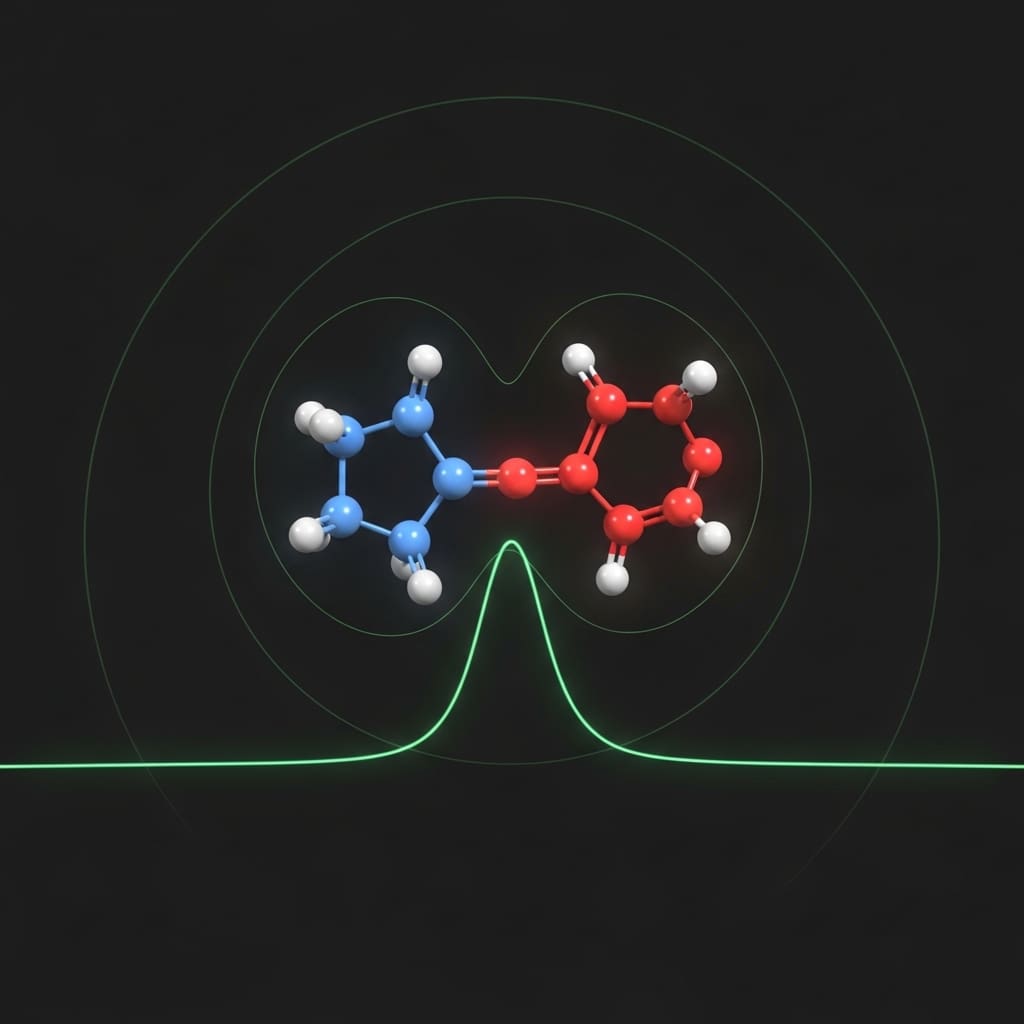
Researchers have long recognised conical intersections as crucial pathways for nonadiabatic transitions, yet molecular dynamics simulations frequently fail to sample the exact geometries where electronic energies become degenerate? Johannes C. B. Dietschreit, Sebastian Mai, and Leticia González, all from the Institute of Theoretical Chemistry at the University of Vienna, now demonstrate this isn’t a simulation error, but a fundamental consequence of statistical mechanics. Their work, utilising a linear vibronic coupling model, reveals an infinite free-energy barrier surrounding the conical intersection seam, effectively preventing trajectories from reaching it. This discovery explains why mixed quantum/classical methods accurately model nonadiabatic behaviour without needing to sample exact degeneracies, and corroborates recent evidence suggesting classical trajectories can ‘sense’ conical intersections without directly visiting them, offering a significant advance in our understanding of molecular dynamics at these critical points.
Free energy barriers prevent trajectory completion at conical intersections, hindering nonadiabatic transitions
Scientists have uncovered a fundamental statistical-mechanical constraint governing how molecules behave near conical intersections, critical points where electronic states can change during chemical reactions. Despite extensive use of mixed quantum-classical (MQC) simulations to model these transitions, researchers have consistently observed a curious phenomenon: trajectories approach regions of near-degeneracy but rarely, if ever, reach the exact point of zero energy gap.
This work demonstrates this isn’t a limitation of the simulations, but an inherent property dictated by the laws of physics. Using a linear vibronic coupling model, the team derived an analytical expression for free energy along the adiabatic energy gap, revealing an infinite free-energy barrier arises as the gap closes.
The research clarifies why MQC methods can accurately predict nonadiabatic behaviour without explicitly sampling exact degeneracies, aligning with recent findings suggesting classical trajectories can ‘sense’ conical intersections without directly visiting them. Molecular dynamics simulations of the methaniminium cation (CH2NH+ 2) on the S1 surface corroborated the theoretical prediction.
Trajectories were observed to approach regions with small adiabatic gaps, but were unable to reach the conical intersection seam, even though it represents a region of lowest potential energy. This finding highlights a crucial distinction between approaching and actually reaching a point of perfect degeneracy.
The study builds upon previous work analysing nonadiabatic transition probabilities using the Landau, Zener formula, demonstrating that trajectory behaviour is sensitive to the direction of approach and the local topography of the conical intersection. Researchers defined a collective variable as the adiabatic energy gap and derived a free energy profile, revealing the infinite barrier at zero gap.
This analytical result, combined with the molecular dynamics simulations, provides a quantitative perspective on the limitations of classical treatments of nuclear motion near conical intersections. The team’s work offers a deeper understanding of excited-state dynamics and has implications for refining MQC simulations used to model photochemical processes.
Modelling adiabatic energy gap dynamics and conical intersection recrossing in methaniminium cation reveals key insights
A linear vibronic coupling model underpinned the investigation into conical intersection dynamics, allowing researchers to derive the free energy along the adiabatic energy gap. Analytical demonstrations revealed that as this gap approaches zero, an infinite free-energy barrier emerges around the conical intersection seam, a statistically significant finding.
Molecular dynamics simulations were then performed on the methaniminium cation on the S1 surface to validate this prediction, employing a specific geometry corresponding to the minimum-energy conical intersection point. Trajectories were propagated to assess their ability to reach the CI seam, with results showing they could approach regions of small adiabatic gaps but never actually reach the seam itself, even when the CI represented the lowest potential energy point.
This work utilized a classical treatment of nuclei, mirroring the approach common in mixed quantum-classical (MQC) methods, and focused on the adiabatic energy gap as a collective variable to analyse the free energy landscape. The simulations employed established potential energy surfaces for methaniminium cation, leveraging prior work that identified the S1/S0 conical intersection as a point of minimum energy.
Furthermore, the study built upon the Landau, Zener formula to quantitatively assess nonadiabatic transition probabilities, considering the direction of approach and local CI topography. Histograms of the energy gap during surface hops in MQC simulations were analysed, although limitations in resolution prevented definitive exclusion of transitions occurring very close to zero gap. The research confirmed that trajectories need not reach the CI itself for nonadiabatic transitions to occur, provided they pass through regions of sufficiently strong coupling between electronic states, offering a refined understanding of how MQC methods accurately capture nonadiabatic behaviour.
Free energy barriers prevent sampling of conical intersection regions in molecular dynamics simulations
Researchers demonstrate an infinite free-energy barrier arises around conical intersection seams, explaining why molecular dynamics simulations rarely sample exact degeneracies. Using a linear vibronic coupling model, the study derives the free energy along the adiabatic energy gap, revealing this fundamental statistical-mechanical constraint.
Molecular dynamics simulations of the methaniminium cation on the S1 surface corroborate the prediction, showing trajectories approach small adiabatic gaps but never reach the conical intersection seam, even when it represents the lowest potential energy region. The work builds upon previous analyses of nonadiabatic transitions and the limitations of mixed quantum-classical simulations.
Specifically, the research clarifies why these methods successfully capture nonadiabatic behaviour without explicitly sampling exact degeneracies. Analysis of the energy gap distributions from time steps where trajectories changed adiabatic surfaces in prior MQC simulations indicated hops occurred away from the CI seam, though resolution limited definitive conclusions.
This study confirms that trajectories do not need to reach the CI itself, but merely pass through regions of strong nonadiabatic coupling to enable state transitions. The derived free energy profile, defined as F(z) = −kBT ln [ρ(z) ⟨λξ⟩z], quantifies this barrier. Here, ρ(z) represents the marginal probability density of configurations satisfying ξ(R) = z, calculated as ⟨δ(ξ(R) −z)⟩.
The thermal de Broglie wavelength of the collective variable, λξ = p h2/(2πkBT mξ), is also incorporated, with mξ denoting the generalized mass in curvilinear coordinates. Simulations on methaniminium cation (CH2NH+ 2) confirm that despite the energetic driving force towards the minimum-energy conical intersection, trajectories consistently approach but do not reach the exact degeneracy point. This finding aligns with the statistical-mechanical argument presented and supports the notion that visiting the CI seam is statistically forbidden.
Entropic barriers prevent classical dynamics accessing conical intersection regions efficiently
Researchers have demonstrated a fundamental statistical-mechanical constraint preventing classical molecular dynamics simulations from reaching conical intersection (CI) seams, despite their importance in mediating nonadiabatic transitions. Employing a linear vibronic coupling model and simulations of the methaniminium cation, they derived a free energy landscape showing an infinite barrier arises as the adiabatic energy gap closes around the CI seam.
This explains why mixed quantum-classical simulations successfully model nonadiabatic behaviour without directly sampling exact degeneracies. The findings clarify that classical trajectories can approach regions of small adiabatic gaps but never attain the CI seam itself, mirroring how zero probability arises for zero relative distance or velocity in other statistical distributions.
This statistical inaccessibility isn’t due to an energetic barrier, but rather an entropic one, effectively designating the CI seam as “forbidden territory” for classical trajectories. The research supports recent observations that classical trajectories can detect the presence of CIs without ever reaching them, reinforcing the idea that CIs exert a strong influence on dynamics while remaining statistically inaccessible with classical nuclear motion.
The authors acknowledge a limitation in treating nuclei classically and suggest future work could explore the impact of quantum nuclear effects, such as zero-point vibrations or tunneling, on the observed free-energy barrier. These findings have implications for interpreting reaction pathways, excited-state transition-state analogies, and designing enhanced sampling strategies for nonadiabatic processes, highlighting that mixed quantum-classical simulations rely on sampling the CI’s vicinity rather than the degeneracy manifold itself. All simulation data and analysis scripts are publicly available for further investigation.
👉 More information
🗞 The Entropic Barrier around the Conical Intersection Seam
🧠 ArXiv: https://arxiv.org/abs/2602.02115


