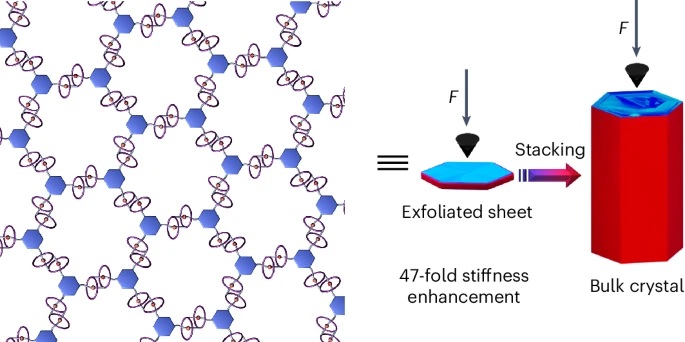
Recent advancements in materials science have enabled the creation of highly complex and functional structures through supramolecular chemistry and polymer synthesis. Researchers have developed intricate systems, such as molecular machines, muscle-like supramolecular polymers, and two-dimensional covalent organic frameworks, which leverage non-covalent interactions and dynamic bonding to achieve unprecedented levels of organization and functionality. These innovations, often inspired by biological systems, demonstrate the potential for creating materials with tailored mechanical, electronic, and responsive properties, paving the way for applications in nanotechnology, sensing, and adaptive materials.
Supramolecular polymers are dynamic materials that can adapt their properties in response to external stimuli. These materials are designed using non-covalent interactions, such as hydrogen bonds or π-π stacking, which allow for reversible assembly and disassembly. This unique property makes them ideal for applications like soft robotics, drug delivery, and adaptive materials.
Covalent organic frameworks (COFs) are porous materials with ordered structures, synthesized through covalent bonding. They offer high surface area and tunable properties, making them suitable for applications in gas storage, catalysis, and sensing. The synthesis of COFs typically involves the use of building blocks like benzene dicarboxylate or triazine derivatives, which are linked together under specific conditions to form the desired framework.
Hydrogen-bonded organic frameworks (HOFs) are crystalline materials held together by hydrogen bonds. These frameworks exhibit high porosity and stability, making them promising for applications in gas separation, sensing, and catalysis. The formation of HOFs relies on the careful design of molecular building blocks that can self-assemble into ordered structures through directional hydrogen bonding.
Polycatenation refers to the process of linking multiple polymer chains together, creating complex architectures with enhanced mechanical and thermal properties. This technique is used in the development of materials like thermoplastics and elastomers, where the interlinked structure provides improved durability and flexibility. Polycatenation can be achieved through various methods, including chemical cross-linking or physical entanglement, depending on the desired properties of the final material.
More information
External Link: Click Here For More