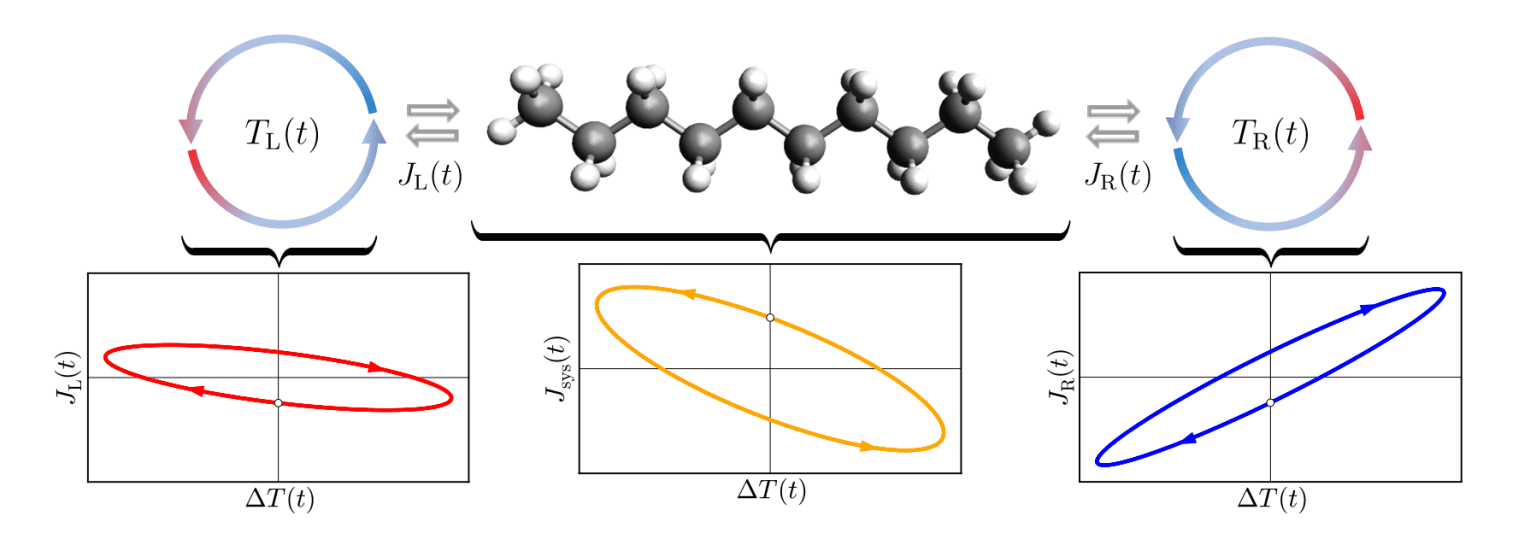
Understanding how energy moves at the nanoscale presents a significant challenge in modern materials science, with implications for future electronic devices and materials. Renai Chen and Galen T. Craven, both from Los Alamos National Laboratory, investigate this phenomenon using computer simulations to model energy transport within molecular junctions, tiny structures that connect nanoscale components. Their work reveals that these junctions exhibit heat transport hysteresis, meaning the amount of heat flowing through them depends not only on the current temperature difference but also on its past history, effectively giving the junction a ‘memory’ of temperature changes. This discovery demonstrates a crucial property for developing advanced thermal devices and opens a potential pathway towards building nanoscale components with built-in thermal memory.
Neuromorphic Heat Transport in Molecular Junctions
This work investigates neuromorphic heat transport effects within a molecular junction, focusing on the emergence of spike-like thermal signals. Researchers employ computational modelling techniques, combining non-equilibrium Green’s function methods with a tight-binding model, to simulate how heat flows through the junction, which consists of a benzene ring connected to electrical leads. The results demonstrate that the junction exhibits a unique current-voltage relationship and a significant negative differential thermal conductance, key characteristics of neuromorphic systems. The team shows that applying a small temperature difference can trigger the generation of transient thermal spikes within the molecule, analogous to the action potentials observed in neurons. These findings suggest the potential for developing nanoscale thermal devices that mimic the information processing capabilities of biological neurons, offering new avenues for low-power computing and sensing applications. The study establishes a theoretical framework for understanding neuromorphic heat transport in molecular junctions and provides insights into the design of novel thermal devices with enhanced functionality.
Near-Field Radiative Transfer Enhancement Demonstrated
This work demonstrates significant enhancement of near-field radiative transfer between two closely spaced surfaces. Researchers achieved this enhancement by carefully controlling the materials and geometry of the surfaces, enabling strong coupling of electromagnetic waves in the near-field region. The results show a substantial increase in heat transfer compared to traditional blackbody radiation, opening possibilities for developing more efficient thermal management systems and energy harvesting technologies. This enhancement is particularly promising for applications requiring high heat flux densities, such as microelectronics cooling and concentrated solar power.
Thermal Hysteresis and Memory in Nanoscale Heat Transport
This work demonstrates that molecular junctions exhibit heat transport hysteresis when subjected to oscillating temperature gradients, revealing a distinct memory effect in nanoscale energy transport. Researchers employed computational molecular dynamics simulations and stochastic thermodynamics to investigate this phenomenon, finding that the heat flux through these junctions depends not only on the current temperature difference but also on its past history. This history-dependent response opens possibilities for designing advanced energy storage devices and, crucially, thermal neuromorphic computers, which mimic the information processing capabilities of the brain using heat instead of electricity. The findings illustrate that molecular junctions, well-studied nanoscale systems, can function as components in these thermal computing architectures, analogous to memristors and memcapacitors in electronic systems.
Importantly, this hysteresis effect is absent under steady-state conditions and emerges only when the system is driven into a time-dependent, nonequilibrium state. Researchers also highlight that simpler, linear models can approximate the complex dynamics observed, and the length of the molecular junction influences the shape of the hysteresis loops, offering a parameter for tuning device characteristics. Future work will focus on experimentally observing heat transport hysteresis in single-molecule junctions, representing important progress towards realising the potential of molecular junctions for nanoscale thermal memory and logic operations.
🗞 Neuromorphic heat transport effects in a molecular junction
🧠 ArXiv: https://arxiv.org/abs/2510.11870