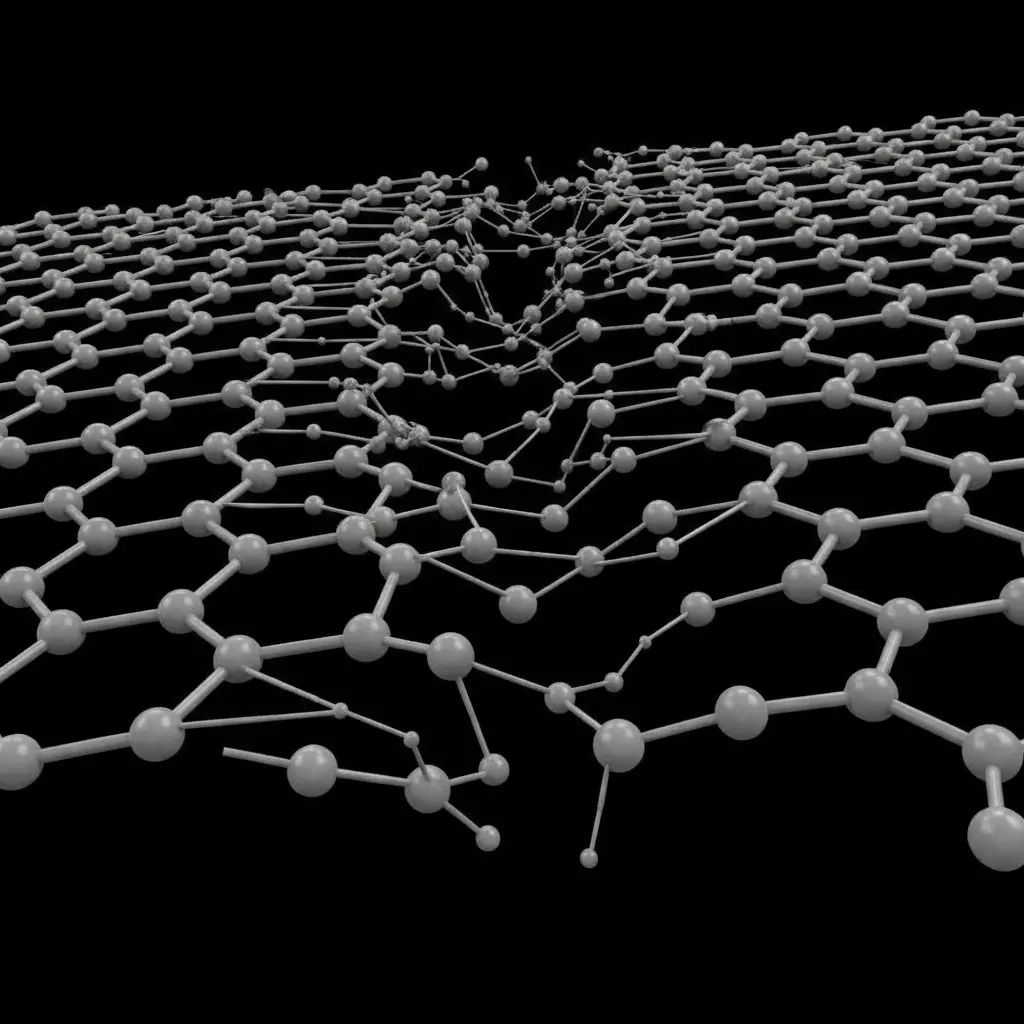
The behaviour of graphene under stress is crucial for developing advanced nanomaterials, and researchers are increasingly exploring defect engineering , specifically the introduction of parallel cracks , to control how these materials fracture. Suyeong Jin of Pukyong National University, Jung-Wuk Hong from the Korea Advanced Institute of Science and Technology, and Alexandre F. Fonseca et al. have investigated how the choice of interatomic potential impacts predictions of graphene fracture. Their work directly compares molecular dynamics simulations using two commonly employed potentials, AIREBO and ReaxFF, applied to graphene containing parallel cracks under tensile loading. This research is significant because it demonstrates substantial differences in predicted material response depending on the potential used, highlighting the critical need for careful selection when modelling the fracture of defect-engineered graphene and ensuring reliable simulation results.
The geometry consisted of graphene sheets with pre-existing parallel cracks, with a defined gap, Wgap, between them, and simulations were conducted applying tensile loading along both the armchair and zigzag directions. By systematically varying the interatomic potential, the study aims to establish the robustness of fracture predictions and identify potentials that yield consistent and reliable results. This work provides a comparative analysis of fracture responses obtained using several commonly employed interatomic potentials for graphene. Results demonstrate significant discrepancies in fracture strength and crack propagation mechanisms depending on the chosen potential, highlighting the critical need for careful potential selection in atomistic fracture simulations. This research offers insights into the limitations of current potentials and provides guidance for future development of more accurate and transferable potentials for modelling graphene fracture.
Graphene Fracture, Ductility and Crack Coalescence
Graphene Fracture, Ductility and Crack Coalescence
This research paper investigates the fracture toughness and ductility of graphene using molecular dynamics simulations with both ReaxFF and AIREBO potentials. The study focuses on understanding crack propagation, crack coalescence, and the influence of defects on graphene’s mechanical behavior. A key finding is that graphene exhibits increased ductility under certain conditions, specifically when cracks coalesce in an abnormal manner, challenging the traditional view of graphene as a purely brittle material. The study compares the performance of the ReaxFF and AIREBO potentials in simulating graphene fracture, highlighting nuances in their behavior and accuracy. The presence of defects, such as vacancies, significantly affects the fracture process, acting as stress concentrators and influencing crack propagation paths. The research explores the fracture toughness of graphene, aiming to understand its resistance to crack propagation, utilising molecular dynamics simulations with the LAMMPS software package and the von Mises stress criterion to analyze stress distribution.
Graphene Crack Spacing Impacts Fracture Behaviour
Assessing Interatomic Potential Impact on Crack Behavior
Scientists quantified how interatomic potential selection impacts fracture predictions in graphene containing parallel cracks. The research team employed molecular dynamics simulations using the AIREBO potential to investigate graphene sheets with pre-existing cracks, subjected to tensile loading along both armchair and zigzag directions. Experiments revealed that the stress-strain responses, Young’s modulus, effective mode-I stress intensity factor, and energy absorption all vary significantly with the crack separation distance, denoted as Wgap. The study meticulously measured Young’s modulus by performing linear regression on the stress-strain curve between zero and 0.01 strain.
Results demonstrate that the AIREBO-based Young’s modulus for pristine graphene is approximately 0.91 TPa for armchair and 0.92 TPa for zigzag configurations. Introducing parallel cracks diminished the effective modulus, notably to 0.72, 0.74 TPa for merged cracks (Wgap = 0), with partial recovery to 0.80, 0.81 TPa at larger separations for both orientations. The effective fracture toughness, Keff IC, also increased from approximately 2.7 to 3.8 MPa√m for armchair and from 2.1 to 3.0 MPa√m for zigzag as Wgap increased. Data shows that for armchair cracks, the peak stress rises from approximately 30 GPa at Wgap = 0 to 40 GPa at the largest separation, while the peak strain increases from roughly 0.04 to 0.05.
In contrast, the zigzag configuration exhibited lower peak stresses, ranging from approximately 23-31 GPa, occurring at smaller strains of approximately 0.03-0.04. Furthermore, the team calculated energy absorption as the area under the stress-strain curve up to 0.08 strain, revealing a strong dependence on Wgap and potential choice. The breakthrough delivers insights into the fracture sequence, showing that armchair cracks experience near-simultaneous instability of outer cracks, while zigzag cracks exhibit a staged fracture evolution with sequential crack propagation. These findings underscore the critical need for careful selection of interatomic potentials in defect-engineered fracture simulations, as the choice significantly influences predictions of ductility and energy absorption. The work establishes a foundation for more accurate modelling of graphene fracture behaviour and informs the design of materials with tailored mechanical properties.
Comparing Simulation Potentials for Graphene Defects
Potential Choice Impacts Graphene Fracture Behaviour
This study reinvestigated the fracture behaviour of hydrogen-passivated graphene containing parallel cracks, employing the AIREBO interatomic potential. By directly comparing the results with previous simulations utilising the ReaxFF potential, researchers quantified the significant influence of potential choice on predicted fracture characteristics. The work demonstrates that AIREBO predicts lower peak stresses and earlier softening compared to ReaxFF, ultimately affecting post-peak deformation and energy absorption. The findings reveal a consistent strengthening trend with increasing crack separation, irrespective of the potential used, but highlight that macroscopic energy absorption, peak stress, and ductility are all highly sensitive to the chosen interatomic potential.
This underscores the importance of careful selection and interpretation when modelling defect-engineered graphene fracture at the atomistic level. The authors acknowledge a limitation in the absence of experimental validation, cautioning that the results represent potential-dependent trends rather than definitive material behaviour. Future work could benefit from direct comparison with experimental fracture data to validate the simulation results and refine the understanding of these phenomena. The researchers suggest that the observed “lever-like” fracture structures warrant experimental confirmation, given their potential to maintain electrical conductivity and utility in sensor applications. This research contributes to a growing understanding of how to tailor graphene’s fracture response through defect engineering, while simultaneously emphasising the critical role of computational methodology in achieving reliable predictions.
🗞 Effect of Interatomic Potential Choice on Fracture Modes of Graphene with Parallel Cracks
🧠 ArXiv: https://arxiv.org/abs/2601.08346