

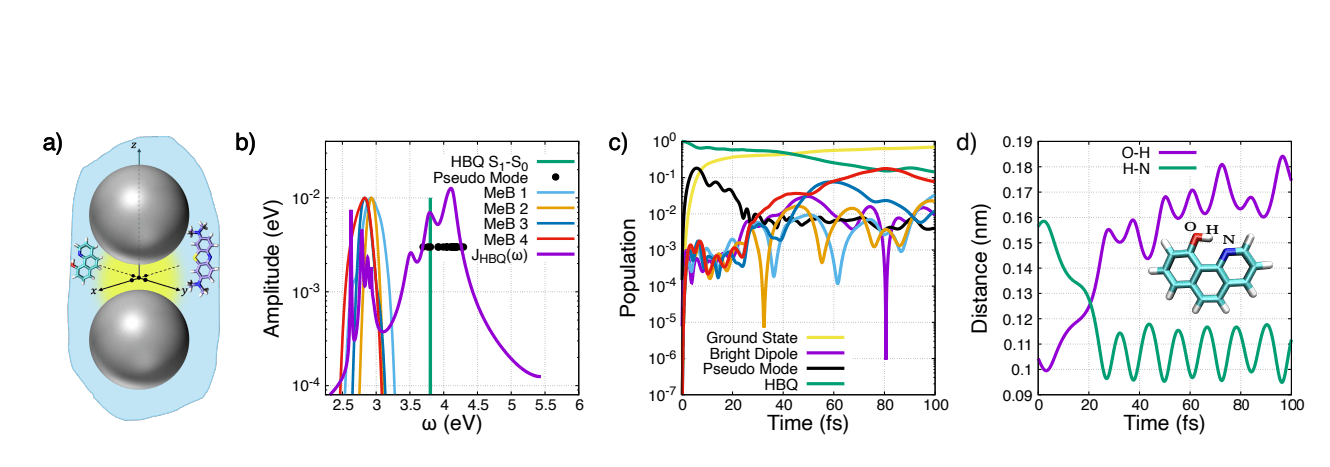
Understanding how light interacts with matter at the nanoscale is crucial for developing advanced technologies in areas like sensing and quantum computing, and Ruth H. Tichauer, Maksim Lednev, and colleagues from Universidad Autónoma de Madrid and University of Jyväskylä present a new approach to modelling these complex interactions. Their research introduces a powerful framework that combines accurate quantum mechanical calculations with a method for simulating the behaviour of light within nanophotonic structures, allowing for a more realistic representation of light-matter interactions than previously possible. This method accounts for both the quantum nature of molecules and the way light is confined and altered by nanoscale environments, demonstrating that strong coupling between light and matter can persist even with molecular movement and disorder. The team’s work further reveals how the shape of light and molecular arrangements influence energy transfer between molecules, offering new insights into the design of efficient nanoscale light-harvesting systems.
The authors have developed a methodology combining several advanced techniques to accurately model the behavior of excitons, pairs of electrons and holes, interacting with plasmonic nanostructures. This framework addresses a key challenge in nanophotonics: accurately predicting how light and matter interact when confined to extremely small spaces, crucial for designing new materials and devices with tailored optical properties. The approach combines Density Functional Theory, the Finite Element Method, the Lindblad Master Equation, and Non-Adiabatic Molecular Dynamics to address the problem at various length scales.
To handle the computational demands, calculations are accelerated using powerful Graphics Processing Units. A key innovation is the use of a macroscopic quantum electrodynamics approach, combining quantum mechanical calculations with classical simulations to study relatively large and complex systems. The framework realistically models disorder in the molecular environment, a crucial factor for understanding real-world materials, allowing scientists to move beyond simplified models and explore complex light-matter interplay. This framework has significant implications for the design of novel optoelectronic devices, enabling optimization of light-matter interactions for enhanced performance. It also aids in understanding light-harvesting systems, both natural and artificial, revealing energy capture and transfer mechanisms. Furthermore, the framework contributes to the development of quantum technologies based on exciton-polaritons, offering new possibilities for information processing and sensing, ultimately providing a powerful computational tool for nanoscale investigations and paving the way for new materials and technologies.
Nanoscale Light-Matter Interaction via Quantum Simulations
Scientists have developed a computational framework that combines quantum mechanical simulations with a few-mode field quantization approach to simulate light-matter interactions at the nanoscale. This method overcomes the limitations of previous approaches by accurately describing complex environments and molecular properties. The team employs a mixed quantum-classical dynamics scheme, separating fast electronic and photonic processes from slower nuclear motions, allowing for precise calculation of how molecules interact with light within confined nanophotonic structures. Researchers quantized the continuous field using a minimal set of interacting modes, determining parameters by fitting to the spectral density obtained from classical electromagnetic simulations.
This innovative approach accurately captures the highly inhomogeneous and multimodal nature of light confined within plasmonic nanocavities, where field enhancements concentrate in nanometer-scale hot spots. The framework accounts for dynamic disorder introduced by molecular motion and environmental fluctuations, enabling the study of systems with realistic molecular properties, unlike idealized two-level system models. The study pioneered a method for calculating the time evolution of the hybrid light-matter system, solving the time-dependent Schrödinger equation for the coupled electron-photon wavefunction, which depends parametrically on nuclear coordinates. Simultaneously, classical equations of motion govern nuclear motion within the potential landscape created by the fast electron-photon subsystem. Results demonstrate that strong light-matter coupling persists despite dynamic disorder, but symmetry-protected degeneracies present in simpler models are lifted when realistic molecular properties are included.
Nanoscale Light-Matter Interactions via Field Quantization
Scientists have developed a novel framework that combines advanced computational techniques to simulate light-matter interactions at the nanoscale, specifically focusing on organic molecules interacting with plasmonic nanoresonators. This work introduces a method coupling ab initio quantum mechanics/molecular mechanics (QM/MM) molecular dynamics with few-mode field quantization, allowing for detailed modelling of complex systems with realistic molecular properties and electromagnetic environments. The team accurately describes arbitrary nanophotonic structures by quantizing the electromagnetic environment using a minimal set of interacting modes, determined by fitting to the spectral density obtained from classical electromagnetic simulations. Experiments reveal that strong light-matter coupling persists even when accounting for the dynamic disorder introduced by molecular motion and environmental fluctuations.
The research demonstrates that symmetry-based degeneracies, commonly assumed in simplified two-level system models, are lifted when realistic molecular properties are incorporated into the simulations. Specifically, the team observed a clear lifting of these degeneracies, indicating the importance of considering full molecular complexity. Furthermore, the framework enables the study of cavity-mediated intermolecular energy transfer with full spatial resolution, providing insights into how energy moves between molecules within the nanostructure. The method accurately captures the spectral density of the electromagnetic environment, utilizing a compact photonic Hamiltonian without assuming spatial homogeneity or identical emitters. By modelling each molecule as a few-level system with geometry-dependent properties calculated on the fly using QM/MM, the team achieved a highly accurate representation of the system’s dynamics. The results show that the framework successfully simulates the complex interplay between light and matter at the nanoscale, paving the way for advancements in areas such as light harvesting, sensing, and nanoscale optical devices.
Strong Coupling Beyond Simplified Models
This work presents a new theoretical framework for simulating how light interacts with molecules positioned near nanoscale structures, specifically focusing on the complex interplay of light and organic chromophores confined by plasmonic nano-resonators. Researchers developed a method that combines advanced quantum mechanical simulations with a few-mode field quantization approach, allowing for detailed modelling of light-matter interactions in spatially inhomogeneous and lossy environments. This approach moves beyond simplified models by directly accounting for the unique properties of individual molecules and the complex nature of the surrounding electromagnetic field. The simulations demonstrate that strong coupling between light and molecules persists even when molecular motion and disorder are included, challenging assumptions inherent in simpler theoretical models.
Furthermore, the framework reveals how spatial variations in the electromagnetic field and molecular disorder influence energy transfer between molecules, providing insights into cavity-mediated intermolecular interactions. The team successfully applied this method to a system involving multiple emitters and a donor-acceptor combination, achieving full spatial resolution of the energy transfer process. The authors acknowledge that their model still relies on approximations in representing the electromagnetic environment with a limited number of modes. Future research directions include extending the method to incorporate more complex molecular systems and exploring the impact of non-reciprocal media on light-matter interactions. This work establishes a powerful new tool for nanoscale investigations.
👉 More information
🗞 Incorporating QM/MM molecular dynamics into the few-mode quantization approach for light-matter interactions in nanophotonic structures
🧠 ArXiv: https://arxiv.org/abs/2511.03303


