

Moiré materials continue to reveal surprising quantum properties, and a new study introduces lead iodide (PbI2) into this expanding family of two-dimensional heterostructures. Yan Sun, M. Monteverde, and colleagues at Université Paris-Saclay, CNRS, alongside collaborators from institutions in Ukraine and Japan, demonstrate that combining PbI2 with hexagonal boron nitride creates a platform for observing unusual electronic behaviour in high magnetic fields. The research reveals dissipationless transport at charge neutrality and a fractional conductance plateau, which the team attributes to ‘Chern junctions’, boundaries between regions with different quantum properties, arising from the moiré pattern. These findings not only expand the range of materials exhibiting these exotic quantum states, but also suggest a pathway towards engineering coherent electronic transport in two-dimensional materials through spin-orbit interactions enhanced by the PbI2 layer.
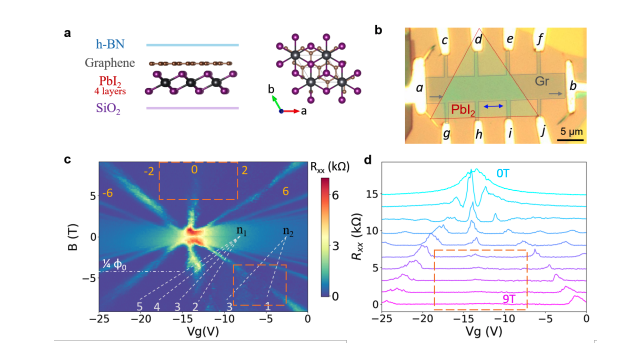
Expanding the moiré material library continues to unlock novel quantum phases and emergent electronic behaviours. This work introduces lead iodide (PbI2) into the moiré family and investigates the magnetotransport properties of the resulting moiré superlattice in hexagonal boron nitride/graphene/PbI2 heterostructures. The research focuses on understanding how these layered materials interact to create new electronic properties, particularly in strong magnetic fields.
Graphene and Perovskite Exhibit Quantum Hall Effects
This research details the observation of unusual quantum Hall effects in graphene heterostructures incorporating lead iodide perovskite (PbI2). The team discovered behaviour resembling fractional quantum Hall (FQH) states, a surprising result given the system’s unconventional nature. FQH states typically arise in high-quality two-dimensional electron gases under specific conditions, but this system exhibits them in a unique context. The key to this behaviour lies in creating a heterostructure, layering graphene with lead iodide perovskite (PbI2), which induces charge transfer and creates a two-dimensional electron gas within the graphene.
The observed FQH-like states do not arise from typical mechanisms seen in conventional FQH systems. The authors propose a different origin, potentially linked to the unique electronic properties at the interface between graphene and PbI2. The observed plateaus, indicating quantized states, are remarkably robust, even with imperfections in the material. This ability to induce and control these unusual quantum states in a relatively simple heterostructure opens up possibilities for new electronic devices.
Dissipationless Transport and Chern Junctions Emerge
Researchers have discovered novel quantum behaviour within layered materials combining hexagonal boron nitride with lead iodide (PbI2), opening new avenues for exploring exotic electronic properties. By creating a moiré superlattice, they observed robust dissipationless transport at the charge neutrality point, indicating the formation of incompressible quantum states. This suggests the material supports the movement of electrons without energy loss, a crucial characteristic for advanced electronic devices. Notably, the team detected a fractional conductance plateau at a specific value, indicative of a unique “Chern junction” forming between different quantum states within the material.
This junction arises from the interplay between the moiré superlattice and conventional quantum Hall effects, effectively creating a pathway for electrons to flow with unusual properties. Further investigation revealed coherent electronic interference along specific lines within the material, demonstrating a high degree of quantum coherence. This interference pattern, stemming from the moiré superlattice, creates an area where electrons behave as waves, reinforcing the potential for creating devices based on quantum phenomena. Remarkably, the team observed spatially correlated resistance fluctuations between different parts of the material, indicating coherent transport across macroscopic distances.
PbI2 Heterostructures Reveal Fractional Quantum Hall States
This research demonstrates the successful integration of lead iodide (PbI2) into moiré heterostructures, creating a new platform for exploring quantum phenomena in two-dimensional materials. The team observed robust dissipationless transport at the charge neutrality point in a hexagonal boron nitride/PbI2 structure, indicating the presence of incompressible states. Notably, a fractional conductance plateau emerged, attributed to a junction between distinct topological states arising from the moiré superlattice and conventional quantum Hall effects. The findings suggest that proximity-induced spin-orbit coupling from the PbI2 layer significantly influences the electronic properties of the moiré material. Researchers also identified coherent electronic interference, linked to variations in the moiré superlattice period caused by the mechanical flexibility of the PbI2. The authors acknowledge that local strain within the PbI2 layer contributes to these variations, creating domain walls that act as quantum beam splitters.
🗞 Chern junctions in Moiré-Patterned Graphene/PbI2
🧠 ArXiv: https://arxiv.org/abs/2508.04935


