The behaviour of electrons within materials exhibiting ‘flat bands’ – a specific electronic structure where electron velocity is significantly reduced – continues to reveal unexpected phenomena, particularly concerning the spontaneous emergence of magnetism. Recent research focuses on the role of geometric properties within these materials, identifying a previously unrecognised quantity, the ‘geometric dipole’, as a key determinant of magnetic behaviour. This dipole, analogous to how the metric defines spatial spread, influences the energy and stiffness of particle-hole excitations, effectively boosting ferromagnetism, especially in topological bands. Lei Chen, Sayed Ali Akbar Ghorashi, and Jennifer Cano, all from Stony Brook University, alongside Valentin Crépel from the Flatiron Institute, detail these findings in their article, “Quantum-geometric dipole: a topological boost to flavor ferromagnetism in flat bands”, demonstrating the predictive power of this geometric indicator for understanding and potentially controlling magnetism in these complex materials.
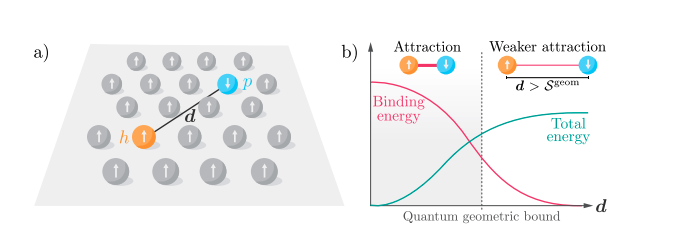
Recent research identifies the geometric dipole, a previously unrecognised geometric quantity, as a crucial determinant of robust flavour-polarized phases observed in flat-band moiré materials. These materials, created by stacking two-dimensional layers with a slight rotational offset, exhibit ‘flat bands’ where electrons have minimal kinetic energy, enhancing the influence of electron-electron interactions and leading to novel collective behaviours. The geometric dipole directly connects to the characteristic size of particle-hole excitations, which represent fundamental disturbances in the electronic structure, such as magnons – quantized spin waves found in ferromagnets. Larger particle-hole separations, dictated by the magnitude of the geometric dipole, weaken attractive interactions between electrons and consequently increase the energy required to create these excitations. This establishes a new understanding of the mechanisms driving phenomena in these bilayer materials.
Molybdenum ditelluride (MoTe2) bilayers exemplify these flat-band characteristics, and the geometric dipole governs the emergence of robust flavour-polarized phases within them. Flavour refers to the degree of freedom associated with the electron’s spin and valley, and polarization signifies a preferential alignment of these degrees of freedom. Researchers demonstrate a direct link between geometric properties of the material’s electronic band structure and its magnetic behaviour, moving beyond traditional explanations based solely on material composition.
Specifically, the research shows that larger separations between
Specifically, the research shows that larger separations between particle-hole pairs correlate with weaker mutual attraction and, correspondingly, higher excitation energies. Within topological bands – electronic bands possessing non-trivial topological properties – this energy enhancement possesses a lower bound when considered within a single-mode approximation. This underlines the significant role of topology, a mathematical property describing the connectedness of a space, in driving flat-band ferromagnetism, a state where the material exhibits spontaneous magnetic ordering.
Researchers actively connect geometric properties of the band structure to physical observables, providing a framework for understanding and predicting magnetic behaviour. They detail parameters defining effective mass, interlayer coupling strengths – the strength of interaction between the layers – and screening lengths, enabling precise calculations of the material’s behaviour. Analysis of Berry curvature – a measure of the geometric phase acquired by electrons – and the trace of the quantum metric, which describes the shape of the electronic bands, reveals the topological properties of the electronic bands, pinpointing the critical point of the topological phase transition, where the material’s electronic properties fundamentally change.
Researchers actively explore the influence of external stimuli, such as strain or electric fields, on the geometric dipole and its subsequent impact on magnetic properties. They investigate the interplay between the geometric dipole and other factors, like electron-electron interactions, to further refine our understanding of flat-band magnetism. Extending these findings to other correlated electron systems beyond moiré materials, such as transition metal dichalcogenides and twisted graphene structures, represents a promising avenue for future research.
Researchers apply an external displacement field to modulate
Researchers apply an external displacement field to modulate the interlayer potential, influencing the electronic structure and inducing topological phase transitions. This ability to tune the material’s properties through external control offers potential for developing novel electronic devices with tailored magnetic characteristics.
🗞 Quantum-geometric dipole: a topological boost to flavor ferromagnetism in flat bands
🧠 DOI: https://doi.org/10.48550/arXiv.2506.22417