

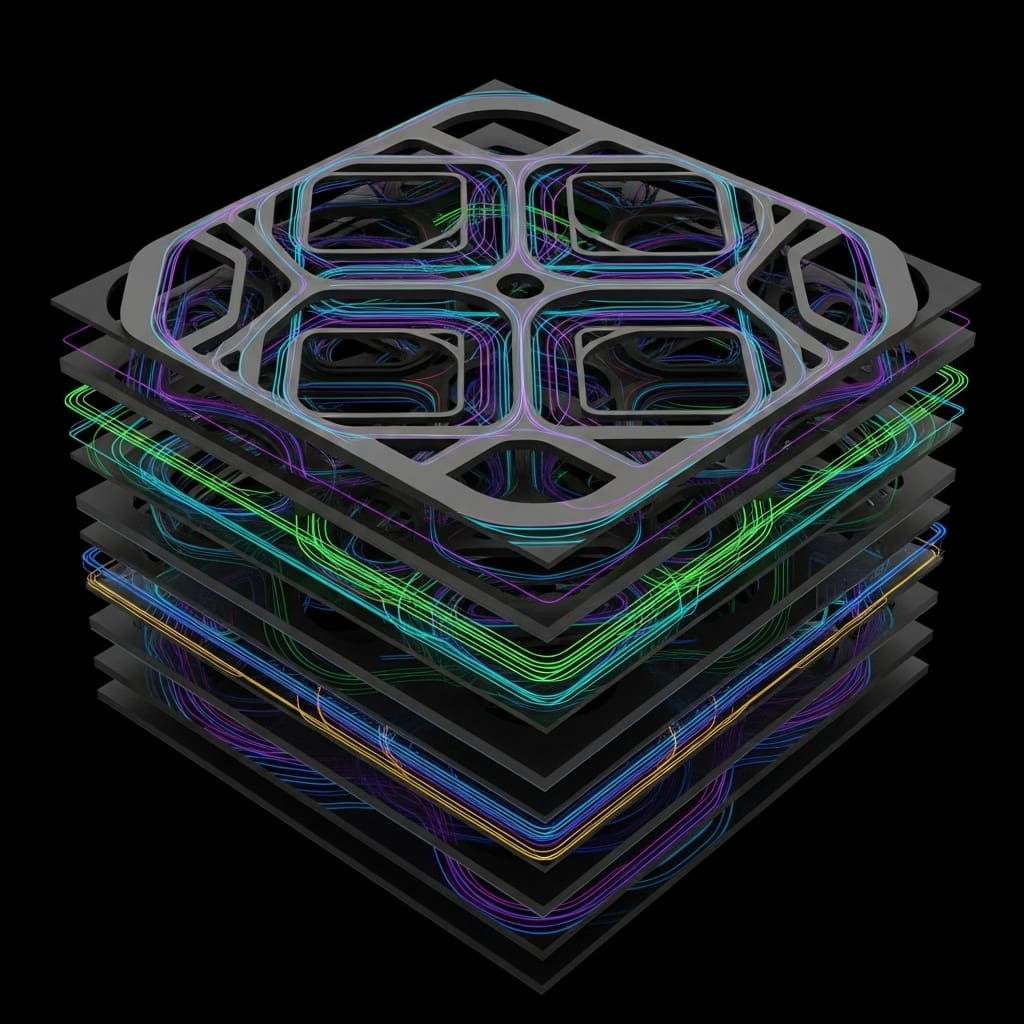
The emergence of Moiré materials, created by stacking two-dimensional layers, has recently revolutionised the fields of quantum physics and materials science. Ilya Popov and Elena Besley, both of the University of Nottingham, alongside their colleagues, now extend this concept into three dimensions, opening up a completely new area of crystallographic study. Their research establishes the underlying mathematical principles governing these three-dimensional Moiré crystals, offering a systematic method for their construction using complex algebraic techniques. This work is significant because it moves beyond the limitations of two-dimensional Moiré patterns, potentially unlocking novel properties and applications in both condensed matter physics and solid-state chemistry, far exceeding those found in the individual materials themselves.
Two-dimensional (2D) layers such as graphene or transition metal dichalcogenides have transformed our understanding of strongly correlated and topological quantum phenomena. The lattice mismatch and relative twist angle between 2D layers have been shown to result in Moiré patterns associated with widely tunable electronic properties, ranging from Mott and Chern insulators to semi- and superconductors. Extended to three-dimensional (3D) structures, Moiré materials unlock an entirely new crystallographic space defined by the elements of the 3D rotation group and translational symmetry of the constituent lattices0.3D Moiré crystals exhibit f.
3D Moiré Crystals via Clifford Algebra
The study pioneers a novel approach to constructing three-dimensional Moiré crystals, moving beyond the traditionally confined two-dimensional materials. Researchers established fundamental mathematical principles of 3D Moiré crystallography, addressing the long-standing question of how to systematically build these complex structures. The work centres on utilising Clifford algebras over the field of rational numbers to define and manipulate the rotational symmetries crucial for creating periodic 3D Moiré patterns from arbitrary lattices. This innovative mathematical framework allows for a complete parametrisation and classification of these crystals, extending beyond the previously studied simple cubic lattices.
Scientists developed a method to determine the conditions under which rotations can generate periodic Moiré patterns within any given three-dimensional lattice, denoted as Z3. The team demonstrated that for a simple cubic lattice, allowed rotations belong to the SO3(Q) group, parametrised by five integer numbers, but extended this to encompass all seven crystal systems. Experiments did not involve physical material synthesis, but rather a theoretical construction of lattices and rotations within a Cartesian coordinate frame, utilising non-coplanar basis vectors u1, u2, and u3 in three-dimensional space. This computational approach enables the exploration of a vast crystallographic space inaccessible through conventional experimental methods.
The research harnessed the power of abstract algebra to solve a critical problem in materials design: predicting the stability and properties of 3D Moiré structures. By formulating necessary conditions for periodicity, the study provides a complete crystallographic classification of these crystals, offering a roadmap for their potential realisation in solid-state matter. Researchers generated diverse examples of novel 3D Moiré crystals representing chemically meaningful frameworks, analysing their structure and topology from a crystallographic perspective. This work establishes the principal foundations of 3D Moiré crystallography, opening avenues for exploring materials with unique optical, magnetic, and electronic properties beyond those achievable with conventional twistronics.
3D Moiré Crystals via Clifford Algebra
Scientists have established fundamental mathematical principles governing the construction of three-dimensional Moiré crystals, unlocking a new crystallographic space beyond traditional two-dimensional materials. The research details a general method for building these 3D structures using Clifford algebras over rational numbers, allowing for precise control over their formation and properties. Experiments demonstrate that the key to creating periodic Moiré patterns lies in identifying rotations that satisfy specific conditions for any arbitrary Z3 lattice, a problem now solved through this novel mathematical framework. The team formulated the necessary conditions for the existence of these periodic patterns, achieving a complete parametrisation of the rotations that generate them.
This breakthrough delivers a complete crystallographic classification of 3D Moiré crystals, moving beyond the limitations of previous work focused solely on simple cubic lattices. Specifically, the researchers show that for any given prototype lattice, rotations can be fully described and classified, enabling the design of crystals with tailored characteristics. The work builds upon earlier findings by Wang et al., who identified rotations belonging to the SO3(Q) group for simple cubic lattices, but extends this to encompass all seven crystal systems. Measurements confirm that the construction of 3D Moiré crystals relies on a rational matrix, ‘h’, satisfying the equation u’ = uh, where ‘u’ represents the lattice basis vectors and ‘u’’ the rotated basis vectors.
The team determined that elements of this matrix can be expressed as hij = mij/nij, where mij and nij are co-prime integers, and subsequently defined a set of integer numbers, li, as the least common multiple of n1i, n2i, and n3i. Using these parameters, the unit cell of the resulting Moiré lattice is spanned by vectors liu’i, containing atoms originating from both constituent crystals. Further analysis revealed that the fractional coordinates of atoms within the Moiré crystal are determined by specific transformations, ̄fi = k−tfi for atoms from the original lattice and ̄fj = lfj for atoms from the rotated lattice. The researchers also addressed the stability of these structures, suggesting their potential extends beyond nanomaterials and into broader solid-state chemistry applications. By generating examples of novel 3D Moiré crystals with chemically meaningful frameworks, the study lays the principal foundations for a new field of 3D Moiré crystallography, promising advancements in condensed matter physics and materials science.
3D Moiré Crystals and Clifford Algebra Construction
This work establishes the foundational principles of three-dimensional Moiré crystallography, offering a general method for constructing these crystals alongside a complete classification of their possible structures. By utilising Clifford algebras, the researchers demonstrate how to systematically build 3D Moiré crystals from layered materials, opening up a new crystallographic space beyond traditional two-dimensional approaches. The resulting structures exhibit symmetries, topologies and chemical frameworks distinct from their constituent lattices, suggesting potential for novel material properties. The significance of this achievement lies in unlocking unprecedented opportunities for discovering materials with tunable electronic, optical and quantum characteristics.
The authors demonstrate that a wide range of realistic 3D Moiré crystals can be generated, many of which would likely be overlooked by conventional chemical intuition, and provide a theoretical framework to aid future development in the field. While acknowledging that some generated structures may be unphysical, the research highlights the potential for creating materials with previously inaccessible properties. The authors note a key limitation is the current challenge of fabricating these complex 3D structures, though they point to recent advances in holographic fabrication and ultracold atomic gases as promising avenues. Future research, they suggest, should focus on developing new fabrication techniques to realise these theoretical designs and fully explore their application potential. The complete mathematical proofs and detailed crystal structures are included as supplementary information, supporting the validity of the presented method.
👉 More information
🗞 Three-dimensional Moiré crystallography
🧠 ArXiv: https://arxiv.org/abs/2601.04971

