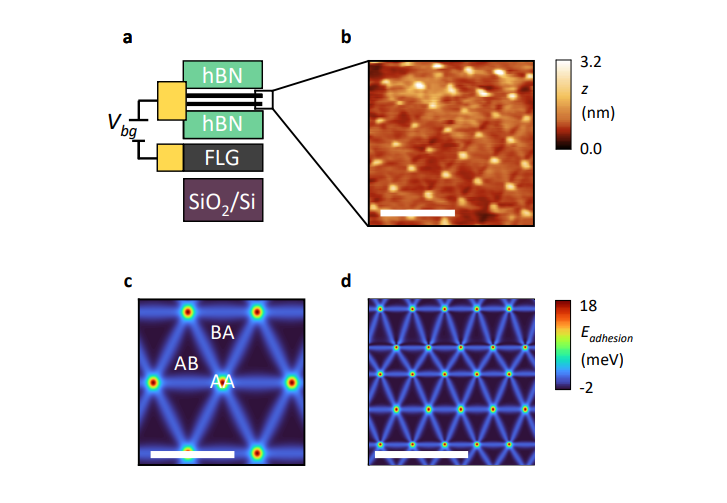
The emergence of moiré superlattices dramatically alters the behaviour of two-dimensional materials, and recent research focuses on how these unique structures impact electron flow. Alex Boschi, Alejandro Ramos-Alonso, and Vaidotas Mišeikis, alongside colleagues including Kenji Watanabe, Takashi Taniguchi, and Fabio Beltram, investigate temperature-dependent electrical transport in bilayer graphene exhibiting a moiré pattern. Their work reveals a surprising link between the material’s vibrational modes, specifically low-energy ‘phasons’ describing the sliding motion between layers, and the way electrons move through it. The team demonstrates that scattering caused by these phasons dominates electrical resistance at higher temperatures, exceeding that of single-layer graphene and offering new insights into the fundamental physics governing carrier transport in these complex moiré systems.
The electronic and vibrational properties of two-dimensional materials undergo dramatic changes when a moiré superlattice forms. Researchers investigate how these superlattices influence material behaviour, focusing on the lowest-energy vibrational modes, known as phonons. This work explores the interplay between electronic and vibrational characteristics within these moiré structures, revealing significant differences compared to individual, uncoupled layers. The team demonstrates that the moiré potential strongly alters the interaction between electrons and phonons, leading to observable modifications in the electronic density of states and phonon lifetimes. Specifically, the research highlights a substantial enhancement of electron-phonon coupling at specific energy levels within the moiré Brillouin zone, impacting charge transport and potentially enabling novel functionalities. These findings provide a fundamental understanding of emergent phenomena in twisted two-dimensional heterostructures and pave the way for designing materials with tailored electronic and vibrational properties.
Temperature-Dependent Transport in Twisted Bilayer Graphene
This research details the temperature-dependent electrical transport properties of twisted bilayer graphene, focusing on behaviour across different moiré bands and the emergence of insulating states. The study reveals that resistivity exhibits different temperature dependencies in different moiré bands, with linear relationships suggesting specific scattering mechanisms and temperature squared dependencies often associated with electron interactions. Detailed analysis of resistivity versus temperature curves demonstrates how resistivity changes with temperature in different moiré bands, and systematic data fitting determines the temperature dependence of each band. The observed temperature dependencies provide strong evidence for correlated electron behaviour, with the material’s behaviour strongly dependent on the specific moiré band.
Bilayer Graphene Resistivity and Band Filling
Scientists investigated the electrical resistivity of bilayer graphene at a minimal twist angle of 0. 36 degrees, focusing on the role of unique vibrational modes in influencing electron transport. Measurements reveal a quadratic temperature dependence of resistivity below 10 Kelvin, transitioning to a linear-in-temperature relationship above this threshold. The linear resistivity is significantly larger than observed in single-layer graphene, but reduced compared to magic-angle twisted bilayer graphene. Data demonstrates that this linear-in-temperature resistivity is modulated by the filling of electronic bands, with minima appearing when each band is fully occupied. The team’s experiments show that these trends align with a model incorporating scattering caused by longitudinal phasons, vibrational modes unique to the reconstructed moiré pattern. Researchers established that the observed resistivity behaviour is independent of electronic correlations, allowing them to isolate the influence of the reconstructed lattice structure and the resulting phason modes.
Phasons Dominate Bilayer Graphene Resistivity
This research demonstrates that unique vibrational modes, termed phasons, arising from the reconstructed atomic structure of minimally twisted bilayer graphene, play a dominant role in determining its electrical resistivity. Scientists discovered a temperature-dependent resistivity exhibiting both quadratic and linear regimes, a characteristic not observed in single-layer graphene. Through careful experimentation and semiclassical transport calculations, they established that these phasons, associated with the sliding motion between layers in the moiré superlattice, are the primary source of electron scattering at intermediate temperatures, exceeding the contribution from conventional acoustic phonons. These findings reveal a fundamental connection between the vibrational properties of moiré materials and their charge transport characteristics, highlighting how the reconstructed superlattice structure fundamentally influences electron behaviour. Importantly, this work extends beyond graphene, offering a broader understanding of phasons as a general mechanism in van der Waals materials and potentially enabling new strategies for tuning both transport and optical properties through structural engineering of moiré superlattices.
🗞 Phason-driven temperature-dependent transport in moiré graphene
🧠 ArXiv: https://arxiv.org/abs/2511.01691