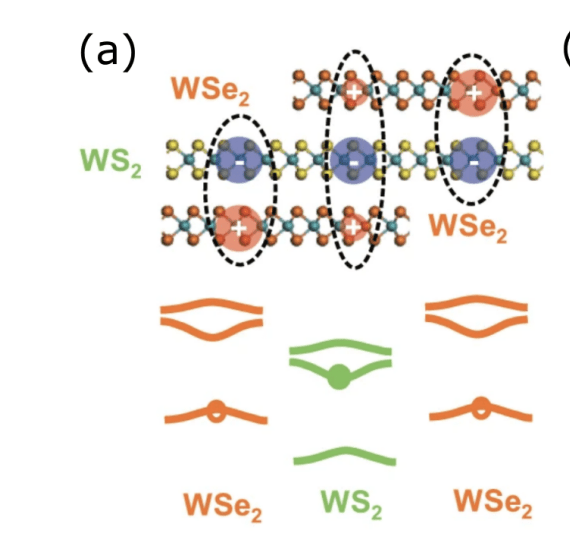
Moiré excitons, formed in twisted van der Waals heterostructures, exhibit strong interactions and extended lifetimes, enabling exploration of novel excitonic phases like superfluids and supersolids, potentially stable at room temperature. Hybridisation with photons creates moiré exciton-polaritons, quasiparticles with enhanced nonlinear optical properties and topological features, offering a platform for advanced optoelectronics and photonics.
The emergent properties of twisted van der Waals heterostructures continue to reveal unexpected phenomena in condensed matter physics, with moiré excitons representing a particularly promising area of investigation. These quasiparticles, formed through the interplay of electronic and optical effects in layered materials, exhibit extended lifetimes and strong interactions, offering potential for novel electronic and photonic devices. Saúl A. Herrera-González, David A. Ruiz-Tijerina, and colleagues, from the Instituto de Física, Universidad Nacional Autónoma de México, comprehensively review the theoretical underpinnings and experimental advancements in this field in their article, ‘Moiré excitons and exciton-polaritons: A review’. The work details the formation of these excitons, their impact on material properties, and the potential for realising correlated phases such as excitonic insulators and superfluids, alongside an exploration of the unique characteristics of moiré exciton-polaritons – hybrid light-matter quasiparticles with enhanced optical properties.
Two-Dimensional Materials Enable Exploration of Novel Physical Properties and Device Concepts
The emergence of two-dimensional (2D) materials, including graphene and transition metal dichalcogenides, stimulates considerable research into novel physical phenomena, offering potential for future technologies. These atomically thin materials exhibit unique electronic, optical, and mechanical properties due to their reduced dimensionality and strong light-matter coupling, presenting opportunities for developing quantum simulators and advanced optoelectronic devices.
Van der Waals heterostructures, created by vertically stacking 2D materials, allow for the engineering of materials with tailored properties, enabling precise control over their characteristics. The stacking process generates a moiré superlattice when layers exhibit slight lattice mismatch or a twist angle, creating a periodic interference pattern that fundamentally alters the potential landscape for electrons and excitons. This control influences their behaviour and interactions, opening avenues for exploring novel quantum phenomena and designing advanced devices.
Moiré superlattices enable precise control over electronic band structures, including the formation of flat bands which enhance electron interactions and foster the emergence of correlated electronic phases. This control has led to the observation of exotic states of matter, such as unconventional superconductivity and correlated insulators. Understanding these emergent phenomena requires a combination of theoretical modelling and experimental verification, driving innovation in materials science and condensed matter physics.
Excitons, bound electron-hole pairs, become confined within the moiré superlattice, localising at potential minima and exhibiting tunable properties, including binding energy and optical selection rules. These characteristics make them promising candidates for realising novel many-body phenomena like exciton superfluids and Wigner crystals, offering a pathway to explore fundamental physics and develop new quantum technologies.
Embedding moiré excitons within optical cavities further enhances their properties, creating moiré exciton-polaritons, quasiparticles resulting from the strong coupling of excitons and photons. These quasiparticles exhibit enhanced nonlinearities and unique topological features, opening avenues for advanced optoelectronic devices and novel photonic applications, including efficient light sources and nanoscale optical circuits. This hybridization of light and matter offers a powerful platform for manipulating light at the nanoscale and developing new photonic technologies.
Van der Waals Heterostructures Host Long-Lived, Strongly Interacting Moiré Excitons
Research into moiré excitons and exciton-polaritons represents a significant advance in the study of light-matter interactions within two-dimensional materials. These quasiparticles, formed in twisted or lattice-mismatched van der Waals heterostructures, benefit from extended lifetimes and strong interactions, characteristics that distinguish them from conventional excitons found in traditional semiconductors. The creation of moiré patterns introduces a periodic potential landscape that profoundly influences exciton behaviour, enabling the engineering of novel quantum states.
This periodic confinement dramatically alters the energy levels and spatial distribution of excitons, leading to the formation of flat bands where exciton motion is significantly restricted, enhancing exciton-exciton interactions. Such flat bands foster the emergence of strongly correlated phases, including excitonic insulators, superfluids and even supersolids, potentially stable at room temperature, a considerable advantage for practical applications. Researchers actively manipulate the twist angle and lattice mismatch between the 2D materials to engineer the desired potential landscape and tune the properties of the resulting excitons, allowing for the exploration of different quantum phases and the investigation of their underlying physics.
Furthermore, embedding these moiré excitons within optical cavities introduces a new level of complexity and functionality, creating moiré exciton-polaritons, exhibiting enhanced optical nonlinearities, meaning their response to light is significantly stronger than that of conventional materials, opening up possibilities for developing novel optical devices and exploring new nonlinear optical phenomena. Crucially, the unique properties of moiré exciton-polaritons extend beyond their nonlinearities, exhibiting novel topological features stemming from the interplay between their internal quantum states and the periodic potential of the moiré lattice.
Topological properties relate to the robustness of quantum states against perturbations, offering potential advantages for quantum information processing and the development of robust quantum devices, specifically the formation of topological edge states, which are protected from scattering. The field draws heavily from diverse areas of physics, including condensed matter physics, quantum optics, and nanophotonics, demonstrating its inherently interdisciplinary nature, ultimately offering a powerful solid-state platform for simulating complex quantum systems, developing advanced optoelectronic devices, and exploring the frontiers of quantum photonics.
Twisted Heterostructures Generate Confined Excitons with Altered Optical Selection Rules
Recent research demonstrates that twisting or lattice-mismatching two-dimensional van der Waals heterostructures creates periodic moiré patterns, profoundly influencing the behaviour of excitons – bound electron-hole pairs, establishing a periodic potential landscape within the heterostructure. This enables the engineering of flat bands, which enhance exciton interactions and promote the emergence of correlated phases, including excitonic insulators, superfluids, and supersolids, potentially even at room temperature.
Researchers actively explore these phases and utilise excitons as sensitive probes of underlying electronic correlations within the material, investigating the fundamental physics governing these systems, including the impact of moiré patterns on exciton confinement, optical selection rules, and spin-valley physics. When these moiré excitons are embedded within optical cavities, they couple with photons, forming moiré exciton-polaritons, generating new quasiparticles exhibiting enhanced nonlinear optical responses and novel topological properties. The strong light-matter coupling inherent in these systems amplifies these effects, opening avenues for manipulating light and matter at the nanoscale.
This interdisciplinary field bridges optics, nanophotonics, and correlated electron physics, establishing a solid-state platform with diverse applications, focusing on utilising moiré excitons and polaritons for quantum simulation, advanced optoelectronic devices, and the development of novel photonics technologies. The ability to engineer and control these quasiparticles promises significant advancements in areas ranging from information processing to energy harvesting, solidifying their position as a key area of investigation within contemporary materials science.
Moiré Excitons in 2D Materials Enable Control of Quantum States
The surveyed literature demonstrates a rapidly evolving research landscape centred on moiré excitons and exciton-polaritons within two-dimensional (2D) materials, consistently revealing that the interplay between twisted or lattice-mismatched van der Waals heterostructures and excitons generates a periodic potential, profoundly influencing exciton behaviour and enabling the engineering of novel quantum states. This manipulation extends to the creation of flat bands, strong interactions, and localised states, fostering the exploration of strongly correlated phases such as excitonic insulators, superfluids, and supersolids, with promising indications of stability even at ambient temperatures.
A central theme throughout the reviewed publications concerns the hybridization of moiré excitons with photons within optical cavities, resulting in the formation of moiré exciton-polaritons, exhibiting enhanced nonlinear optical responses and unique topological properties, attracting considerable attention for their potential in advanced optical technologies. Researchers actively investigate these properties, seeking to exploit them for applications ranging from optical switching and frequency conversion to the development of novel photonic devices, consistently demonstrating the ability to probe and manipulate electronic correlations using exciton-based techniques.
This interdisciplinary approach, bridging optics, nanophotonics, and condensed matter physics, positions moiré excitons as a versatile platform for both fundamental research and technological innovation, with future work likely focusing on achieving robust room-temperature operation of exciton-polaritons, a critical step towards practical device implementation. Further exploration of topological phases and their manipulation using moiré potentials represents another promising avenue of research, alongside investigations into the scalability of these heterostructures and the development of efficient light-matter coupling schemes. These advancements will be essential for realising the full potential of moiré excitons and polaritons in areas such as quantum information processing and advanced optoelectronics.
👉 More information
🗞 Moiré excitons and exciton-polaritons: A review
🧠 DOI: https://doi.org/10.48550/arXiv.2507.05204