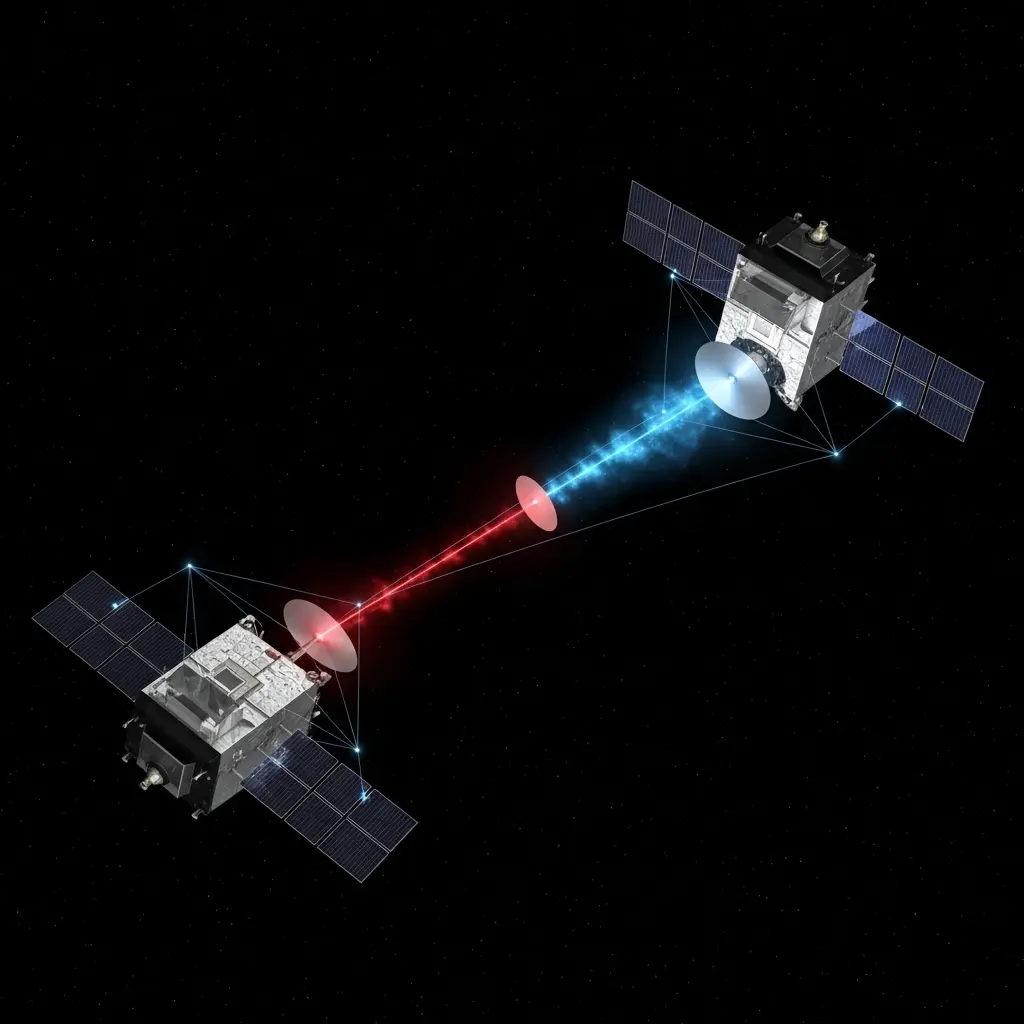
Scientists are exploring innovative methods for establishing efficient communication between CubeSats, and a new study details a promising solution using modulated retroreflectors. Makafui Avevor, Hossein Safi, and Harald Haas, all from the LiFi R&D Centre at the University of Cambridge, alongside Iman Tavakkolnia et al, present a unified model for these retroreflector-enabled optical inter-satellite links, optimising performance under realistic conditions. This research is significant because it demonstrates a pathway to drastically reduce the power consumption , down to just 2.5W , and complexity of satellite communication, potentially outperforming existing laser terminals like NASA’s OCSD and achieving comparable results to the OSIRIS4CubeSat at distances under 500km.
MRR optimisation for CubeSat optical links
Scientists have demonstrated that modulating retroreflectors (MRRs) can significantly enhance low-complexity and energy-efficient asymmetric optical inter-satellite links (OISLs) for CubeSats. In this groundbreaking study, researchers developed a unified statistical channel model for on-off keying (OOK)-modulated OISLs using MRRs. This model accounts for both stochastic and deterministic pointing losses, as well as signal-dependent noise, through Monte Carlo simulations. The team optimized the system performance under CubeSat constraints, focusing on maximizing the achievable information rate. The study unveils that an optimized MRR-based transmitter can outperform NASA’s Optical Communications and Sensors Demonstration (OCSD) terminal and achieve performance comparable to DLR’s OSIRIS4CubeSat at ranges below 500km.
This is particularly noteworthy as the proposed architecture consumes only 2.5W of power during transmission, significantly less than conventional CubeSat optical terminals which typically require more than 10W. Experiments show that MRRs can effectively reduce onboard complexity and power consumption by eliminating the need for an onboard laser transmitter and pointing, acquisition, and tracking (PAT) subsystem. The research establishes a robust framework for evaluating communication reliability through derived bit-error ratio (BER), outage probability, and achievable information rate (AIR). These metrics provide a comprehensive performance characterization of MRR-enabled OISLs under CubeSat size, weight, and power constraints. The proposed architecture opens up new possibilities for high-throughput reliable communications in CubeSat missions. By leveraging the simplicity and low power consumption of MRRs, this work paves the way for more efficient and effective optical inter-satellite links, particularly at short-to-medium ranges where conventional laser terminals face limitations due to pointing accuracy and power requirements.
Modeling the On-Off Keying Channel Performance
OISL Channel Modelling and Performance Optimisation
The research team engineered a unified statistical channel model for an on-off keying modulated retroreflector-enabled optical inter-satellite link (OISL). They employed Monte Carlo simulations to approximate stochastic channel distributions, ensuring the model captured both random and predictable pointing losses. The study also integrated signal-dependent noise into their framework, providing a comprehensive analysis of communication reliability. To optimize the system, scientists used the achievable information rate as the primary metric under various constraints. This approach enabled them to fine-tune the transmitter’s performance, balancing between range and power consumption.
They developed innovative techniques for evaluating communication reliability by deriving bit-error ratio and outage probability, which were crucial in assessing the model’s accuracy. The methodology was benchmarked against three state-of-the-art laser terminals: NASA’s Optical Communications and Sensors Demonstration (OCSD), DLR’s OSIRIS4CubeSat, and NASA’s CLICK BC. The results demonstrated that an optimized MRR-based transmitter could outperform OCSD and achieve performance comparable to OSIRIS4CubeSat at ranges below 500km, while consuming only 2.5W of power during transmission. This significant reduction in energy consumption highlights the potential for more efficient small spacecraft communication systems. The team’s approach enabled a breakthrough by providing a detailed and precise model that could be applied to real-world scenarios, paving the way for future advancements in satellite communications technology.
Modulating retroreflectors optimise CubeSat optical links
Novel MRR Architecture and Link Optimization
Scientists have developed a novel optical inter-satellite link (OISL) architecture utilising modulating retroreflectors (MRRs) for small spacecraft, achieving significant reductions in complexity and power consumption. The research team constructed a unified statistical channel model for an on-off keying modulated, retroreflector-enabled OISL, meticulously capturing both stochastic and deterministic pointing losses alongside signal-dependent noise, critical factors for reliable communication. Stochastic channel distributions were approximated through Monte Carlo simulation, enabling system optimisation under CubeSat constraints with achievable information rate serving as the primary performance metric. Furthermore, the scientists derived expressions for bit-error ratio and outage probability to comprehensively evaluate communication reliability under various conditions.
Experiments revealed that an optimised MRR-based transmitter can demonstrably outperform NASA’s Optical Communications and Sensors Demonstration (OCSD) system. Measurements confirm that the MRR system achieves performance comparable to the DLR’s OSIRIS4CubeSat at ranges below 500km, a crucial distance for many CubeSat missions, all while consuming only 2.5W of power during transmission. This represents a substantial decrease in power demand compared to conventional optical terminals, addressing a key limitation of CubeSat communication systems. The team meticulously measured the achievable data rates and signal quality, demonstrating the viability of gigabit-per-second communication using this innovative approach.
Data shows that the developed channel model accurately predicts system performance under realistic conditions, incorporating the effects of pointing errors, velocity aberration, and noise. The study benchmarked the proposed architecture against three state-of-the-art laser terminals, OCSD, OSIRIS4CubeSat, and NASA’s CLICK BC, providing a robust comparison of performance metrics. Results demonstrate that the MRR-based system offers a compelling alternative to traditional laser communication systems, particularly for CubeSats where size, weight, and power are paramount. The breakthrough delivers a pathway to significantly reduce the complexity of onboard optical terminals, eliminating the need for a laser transmitter and sophisticated pointing, acquisition, and tracking (PAT) subsystem.
Enabling Future Satellite Communication Deployments
Scientists recorded that the MRR architecture’s simplicity makes it ideally suited for rapid prototyping and deployment on CubeSat platforms, enabling more frequent technology demonstrations in low Earth orbit (LEO). The research highlights the potential for MRR-enabled OISLs to support high-throughput, reliable communication for increasingly sophisticated CubeSat missions carrying high-resolution sensors and scientific instruments. Measurements confirm the feasibility of achieving data rates exceeding those currently available with conventional RF links, which are often limited to a few kilobits per second, even with advanced Ka-band systems. This work establishes a foundation for future research into advanced modulation schemes and optimisation techniques to further enhance the performance of MRR-based OISLs.
Optimized OISL Model for CubeSat Communication enhances data
This research demonstrates the development and optimization of a unified statistical channel model for an on-off keying (OOK)-modulated, retroreflector-enabled asymmetric optical inter-satellite link (OISL) suitable for small spacecrafts. The model accounts for stochastic pointing losses, velocity aberration, and signal-dependent noise, enabling the derivation of bit-error ratio (BER), outage probability, and achievable information rate (AIR). By optimizing these metrics under CubeSat size-weight-power (SWaP) constraints, the study shows that an optimized MRR-based transmitter can outperform NASA’s Optical Communications and Sensors Demonstration (OCSD) and achieve performance comparable to DLR’s OSIRIS4CubeSat at ranges below 500km, while consuming only 2.5W of power during transmission. The findings establish a practical low-SWaP alternative for short-range asymmetric CubeSat links, offering enhanced reliability and reduced complexity compared to conventional laser terminals.
However, the round-trip geometry amplifies range dependence, with velocity aberration and aperture size emerging as key limiting factors. The authors acknowledge that while retroreflector-enabled OISLs are not a replacement for high-performance crosslink systems like NASA’s CLICK BC, they provide a complementary solution. Future research should focus on adaptive beam shaping or optical pre-compensation techniques to mitigate velocity aberration, hybrid RF, optical architectures to extend operational range, and tailored forward error correction (FEC) schemes that leverage the unique channel statistics of MRR-based links. Experimental validation through hardware prototypes and in-orbit demonstrations will be essential to assess the practicality of these systems and inform their integration into future CubeSat missions. The limitations acknowledged by the authors include the round-trip geometry’s range dependence, which could impact performance at longer distances. Nonetheless, the proposed architecture offers a promising pathway for low-complexity and energy-efficient OISLs in small spacecraft communications.
🗞 Modulating Retroreflectors for CubeSat Optical Inter Satellite Links: Modeling, Optimization, and Benchmarking
🧠 ArXiv: https://arxiv.org/abs/2601.13829