

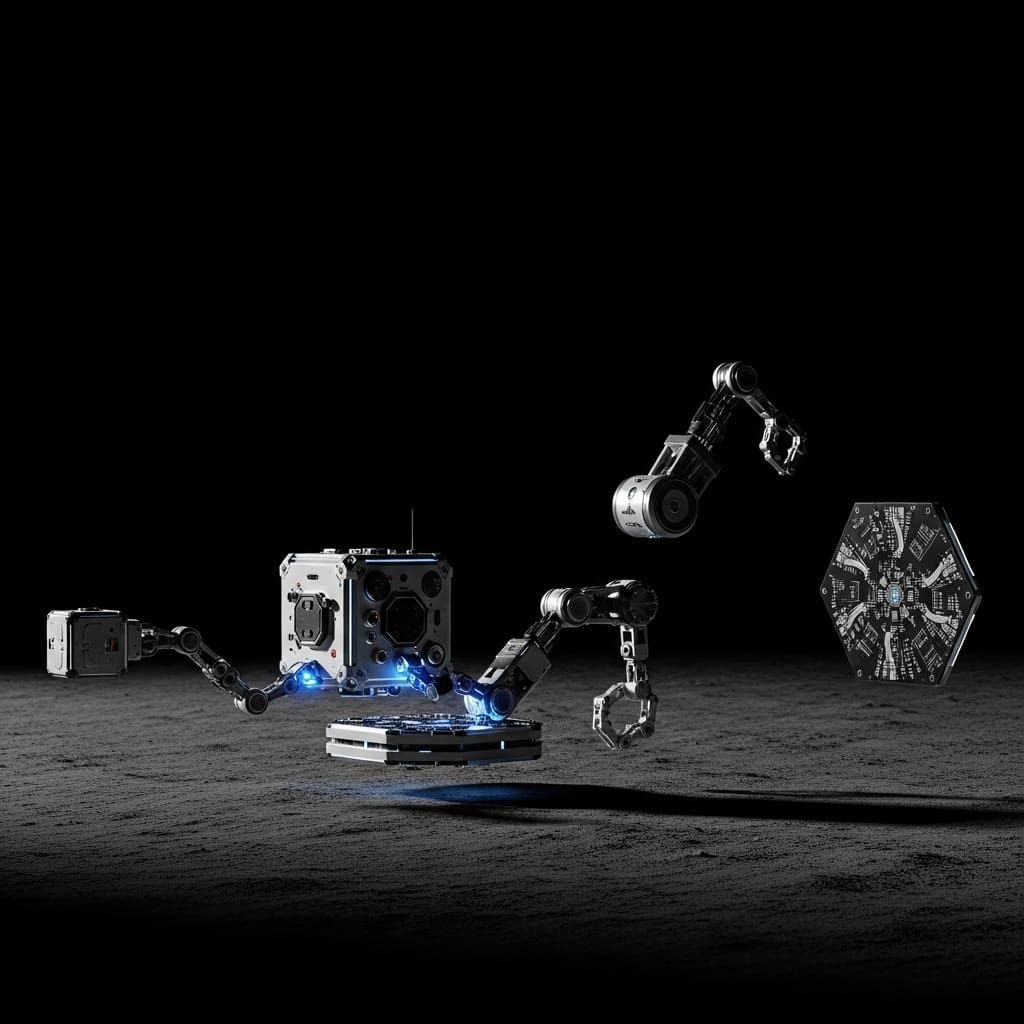
The ambition to establish a permanent human presence on the Moon drives innovation in robotic construction techniques, and a team led by Kentaro Uno, Elian Neppel, and Gustavo H Diaz from the Space Robotics Laboratory at Tohoku University, alongside Ashutosh Mishra, Shamistan Karimov, and A Sejal Jain, presents a significant step towards this goal with their development of MoonBot. This novel robot distinguishes itself through a modular and reconfigurable design, allowing it to adapt to diverse tasks and challenging lunar environments while remaining within the strict weight limitations of space travel. Researchers successfully demonstrate MoonBot’s capabilities through simulated construction operations, including infrastructure component handling and deployment, and inflatable module assistance, validating the concept of on-demand robotic reconfiguration for lunar base construction. The team’s detailed analysis of the system’s performance, particularly concerning connector design, provides crucial insights that will inform the development of future modular robots destined for space exploration.
This work was supported by Japan Science and Technology Agency’s Moonshot R and D Program. Global interest in lunar surface exploration and development is increasing, and robots are proving essential for exploring challenging terrains, utilising local resources, and constructing future human habitats. This paper introduces a new approach to lunar robotics.
Higen Connector for Modular Robots Demonstrated
Scientists have developed MoonBot, a heterogeneous modular robotic system designed for operation under the demanding mass constraints of space missions and adaptable to diverse environmental conditions. This innovative robot achieves reconfiguration on demand, maximizing functionality for establishing infrastructure in challenging terrains. The work details the design and development of MoonBot, culminating in a preliminary field demonstration that validates the core concept through simulated civil engineering tasks and assistive operations with inflatable modules.
MoonBot Demonstrates Reconfigurable Robotic Infrastructure Deployment
The robotic limb module, a key component of MoonBot, measures 1.55 meters in length and weighs 20.7 kilograms on Earth. Experiments reveal its capacity to transport objects weighing up to 2 kilograms, demonstrating its ability to handle small payloads effectively. The limb possesses seven degrees of freedom, enabling a wide range of motion, and is equipped with dual grippers for versatile object manipulation.
Power is supplied by two lithium polymer battery lines, providing untethered operation for approximately two hours. The joint actuator unit achieves a continuous maximum torque of 87.4 Nm at a rotational speed of 5.4 rpm, despite weighing only 1.35 kilograms.
Tests confirm the robust design, utilizing super duralumin and carbon-infused resin, balances lightweight construction with structural integrity. The limb’s housing is produced via stereolithography 3D printing with EPX82 epoxy-based resin, a material selected for its high tensile strength and resilience. Teleoperation of MoonBot is achieved through wireless communication via a Wi-Fi antenna, and the end-effector incorporates infrared LEDs for inter-module connection monitoring. The team recorded data from multiple sensors, including motor current sensors, Hall effect joint angle sensors, photo-reflective sensors, an Inertial Measurement Unit, and a battery level voltage gauge, providing comprehensive operational feedback. These measurements confirm the system’s ability to monitor its own performance and maintain stable operation during complex tasks.
Lunar Robotics, Modular Design and Field Tests
This research presents MoonBot, a newly developed modular and reconfigurable robot designed for operation in challenging environments and specifically suited to lunar surface tasks. The team successfully demonstrated the feasibility of this approach through field trials simulating essential infrastructure establishment, including civil engineering operations and component deployment, showcasing the robot’s ability to adapt its configuration to diverse requirements. A key achievement lies in the development of a versatile connector system, allowing for module attachment, alongside a software architecture prioritizing reliability and safety during teleoperation. The testing process yielded valuable insights into the design of modular robotic systems, particularly regarding the balance between connection stability and flexibility, and the importance of visual feedback for autonomous docking.
While current connectors exhibit lower stability than traditional designs, the team proposes improvements through the integration of visual servoing techniques. Limitations were identified in the software’s command processing, though this was mitigated by the robot’s slow speed and semi-static nature. Future work will focus on enhancing the system’s maintenance capabilities, including developing procedures for module replacement and ensuring connector detachability, with the diaphragm-type connector proving most suitable for this purpose. Further field tests are planned to investigate troubleshooting scenarios relevant to lunar conditions, and the incorporation of power transmission between modules, including a self-recharging capability via a solar power station, represents a significant step towards sustained operation. The consistently reliable performance of the software over three weeks of intensive testing underscores the effectiveness of the team’s safety-first design principles.
👉 More information
🗞 MoonBot: Modular and On-Demand Reconfigurable Robot Toward Moon Base Construction
🧠 ArXiv: https://arxiv.org/abs/2512.21853

