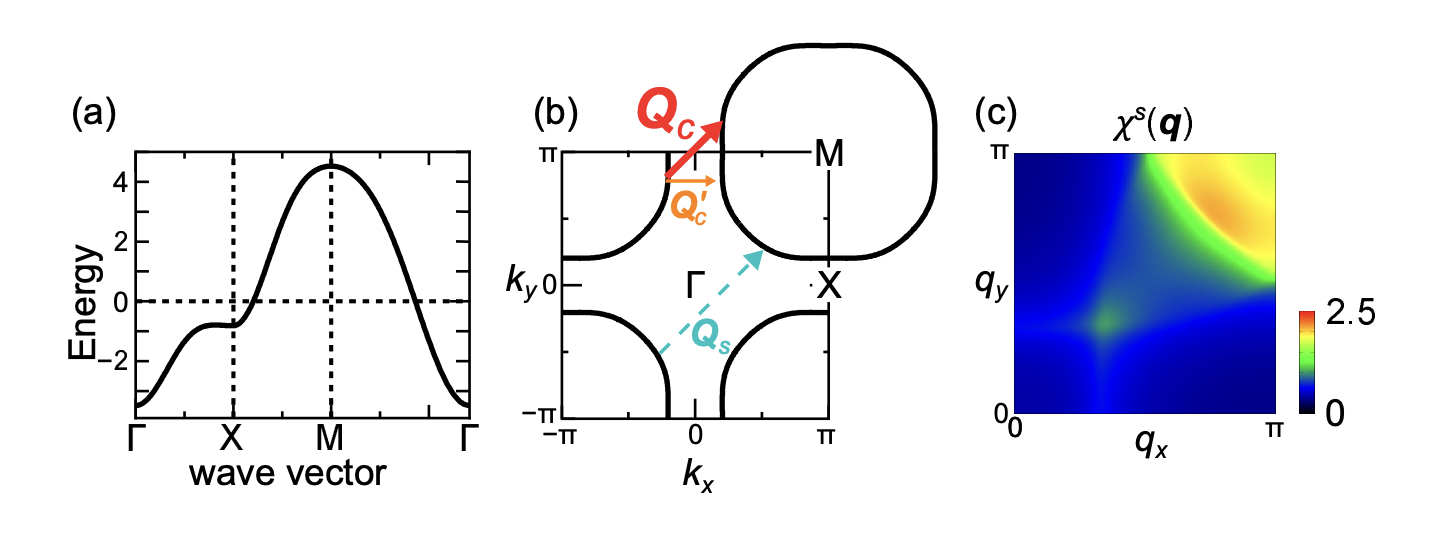
Charge ordering, a phenomenon where electrons arrange themselves in a specific pattern, increasingly appears crucial to understanding superconductivity in materials like cuprates and iron-based superconductors. Youichi Yamakawa and Hiroshi Kontani, both from the Department of Physics at Nagoya University, alongside their colleagues, now present a theoretical framework that explains how these charge orders and superconductivity intertwine. Their work focuses on the complex interactions between electrons, employing a sophisticated method to account for many-body effects often overlooked in simpler theories. The researchers demonstrate that attractive forces arising from these interactions, combined with repulsive forces from spin fluctuations, enhance superconductivity and increase the effective mass of electrons, offering a compelling explanation for the behaviour observed in cuprate superconductors near the point at which charge ordering emerges. This approach, applicable to a range of materials, promises to advance our understanding of unconventional superconductivity and guide the development of future superconducting materials.
In kagome metals, critical phenomena and unconventional superconductivity arising from fluctuations of charge-channel orders represent central issues in contemporary condensed matter physics. To address the essential role of many-body effects, this study proposes the Bethe-Salpeter equation theory to evaluate electron-electron interactions within two-dimensional Hubbard models, satisfying the criteria of the Baym-Kadanoff conserving approximation and ensuring a robust theoretical framework. The results demonstrate that an attractive interaction emerges in the charge channel, originating from the Aslamazov-Larkin vertex corrections that describe the complex interplay of electron correlations.
Self-Consistent Vertex Correction and Functional Renormalization Group
This work represents a comprehensive investigation into strongly correlated electron systems and superconductivity. Researchers employ self-consistent vertex correction (SCVC) theory, explicitly calculating the effects of electron interactions on the electronic self-energy and effective interactions, surpassing the limitations of traditional methods. Complementing this is the functional renormalization group (FRG), used to track how interactions evolve with energy scale and understand the emergence of different ordered phases. A strong emphasis is placed on ensuring that these theoretical methods conserve fundamental physical quantities like charge, momentum, and energy.
The ultimate goal is to develop a unified theoretical framework that can explain phenomena in correlated electron systems, including high-temperature superconductivity, charge density waves, and magnetism. This research encompasses several key areas and concepts, including high-temperature superconductivity in cuprates and iron-based superconductors, where researchers investigate the pairing mechanism and the role of strong electron-electron interactions. They also focus on charge density waves (CDWs) and nematicity, exploring the mechanisms driving CDW formation and the competition between these phenomena and superconductivity. The theoretical methods employed include detailed development and application of SCVC theory and FRG, ensuring conservation laws, and utilizing the Bethe-Salpeter equation to calculate electronic self-energy and effective interactions. The research considers materials like cuprates, iron-based superconductors, heavy fermion systems, nickelates, and kagome materials, with emerging themes including odd-parity superconductivity and spin-loop-current order. This collection of references represents a sophisticated effort to develop a unified theoretical understanding of strongly correlated electron systems, combining self-consistent vertex correction theory and functional renormalization group with a focus on conservation laws.
Bond Fluctuations Drive Unconventional Superconductivity
Researchers have developed a new theoretical framework, the Bethe-Salpeter equation theory, to understand the emergence of unconventional superconductivity in strongly correlated materials. This theory systematically incorporates complex many-body effects, specifically vertex corrections, and satisfies the criteria of the Baym-Kadanoff conserving approximation. The core advancement lies in accurately calculating the interaction mediated by bond-order fluctuations, a crucial step towards quantitatively understanding superconductivity and quantum critical phenomena. The team discovered that an attractive interaction emerges within the charge channel due to the interference of spin fluctuations, providing a mechanism for the formation of charge-channel orders.
Applying this theory to the square-lattice Hubbard model, representing cuprate high-temperature superconductors, researchers revealed a synergy between attractive charge fluctuations and repulsive spin fluctuations. This cooperation yields high-temperature superconductivity, characterized by d-wave symmetry, alongside an enhanced effective mass of charge carriers, aligning with experimental observations. Notably, the calculations demonstrate that near the quantum critical point of d-wave bond order, the interplay of these fluctuations is maximized, leading to strong-coupling superconductivity. This framework not only explains the high transition temperatures and upper critical fields observed in cuprates but also accounts for the large effective mass of charge carriers near the quantum critical point, providing a comprehensive understanding of the electronic state in these complex materials. This framework extends beyond cuprates, offering potential insights into iron-based and nickelate superconductors.
Charge Ordering Enhances Electron Pairing Interactions
This research presents a theoretical study of strong-correlation effects in materials, focusing on how interactions between electrons contribute to superconductivity. The team developed the Bethe-Salpeter equation theory to accurately calculate the effective interactions between electrons, going beyond simpler approximations. This method accounts for complex many-body effects, specifically how fluctuations in charge ordering influence electron pairing. The calculations reveal that attractive interactions emerge in the charge channel due to the interference of spin fluctuations, and these interactions cooperate with repulsive spin fluctuations to enhance superconductivity.
Applying this theory to a model system, the researchers demonstrate that both the superconducting transition temperature and the upper critical field are significantly increased near a charge-ordering quantum critical point, providing a microscopic explanation consistent with observations in cuprate superconductors. The theory is also applicable to other materials, including iron-based and nickelate superconductors. The authors acknowledge limitations in their current calculations and propose extending the calculations to include a full summation over internal frequencies as a future task, which would enable more quantitative studies at lower temperatures. Future research directions also include exploring the effects of bilayer Fermi-surface splitting and applying the theory to multi-orbital systems like iron-based superconductors.
🗞 Theory of superconductivity and mass enhancement near CDW critical point based on Bethe-Salpeter equation method: application to cuprates
🧠 ArXiv: https://arxiv.org/abs/2508.19536