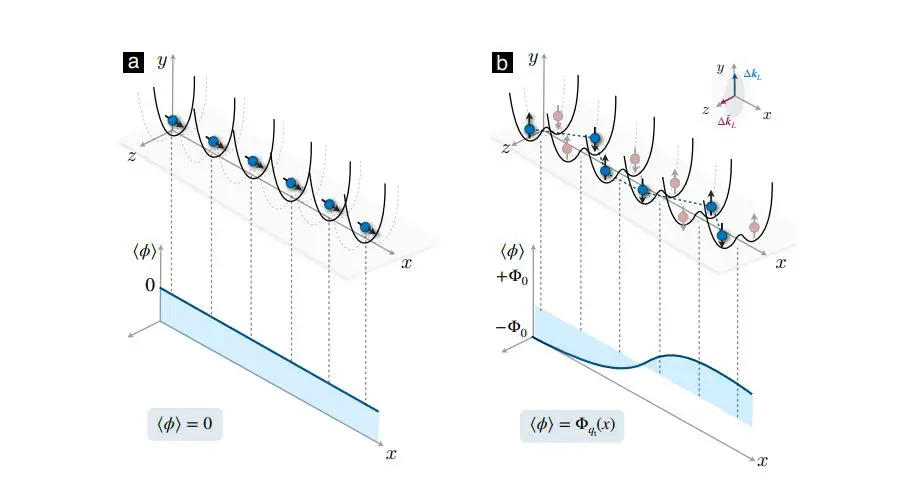
The fundamental nature of charge continues to fascinate physicists, and recent work explores the possibility of observing fractional charges in a controlled laboratory setting. Alan Kahan, Pablo Viñas, and Torsten V. Zache, along with Alejandro Bermudez, investigate this phenomenon using a novel trapped-ion system designed to mimic a complex theoretical model known as Jackiw-Rebbi field theory. Their research demonstrates how to create and observe collisions between excitations carrying fractional charges, representing a significant step towards understanding the behaviour of these exotic particles. By carefully controlling the interactions within the trapped-ion system, the team predicts experimentally verifiable signatures of fractional charge dynamics, potentially opening new avenues for exploring fundamental physics and quantum materials.
The research adopts a coarse-grained description of planar zigzag ion displacements in the vicinity of a structural phase transition as the scalar field. Internal electronic states of the ions encode spins with interactions mediated by transverse phonons and in-plane pin-phonon couplings exhibiting a zigzag pattern, which together correspond to a Yukawa-coupled Dirac field. Rather than assuming a fixed soliton background, the study investigates the effect of back-reaction and quantum fluctuations.
Trapped Ions For Many-Body Quantum Simulation
This extensive list of references details research into quantum simulation, trapped ions, many-body physics, and related fields like disordered systems and nonlinear dynamics. The compilation highlights key themes including the manipulation and control of ions for quantum computation, the study of interacting many-body systems, and the investigation of disorder’s effects on quantum systems. References also cover nonlinear dynamics, solitons, quantum phase transitions, and theoretical methods used to model these complex systems. The collection demonstrates a strong focus on theoretical approaches such as Fokker-Planck equations and variational principles, alongside computational techniques for understanding these systems.
Research areas include quantum optics, laser cooling, and the development of quantum information and computation techniques using trapped ions. The bibliography also encompasses studies of thermalization, ergodicity, and the dynamics of interacting particles. The references can be broadly categorized into experimental work with trapped ions, theoretical studies of many-body physics, theoretical methods and techniques, and research into quantum information and computation. A significant portion of the collection focuses on recent publications, indicating an active and rapidly evolving field. The interdisciplinary nature of the research is apparent, drawing from quantum optics, condensed matter physics, quantum information theory, and nonlinear dynamics. The emphasis on disorder reflects a growing interest in many-body localization and related phenomena, while the inclusion of computational methods suggests a reliance on modeling and analysis.
Fermionic Back-Reaction Localises Topological Kinks
Scientists have achieved a breakthrough in understanding strongly-coupled quantum field theories by utilising trapped ions as a quantum simulator. The research focuses on the Jackiw-Rebbi model, a foundational theory where solitonic excitations bind to fermions, potentially creating particles with fractional charge. The team successfully modeled this complex system, moving beyond the traditional approximation of fixed solitons and instead investigating the effects of back-reaction and quantum fluctuations on the coupled fermion-boson dynamics. Results demonstrate that fermionic back-reaction can lead to the localisation of topological kinks, influencing their stability and behaviour.
The study employed a truncated Wigner approximation combined with fermionic Gaussian states to capture the quantum spreading and scattering of these kinks and anti-kinks. Measurements confirm that back-reaction and fluctuations significantly modify the stability and real-time evolution of the fractionalised fermions bound to the solitons. Specifically, the team observed the diffusion and localisation of fractional charge, and measured the drag experienced by the charge as the soliton moves. Experiments revealed that collisions between half-charged fermions on soliton-antisoliton configurations are smeared by quantum fluctuations, altering the classical collisional dynamics.
Furthermore, the research provides quantitative insights into the behaviour of these exotic particles. The team demonstrated the existence of localised excitations carrying fractional charges, predicting a spectrum of excitations with charges of qf ∈ 1/2(2Z+1). These findings are experimentally accessible using current trapped-ion architectures, opening new avenues for exploring fundamental physics and potentially observing particles with fractional charge in a controlled quantum environment. The work represents a significant step towards simulating complex quantum field theories and understanding the emergent properties of strongly-correlated quantum systems.
Fermionic Back-Reaction Localises Topological Kinks
This research presents a novel investigation into the dynamics of fractionally charged fermions bound to topological solitons, utilising a trapped-ion system as a quantum simulator. Scientists successfully model the Jackiw-Rebbi model, a fundamental framework in quantum field theory, demonstrating how solitonic excitations can bind to fermions and produce fractional charges. The team moved beyond traditional approximations by examining the back-reaction of the fermions on the soliton itself, and incorporating quantum fluctuations into the system’s evolution. The results reveal that fermionic back-reaction can localise topological kinks, and that the combined system exhibits complex behaviour including the spreading and scattering of these kinks. Through this work, scientists predict experimentally accessible signatures of these phenomena within current trapped-ion architectures, offering a pathway to observe and study fractional charges in a controlled quantum environment.
🗞 Real-time collisions of fractional charges in a trapped-ion Jackiw-Rebbi field theory
🧠 ArXiv: https://arxiv.org/abs/2512.07748