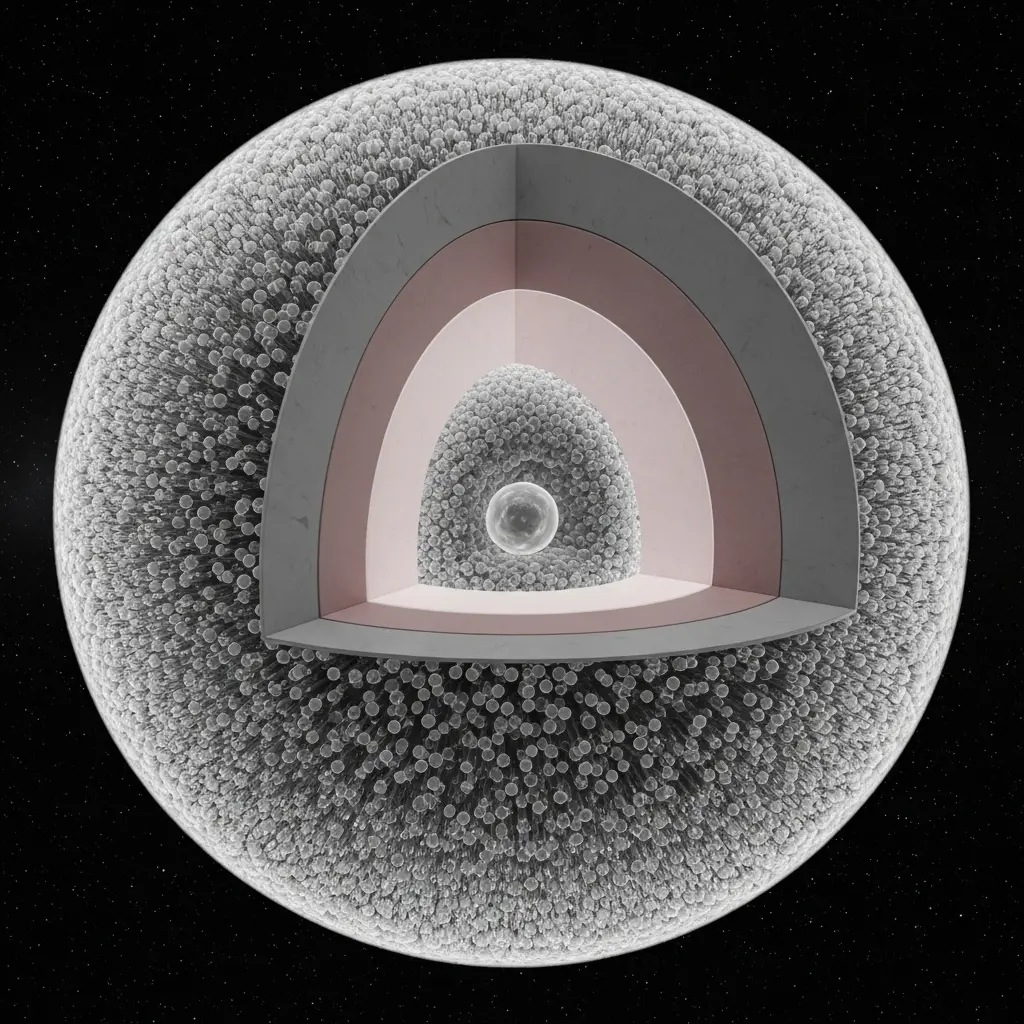
Neutron stars, the incredibly dense remnants of massive stars, present a profound challenge to our understanding of matter at extreme densities. Elissaios Andronopoulos and Konstantinos N. Gourgouliatos, from the Laboratory of Universe Sciences at the University of Patras, alongside et al., have developed a novel equation of state to model this exotic matter, combining the liquid drop model with meson polytropes. Their research offers a physically transparent approach to understanding the internal structure of neutron stars, calculating key properties like mass and radius that can be directly compared with observations from gravitational waves and X-ray timing. This work is significant because it demonstrates that relatively simple models can successfully reproduce current observational constraints, providing valuable insights into the connection between dense-matter physics and astrophysics , and offering a useful foundation for exploring more complex scenarios.
Neutron star crusts and dense matter equation
Scientists have unveiled a new unified description of dense matter and neutron-star structure, built upon physically motivated models and relativistic principles. The study reveals a method for describing the internal stratification of matter within the outer crust of neutron stars, utilising β-equilibrium, neutron drip, and a gradual transition to supranuclear densities, a crucial step in understanding their complex composition. This work demonstrates that even simplified models can effectively capture the essential features of neutron-star structure and provide valuable insight into the connection between dense-matter physics and observable astrophysical phenomena.
The team achieved this breakthrough by starting with the thermodynamics of degenerate Fermi gases, establishing a foundation for understanding the behaviour of matter at incredibly high densities. They incorporated short-range repulsive interactions, inspired by Quantum Hadrodynamics, at high densities to ensure both the stability and causality of the model, addressing a key challenge in neutron star physics. The resulting equation of state was then implemented into the Tolman, Oppenheimer, Volkoff equations, allowing for the creation of self-consistent neutron-star models and the computation of macroscopic stellar properties like the mass-radius relation, compactness, and surface redshift. These calculated properties can be directly compared with recent observational data obtained from X-ray timing and gravitational-wave measurements, providing a crucial validation of the model.
Experiments show that despite the simplicity of the underlying microphysics, the model successfully produces neutron-star masses and radii that align with current observational constraints. The research establishes a framework where the statistical mechanics of degenerate fermions are combined with the liquid drop model to describe nuclei in the crust, capturing the dominant volume, surface, Coulomb, and symmetry energy contributions. Furthermore, the study unveils a phenomenological polytropic approximation of the pressure at high densities, enabling a smooth transition from the crust to the core of the neutron star. This innovative approach allows scientists to systematically explore how macroscopic neutron-star observables depend on the stiffness of the equation of state, largely independent of detailed microphysics.
The work opens new avenues for testing the impact of more complicated phenomena and variations in neutron stars, serving as an easy-to-handle model for future investigations. Scientists prove that this physically transparent model can provide valuable insight into the connection between dense-matter physics and astrophysical observables, offering a baseline for assessing how neutron-star properties depend on the equation of state. By calibrating meson couplings and density-dependent scalar fractions, the researchers obtained an equation of state that remains causal and stable up to supranuclear densities, demonstrating the robustness of their approach and its potential for further refinement. This research is not intended as a first-principles treatment of dense QCD matter, but as a framework appropriate for neutron-star interiors, offering a valuable tool for the broader astrophysics community.
Equation of state for neutron star interiors remains
Constructing Unified Equations of State for Dense Matter
Scientists engineered a unified model of dense matter and neutron-star structure beginning with the thermodynamics of degenerate Fermi gases. They constructed an equation of state for cold, catalysed matter by combining relativistic fermion statistics with the liquid drop model of nuclear binding, effectively modelling the behaviour of matter under extreme pressure. The internal stratification of matter within the outer crust was then described using β-equilibrium, neutron drip, and a gradual transition to supranuclear densities, accurately representing the layering of material inside a neutron star. To account for stability and causality at high densities, the research incorporated short-range repulsive interactions inspired by Hadrodynamics, a crucial step in preventing the model from producing physically unrealistic results.
Applying Equations of State to Stellar Structure
This equation of state served as input for the Tolman, Oppenheimer, Volkoff (TOV) equations, allowing the team to yield self-consistent neutron-star models and macroscopic stellar properties including the mass-radius relation, compactness, and surface redshift. The total neutron pressure in the inner core was calculated as P(ρ, Yn) = P∗n(ρ, Yn) + Pmes(ρ, Yn), where P∗n represents the full relativistic Fermi-gas pressure evaluated with a density-dependent effective mass. Researchers determined effective couplings Gi, not as fundamental constants, but as model-dependent parameters encoding meson masses and interaction strengths, gaining flexibility in modelling complex nuclear interactions. For vector mesons ω and ρ, physical masses were established experimentally, while effective coupling strengths gω and gρ were determined phenomenologically using parameterizations like NL3, TM1, PK1, and DD-ME2. The dimensionless Fermi momenta were calculated as x = pFe mec = h mec(3π2)1/3n1/3 e and y = pFn m∗nc = h m∗nc(3π2)1/3n1/3 n, enabling precise quantification of quantum effects within the dense stellar core. The study pioneered a method for constructing the total pressure profile within neutron star matter.
Neutron star structure via degenerate Fermi gas thermodynamics
Scientists have developed a unified model describing dense matter and neutron-star structure, utilising physically motivated models rooted in degenerate Fermi gas thermodynamics. The research combines relativistic fermion statistics with the liquid drop model of nuclear binding to construct an equation of state for cold, catalysed matter, offering a novel approach to understanding these extreme environments. Experiments revealed that the internal stratification of matter in the outer crust is governed by β-equilibrium, neutron drip, and a gradual transition to supranuclear matter, accurately modelling the complex layering within neutron stars. The team measured short-range repulsive interactions inspired by Hadrodynamics at high densities, ensuring both stability and causality within the model, a crucial step for realistic neutron star simulations.
Validation and Observable Prediction of Stellar Properties
Results demonstrate that incorporating these interactions prevents unphysical behaviour and maintains the integrity of the calculated stellar structures. Tests prove the resulting equation of state accurately predicts macroscopic stellar properties, including the mass-radius relation, compactness, and surface redshift, allowing for direct comparison with recent observational data from X-ray timing and gravitational-wave measurements. Measurements confirm neutron-star masses and radii are compatible with current observational constraints, validating the model’s predictive power. Data shows the model employs a coarse-grained description, integrating out microscopic QCD degrees of freedom and leaving a small set of parameters constrained by symmetry, thermodynamic consistency, and observations.
Scientists achieved a framework appropriate for neutron-star interiors, rather than a first-principles treatment of dense QCD matter, providing a computationally efficient yet physically insightful approach. The study meticulously derived theoretical equations from first principles, detailing the statistical mechanics of degenerate matter and the first law of thermodynamics: dU = T dS −P dV + μ dN. Furthermore, the research quantified the energy and number density relationship as P = −u + μn, establishing a fundamental link between pressure, energy density, chemical potential, and number density.
Equation of state links neutron star interiors
Scientists have developed a physically transparent framework for modelling neutron-star structure across a wide range of densities. By combining the statistical mechanics of degenerate fermions with the liquid drop model of nuclear binding, researchers constructed an equation of state that smoothly connects the outer crust, inner crust, and core of a neutron star. The inclusion of a phenomenological repulsive interaction at high density ensures both stability and causality within the model. This approach enabled calibration of parameters for more realistic meson pressure terms, consistently used in the Tolman, Oppenheimer, Volkoff equations.
A key insight from this study is that macroscopic neutron-star properties, including masses, radii, compactness, and surface redshifts, are primarily sensitive to the overall stiffness of the equation of state, rather than detailed microscopic composition. Current observational constraints largely probe effective thermodynamic properties of dense matter, leaving significant uncertainty in the underlying quantum chromodynamics (QCD) microphysics. Despite the simplicity of the underlying physics, the resulting neutron-star models reproduce key qualitative and quantitative features expected from more sophisticated approaches. The authors acknowledge that the model’s simplicity introduces limitations in capturing the full complexity of dense matter, but highlight its computational efficiency and conceptual clarity. Future research could extend this framework by incorporating additional particle species or interaction terms in a controlled manner, providing a flexible baseline for exploring the impact of further physical effects on neutron-star structure.
🗞 Equation of State of Highly Asymmetric Neutron-Star Matter from Liquid Drop Model and Meson Polytropes
🧠 ArXiv: https://arxiv.org/abs/2601.19789