Understanding how light interacts with collections of nanoscale metallic particles is crucial for developing advanced optical technologies, and a team led by Xin Zheng and Christos Mystilidis, both from KU Leuven, now presents a new approach to modelling this complex behaviour. Their work, which also includes contributions from Christos Tserkezis of the University of Southern Denmark and Guy A. E. Vandenbosch and Xuezhi Zheng of KU Leuven, details a method for predicting how light scatters from groups of these particles, even when each particle has multiple layers of different materials. This new technique accurately captures the subtle quantum effects governing electron behaviour within the metal, offering a significant improvement over existing models and paving the way for designing more efficient and responsive optical devices, as demonstrated through successful comparisons with established computational methods and physical configurations. The research provides a powerful tool for investigating and optimising the optical properties of plasmonic structures, with potential applications in sensing, imaging, and energy harvesting.
Nonlocal Plasmonics and Quantum Nanophotonics
This collection of research focuses on understanding how light interacts with metallic nanostructures, particularly when those structures are incredibly small. The work addresses limitations in traditional electromagnetic modeling by recognizing that the behavior of electrons within metals at the nanoscale deviates from classical predictions. Researchers emphasize the importance of accounting for ‘nonlocal’ effects, which arise from the finite size of electrons and their interactions, and incorporating quantum mechanical corrections to accurately model light-matter interactions. A central theme is the need to move beyond simple models and incorporate more realistic descriptions of electron behavior.
Several studies utilize hydrodynamic models to capture nonlocal effects and improve the accuracy of simulations. The research also explores the optical properties of complex structures, including metal-dielectric composites and arrangements of nanospheres, and investigates how plasmons, collective oscillations of electrons, interact with quantum emitters like molecules and quantum dots. This is crucial for applications in sensing, spectroscopy, and light harvesting.
Nanosphere Scattering via S-matrix Calculations
Scientists have developed a new computational method to model how light scatters from collections of plasmonic nanospheres, even those with multiple internal layers. This approach overcomes limitations in traditional modeling by accurately describing electron behavior within metals at the nanoscale. The method calculates an ‘S-matrix’ for each nanosphere, detailing how light interacts with its surface and internal layers, and then combines these calculations to understand the collective behavior of multiple spheres. To accurately represent metallic behavior, researchers implemented three distinct models describing free electrons: the nonlocal hydrodynamic Drude model, its diffusive variant, and the generalized nonlocal optical response model.
To validate the new method, scientists compared its results with an independent boundary element method solver, using a nanosphere containing two smaller embedded spheres as a test case. The method demonstrated strong agreement regarding predicted frequency shifts and field enhancements, confirming its accuracy and reliability. This advancement enables precise modeling of light-matter interactions at the nanoscale, paving the way for progress in single-molecule sensing and nanoscale optical circuits.
Spherical Interface Light Scattering via S-matrix Calculation
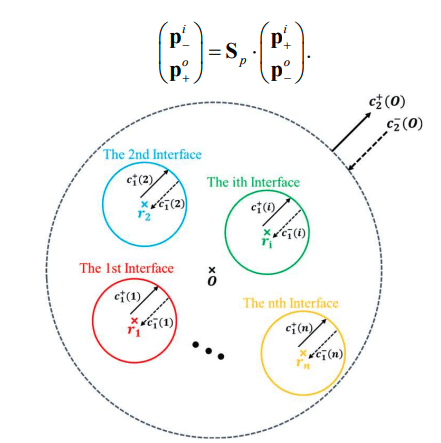
Scientists have developed a new computational method for modeling how light interacts with complex arrangements of metallic nanoparticles, even those with multiple internal layers. This breakthrough allows for detailed investigation of light scattering from structures containing numerous spherical interfaces. The core of the method lies in calculating an “S-matrix” for each spherical interface, which describes how light waves are reflected and transmitted. By applying the translation addition theorem, the algorithm accounts for interactions between multiple interfaces within the same or different spheres.
Validation tests demonstrate excellent agreement between the new method and an in-house boundary element method solver when applied to a sphere containing two smaller embedded spheres. Further physical checks, using a sodium trimer configuration, confirm that the results align with previously reported physical findings for all three material models. This advancement promises to accelerate the design and optimization of nanophotonic devices and materials with tailored optical properties.
Plasmonic Scattering Algorithm Validated by Comparison
This work presents a new algorithm for modelling the scattering of light by multiple plasmonic nanospheres, each potentially containing multiple layers of different materials. The method accurately accounts for non-classical electromagnetic effects, moving beyond the simpler models typically used in this field. The algorithm was validated by comparing its results against an independent boundary element method solver and through physical checks using a specific nanostructure configuration. Good agreement was found in both the predicted absorption spectra and the mapping of near-field electromagnetic intensity. Researchers demonstrate that incorporating more sophisticated models leads to a reduction in predicted field enhancements compared to simpler approaches, and also removes unrealistic concentrations of charge at the boundaries of the nanospheres. This method provides a generalized platform for studying non-classical optical responses from multiple plasmonic spheres and contributes to the growing field of mesoscopic electrodynamics.
👉 More information
🗞 An S-matrix Formalism for the Nonclassical Optical Response of Plasmonic Sphere Aggregates
🧠 ArXiv: https://arxiv.org/abs/2509.04589