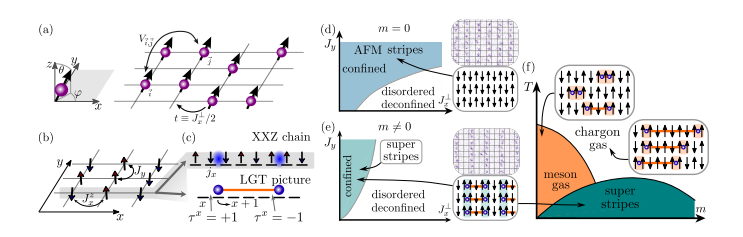
Confinement, the phenomenon where particles bind together, represents a fundamental challenge spanning both high-energy and condensed matter physics, and scientists are now exploring this behaviour using novel platforms. Matjaž Kebrič, Lin Su, and Alexander Douglas, alongside their colleagues, investigate confinement transitions within lattice gauge theories, employing a system of dipolar atoms to model these interactions beyond traditional one-dimensional constraints. Their work reveals the formation of striped phases composed of charged particles, which subsequently melt under increased temperature or particle movement, and demonstrates a pathway to observe these transitions experimentally using erbium atoms in a gas microscope. This research not only predicts a confined meson gas at finite temperature, exhibiting spontaneous spin order, but also establishes a powerful platform for studying confinement in complex many-body systems, including long-range interactions, and opens exciting new avenues for exploring fundamental questions about the nature of matter.
Cold Atoms Simulate Gauge Theory Physics
This body of work represents a comprehensive exploration of quantum simulation, particularly focusing on cold atom systems and the simulation of gauge theories. Research consistently demonstrates the ability to model fundamental interactions and emergent phenomena using these precisely controlled quantum systems, spanning theoretical development and experimental realization to understand confinement, deconfined phases, and the emergence of gauge fields. The foundation of many simulations lies in the precise control offered by cold atom experiments, allowing for the creation of quantum gases, manipulation with optical lattices, and single-atom resolution imaging. A significant portion of the theoretical work relies on tensor network methods, powerful algorithms used to simulate the behavior of many interacting quantum particles.
Advancements in these techniques are enabling researchers to handle symmetry, mixed states, and the dynamic evolution of quantum systems, exploring the behavior of interacting quantum particles in confined geometries and discovering emergent phenomena like Mott insulators, superconductivity, and topological phases. There is a growing interest in simulating the time evolution of quantum systems, crucial for understanding many-body phenomena and exploring non-equilibrium states. Research consistently demonstrates growing sophistication in the field, moving beyond simply demonstrating the simulation of gauge theories to exploring more complex phenomena like string breaking, confinement transitions, and non-equilibrium dynamics. Tensor networks remain the primary tool for theoretical simulations, with ongoing development to improve their accuracy and efficiency. Rydberg atoms are increasingly used for quantum simulation due to their strong interactions and potential for creating highly controllable systems, with a clear push towards simulating higher-dimensional systems and focusing on real-time dynamics crucial for understanding many-body phenomena.
Erbium Atoms Probe Lattice Gauge Theory Phases
Scientists pioneered a novel approach to study confinement by constructing a unique experimental platform based on erbium atoms and a gas microscope, allowing for the observation of coupled chains of lattice gauge theories interacting with matter fields, effectively mapping onto a mixed-dimensional XXZ model. Researchers performed large-scale numerical calculations using matrix-product states to determine the phase diagram of this model, revealing the emergence of striped phases formed by charges capable of melting either by increasing temperature or by adjusting the tunneling rate between chains. To experimentally verify these theoretical predictions, the team utilized their gas microscope to observe the predicted melting of a stripe phase by systematically increasing the tunneling rate of erbium atoms. They meticulously analyzed the spatial distribution of these atoms, constructing histograms to map the lengths of strings and anti-strings, representing the connections between charges.
For low tunneling rates, the histograms peaked at a specific separation, indicating a super-stripe phase with a periodic arrangement of charges. At higher tunneling rates, a dramatic shift occurred, with the histograms peaking at a different separation, signifying a transition to a deconfined chargon gas where charges move freely. Researchers further investigated the system at intermediate tunneling rates, observing qualitative differences in the spatial correlations between neighboring particles, interpreted as evidence for a confined meson gas. These experimental findings are supported by numerical simulations using matrix-product states, demonstrating strong agreement between theory and experiment.
MixD Model Reveals Confinement and Stripe Phases
Scientists have achieved a significant breakthrough in understanding confinement by creating a novel quantum simulation platform. This work demonstrates the ability to study confinement in systems coupled to matter fields, extending beyond traditional one-dimensional models to include long-range interactions. The team constructed a system of coupled chains using erbium atoms trapped in an optical lattice, effectively realizing a mixed-dimensional (mixD) XXZ model and mapping this to a lattice gauge theory. Experiments revealed the emergence of distinct phases, including confined stripe phases and a deconfined chargon gas.
Specifically, measurements confirmed the existence of super-stripe order at non-zero magnetization, where Z2 charges form extended line-like objects, closely resembling spin-charge stripes observed in other complex materials. Further exploration at varying temperatures and tunneling rates demonstrated the melting of these stripe phases, providing direct observation of the transition between confined and deconfined states. To complement the experimental findings, the team performed large-scale numerical calculations using matrix-product states, predicting an antiferromagnetic stripe order at zero magnetization destroyed by quantum fluctuations as Z2 charge excitations proliferate. Importantly, the theoretical work also predicted the existence of a meson gas at finite temperature, where dynamical Z2 charges are confined into mesons and commensurate magnetism emerges. Measurements of the system’s phase diagram show that strong inter-chain coupling leads to confinement, with the density of spin domain walls corresponding to a finite density of Z2-charged matter.
Striped Phases and Confinement Transitions Observed
This research demonstrates a novel platform for studying confinement using coupled chains of lattice gauge theories and matter fields. Scientists successfully mapped this complex system to a mixed-dimensional XXZ model, enabling detailed investigation through large-scale numerical calculations and experiments with erbium atoms in a quantum gas microscope. The team observed the formation of striped phases and demonstrated the melting of these stripes by increasing particle mobility, directly corresponding to a confinement-deconfinement transition. Further theoretical work predicted and numerically confirmed the existence of a confined meson gas at low temperatures and magnetization, where thermal fluctuations destroy the stripes but allow for spontaneous ordering. This disordered regime corresponds to a deconfined phase in the lattice gauge theory, revealing a transition from bound particle pairs to free particles.
🗞 Exploring confinement transitions in lattice gauge theories with dipolar atoms beyond one dimension
🧠 ArXiv: https://arxiv.org/abs/2509.16200