

Designing metasurfaces, nanoscale structures that manipulate light, traditionally demands extensive and computationally expensive simulations, hindering the creation of complex designs. Huanshu Zhang, Lei Kang, and Sawyer D. Campbell, from The Pennsylvania State University, along with Douglas H. Werner, present a new approach that leverages the power of large language models to overcome this limitation. Their work demonstrates that these models, typically used for natural language processing, can learn the relationship between a metasurface’s shape and its optical properties, enabling rapid design and prediction of performance. This “chat-to-chip” workflow bypasses the need for task-specific neural networks and laborious training, offering a significantly more user-friendly and efficient method for designing arbitrarily shaped nanophotonic devices and representing a substantial advance in data-driven nanophotonics.
LLM Inverse Design Surpasses Tandem Networks
This study details results comparing a large language model (LLM)-based inverse designer to a traditional tandem network approach for designing metamaterials. The LLM consistently generates a wider range of possible designs than the tandem network, potentially leading to more innovative and optimized solutions. Unlike the tandem network, which often limits design flexibility, the LLM avoids this clamping effect, generating more varied designs. This preservation of geometric degrees of freedom allows for a broader range of possibilities, resulting in a favorable trade-off between design fidelity and solution diversity. Quantitative analysis demonstrates that the LLM consistently achieves lower error rates, indicating better performance in matching desired spectral responses. In essence, the LLM explores a wider range of possible solutions, potentially leading to more creative and optimized designs.
LLMs Accelerate Metasurface Inverse Design
Researchers addressed a significant bottleneck in metasurface design by pioneering a new approach leveraging large language models (LLMs). Traditional methods rely on full-wave electromagnetic solvers, demanding extensive computational resources and time. This work circumvents these limitations by employing LLMs, pre-trained on vast datasets, to predict the optical response of metasurfaces and facilitate inverse design. The team demonstrated that LLMs require minimal architectural redesign for new optical functions, eliminating the laborious process of network topology selection and hyper-parameter optimization. The study involved fine-tuning LLMs on datasets pairing descriptions of metasurface unit cells with their corresponding simulated optical responses, enabling the LLMs to learn the mapping between geometry and optical behavior without extensive feature engineering. After fine-tuning, the LLMs accurately predicted spectra within seconds, significantly accelerating the design process and lowering the entry barrier for researchers lacking extensive machine-learning expertise.
LLMs Predict Metasurface Optical Properties Rapidly
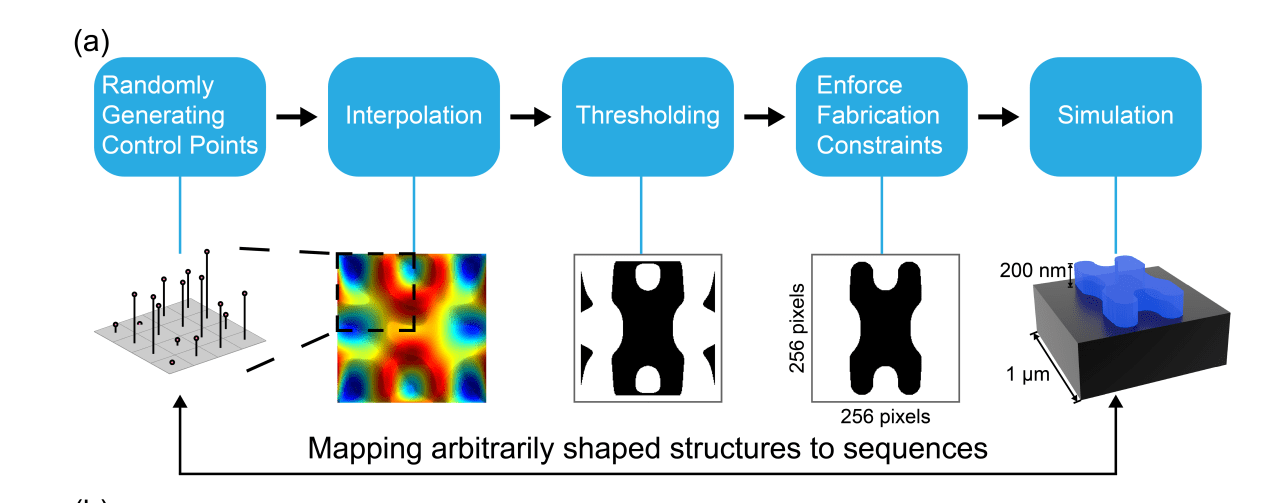
This work demonstrates a breakthrough in metasurface design, leveraging the power of large language models (LLMs) to rapidly predict and generate optical properties of nanostructures. Researchers successfully trained LLMs to understand the relationship between the geometry of a metasurface and its resulting transmission spectrum, eliminating the need for computationally expensive full-wave simulations. The core of the method involves converting a grid of control points, defining the metasurface shape, into a prompt, and then training the LLM to predict the corresponding transmission spectrum. The team generated a comprehensive dataset of unique metasurface designs, each created with randomly generated control-point grids and simulated using commercial software. The researchers implemented a parameter-efficient approach, injecting low-rank adapters into the LLM, minimizing computational demands and enabling training with commonly available hardware. The resulting system can predict the optical response of a metasurface within seconds, representing a significant acceleration compared to traditional simulation methods.
Chat-to-chip Design with Language Models
This work demonstrates a new approach to designing metasurfaces, achieving both forward and inverse design through the application of large language models. Researchers successfully trained these models to predict the spectral response of nanostructures and, crucially, to generate the physical geometries needed to achieve desired spectral characteristics. This “chat-to-chip” workflow bypasses the need for computationally expensive simulations and specialized machine learning expertise, offering a faster and more accessible design process. Systematic benchmarking across several open-weight language models quantified performance and established a clear reference for future studies. While acknowledging the limitations of current models, the team highlights the potential for this approach to enable automated exploration of increasingly complex metasurfaces and multifunctional electromagnetic devices.
👉 More information
🗞 Chat to Chip: Large Language Model Based Design of Arbitrarily Shaped Metasurfaces
🧠 ArXiv: https://arxiv.org/abs/2509.24196