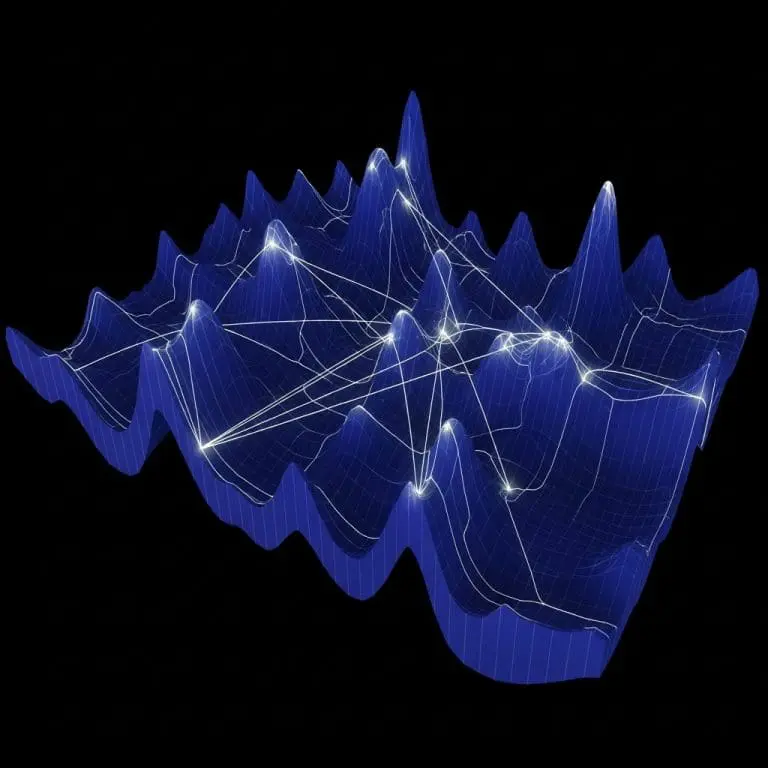
Scientists are increasingly using state-space models to decipher the complex evolution of brain activity, but current methods often treat brain regions as isolated entities. Tingting Dan, Jiaqi Ding, and Guorong Wu, all from the Departments of Psychiatry and Computer Science at the University of North Carolina at Chapel Hill, alongside et al present a novel approach called GeoDynamics that moves beyond this limitation. Their research introduces a geometric state-space neural network capable of tracking brain-state trajectories directly on the natural, curved surface of brain functional connectivity, a significant step towards modelling the brain as a truly integrated dynamical system. By accurately capturing these trajectories, GeoDynamics not only reveals how brain states change with tasks but also demonstrates potential for early detection of neurological disorders like Alzheimer’s, Parkinson’s, and autism, and even extends to broader applications in spatiotemporal data analysis.
The study establishes a novel method for modelling brain dynamics by integrating state space models with manifold learning, offering a holistic view of how brain function emerges from complex interactions. GeoDynamics learns intrinsic functional connectivity feature representations directly on the SPD manifold, considering whole-brain wiring patterns by treating each functional connectivity matrix as a manifold instance. This approach moves beyond traditional sliding window techniques, which can be sensitive to window size and hinder the detection of subtle brain state changes, by leveraging the power of recurrent neural networks and the mathematical insight of state space models.
Experiments show the model effectively captures temporal dynamics through two core ordinary differential equations, the state and observation equations, describing the relationship between input signals and system output mediated by latent brain states. This validation confirms the model’s ability to handle complex spatiotemporal dynamics across diverse domains, suggesting its potential for broader applications beyond brain imaging. By directly modelling brain dynamics on the SPD manifold, GeoDynamics provides a more accurate and comprehensive representation of brain function than previous methods, opening new possibilities for investigating the neural basis of cognition and behaviour.
Manifold-Aware Recurrent Modelling of Brain Dynamics reveals underlying
This innovative approach addresses limitations in existing methods that treat the brain as loosely connected regions or impose oversimplified priors, instead aiming for a holistic, self-organized dynamical system perspective. Experiments employed functional neuroimaging data where brain activity is tracked via BOLD signals, often complicated by noise and fluctuations, traditional neural mass models often ignore crucial spatial dependencies. Researchers bypassed the limitations of sliding window techniques, which are sensitive to window size and can miss subtle brain state changes, by harnessing the power of recurrent neural networks (RNNs), specifically long short-term memory (LSTM) and gated recurrent units (GRU). The study pioneered the use of SSMs, which model temporal dependencies in sequential data using hidden variables or “states” denoted as s(t), achieving powerful fits to functional neuroimaging data and demonstrating success in fields like computer vision and natural language processing. The. Furthermore, the study replaced the Euclidean algebra of conventional SSMs with Riemannian geometric algebra, accompanied by theoretical analysis, to effectively capture spatio-temporal information and better handle irregular data structures.
Brain dynamics mapped on positive definite manifolds reveal
The team measured brain functional connectivity (FC) at each time point, recognising that it naturally forms an SPD matrix residing on a curved Riemannian manifold rather than a Euclidean space. The researchers employed the Stein metric to compute distances between SPD matrices, avoiding computationally expensive eigendecompositions while preserving crucial geometric structure. Tests prove that GeoDynamics accurately models the temporal evolution of brain states by utilising a weighted Fréchet mean (wFM) for intrinsic averaging along geodesics and a group action translation on the manifold to represent state transitions. Specifically, the state update equation, S(k) = T F {Sj}k−1 j=k−τ, {Aj}k−1 j=k−τ, F {Xj}k j=k−τ, {Bj}k j=k−τ, demonstrates how past states and inputs contribute to the current state, while the observation equation, Y (k) = T F {Sj}k j=k−τ, {Cj}k j=k−τ, F {Xj}k j=k−τ, {Dj}k j=k−τ, defines the output based on the weighted Fréchet mean and manifold translation.
The discretization of continuous-time dynamics, using the matrix exponential scheme eA = exp(∆A), ensures stable temporal integration and preserves geometric structure. The logarithmic map, y(k) = log Y (k) = Φ log(Λ)Φ⊤, was used to map the SPD output matrix to the tangent space, enabling compatibility with standard classification techniques and achieving high accuracy in task decoding. This work establishes a powerful new framework for understanding complex dynamical systems by leveraging the intrinsic geometry of data.
Geometric Deep Learning Maps Brain Dynamics
The authors acknowledge a limitation in the complexity of modelling truly holistic self-organised dynamical systems, as current approaches still rely on certain simplifications. Future research could explore expanding the model’s capacity to capture even more nuanced brain activity and applying it to a wider range of cognitive and behavioural studies, potentially refining diagnostic capabilities and furthering our understanding of the brain.
👉 More information
🗞 GeoDynamics: A Geometric State-Space Neural Network for Understanding Brain Dynamics on Riemannian Manifolds
🧠 ArXiv: https://arxiv.org/abs/2601.13570