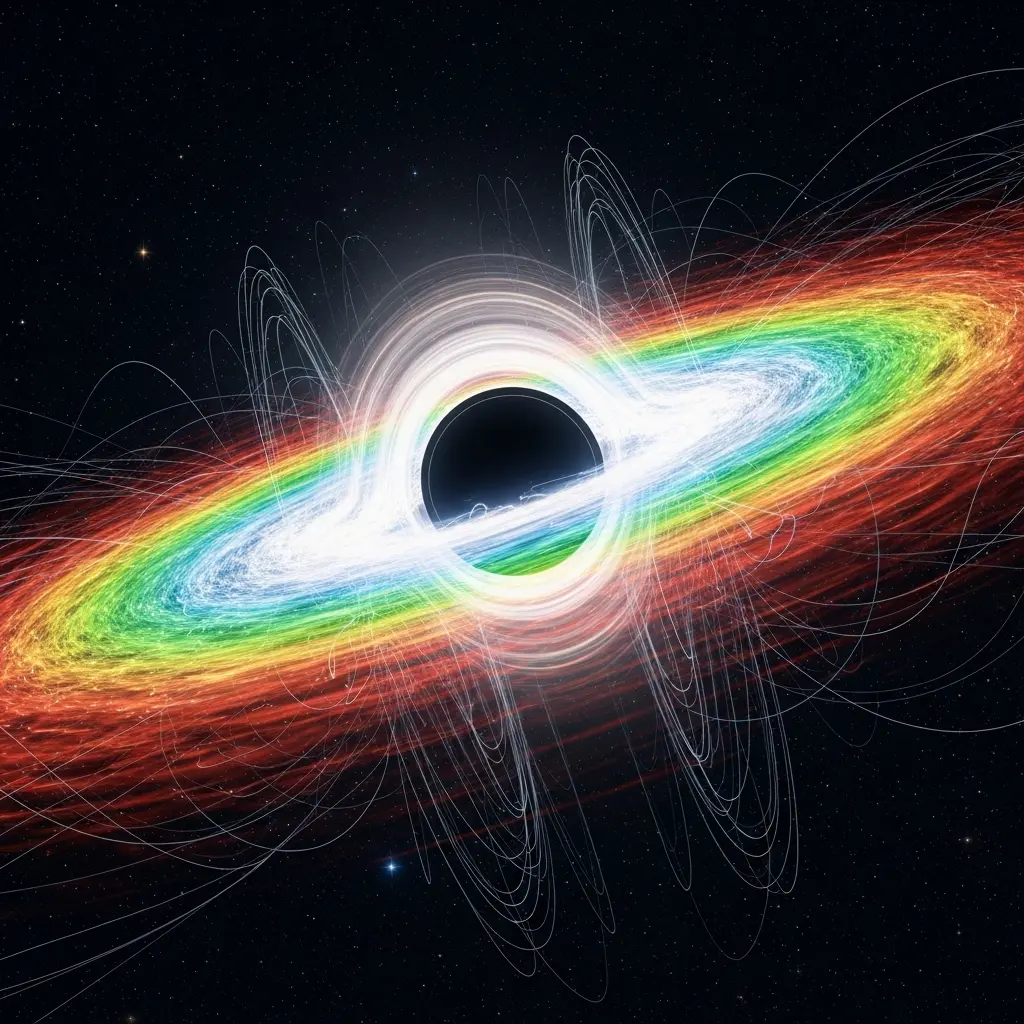
Scientists are tackling the complex problem of understanding how Sagittarius A*, the supermassive black hole at the centre of our galaxy, varies in brightness across different wavelengths. Gabriel Sasseville, Julie Hlavacek-Larrondo, and Daryl Haggard, from the University of Montreal and McGill University, alongside et al., present a novel approach using diffusion models to fill in the gaps in multi-wavelength light curves from Chandra, GRAVITY, Spitzer, and ALMA observations. This research is significant because it represents the first application of score-based generative models to astronomical time series, offering a powerful new tool for reconstructing sparse and noisy data, crucial for identifying flares and measuring time lags that reveal the physics of black hole accretion. Their innovative technique outperforms existing methods, promising high-fidelity, uncertainty-aware reconstruction of Sgr A*’s dynamic behaviour.
Sgr A light curves reconstructed with diffusion models
These models tackle the inherent difficulties in analysing Sgr A’s variability, irregular sampling, band-dependent noise, and substantial data gaps, which have historically complicated efforts to identify flares and measure crucial cross-band time lags. The core of this innovation lies in the development of models trained on simulated light curves meticulously constructed to mirror the statistical and observational characteristics of real Sgr A data. By leveraging these simulations, the researchers were able to create a system capable of filling in missing data points with high fidelity and, importantly, quantifying the associated uncertainties. This probabilistic approach is essential for accurately interpreting the data and drawing meaningful conclusions about the black hole’s behaviour.
The team’s work establishes a significant advancement in handling incomplete astrophysical datasets, moving beyond simple interpolation techniques to a more sophisticated, uncertainty-aware reconstruction. This demonstrates the promise of diffusion models for high-fidelity reconstruction of multi-wavelength variability in Sgr A*. This capability is particularly valuable for Sgr A*, where coordinated multi-wavelength campaigns are often hampered by logistical challenges and limited temporal overlap. The research establishes a new standard for analysing complex astrophysical time series, paving the way for more detailed investigations into the dynamics of black holes and their environments.
This breakthrough has significant implications for time-domain astrophysics, a rapidly growing field driven by increasingly sophisticated observational facilities. By providing a reliable method for reconstructing incomplete data, the study unlocks the potential to extract more information from existing and future observations of Sgr A* and other variable astrophysical sources. The ability to accurately measure cross-band time lags, for example, will allow scientists to probe the physical processes driving Sgr A*’s flares with unprecedented precision. Furthermore, the techniques developed in this work are broadly applicable to other areas of astrophysics, offering a powerful tool for analysing sparse, noisy, and multivariate datasets. The research opens exciting new avenues for understanding the complex behaviour of black holes and other dynamic astrophysical systems, promising a deeper understanding of the universe around us.
Generative Interpolation of Sagittarius A* Time Series reveals
Scientists tackled the challenge of irregular and incomplete multi-wavelength data from Sagittarius A* (Sgr A*) by pioneering a novel generative approach for interpolating sparse astrophysical time series. The research focused on data obtained from four observatories: Chandra (2-8 keV X-ray), GRAVITY (2.2 micron near-infrared), Spitzer (4.5 micron infrared), and ALMA (340GHz submillimeter), crucial for understanding accretion physics around the black hole. These observations, however, suffered from irregular sampling, noise, and significant data gaps, hindering the identification of flares and accurate measurement of cross-band time lags. This innovative method reconstructs underlying continuous signals from sparse observations, effectively filling in missing data points and quantifying uncertainty.
The study also presented the first transformer-based approach for light curve reconstruction, crucially incorporating calibrated uncertainty estimates to reflect the reliability of the interpolated data. Experiments employed simulations capturing the complexities of Sgr A*’s behaviour, allowing for a direct comparison against a multi-output Gaussian Process. The technique reveals subtle connections between different wavelengths, previously obscured by data gaps, and promises to unlock new insights into black hole accretion and emission mechanisms.
Sgr A* Variability Model Outperforms Gaussian Process in
Researchers conducted an observational campaign in July 2019, acquiring simultaneous observations of Sgr A* across the electromagnetic spectrum. Chandra observations in the 2, 8 keV range utilized the ACIS-S3 chip in FAINT mode, while GRAVITY provided high-resolution flux measurements in the K-band (2.1, 2.4μm) with an extinction correction of 2.42 magnitudes applied. Spitzer observations at 4.5μm were conducted over three 16-hour epochs, and ALMA observations at 340GHz were calibrated to within 10% accuracy. Tests prove that the combined dataset, despite its irregularities, provided a robust foundation for model training and evaluation. Furthermore, the study generated 16,350 simultaneous 24-hour light curves at 1-minute cadence across all four wavelengths, split into training (60%), validation (30%), and test (10%) sets. These simulated light curves were created using a semi-empirical radiative model that accurately reproduces the power spectra, time lags, and flux distributions observed in Sgr A*.
Sgr A* light curves reconstructed with generative models
These models are specifically designed to interpolate missing data points and estimate uncertainties, crucial for understanding the dynamic behaviour of Sgr A. This work represents a significant advancement in the analysis of astrophysical time series, particularly for sources exhibiting rapid and complex variability like Sgr A. Robustness tests revealed that TripletFormer maintains performance even with substantial amounts of missing data, including realistic observational gaps, outperforming other tested methods. However, the authors acknowledge that the submillimeter band continues to present the greatest challenge for accurate reconstruction due to its lower signal-to-noise ratio and sparse sampling. Future research should focus on refining models to better handle low signal-to-noise data, potentially through improved kernel choices or alternative architectures. The authors suggest that developing models capable of generalizing across variable data quality conditions is essential for maximizing the scientific return from multi-wavelength observations of Sgr A and other dynamic astronomical sources.
👉 More information
🗞 Probabilistic Interpolation of Sagittarius A*’s Multi-Wavelength Light Curves Using Diffusion Models
🧠 ArXiv: https://arxiv.org/abs/2601.20863