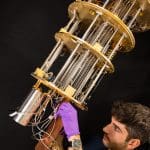
The nature of time itself remains one of the most profound questions in physics, and new research explores whether time is a fundamental aspect of the universe or something that emerges from within it. Giovanni Barontini, from the School of Physics and Astronomy at the University of Birmingham, and colleagues demonstrate a tabletop analogue of the entire universe, known as a Wheeler-DeWitt mini-universe, built using an isolated atomic Bose-Einstein condensate. The team partitions this mini-universe, allowing entropy, a measure of disorder, to flow between sections, and crucially, establishes that time can emerge from changes in entropy, even through cycles resembling the birth and death of a universe. This work not only validates theoretical proposals suggesting time is not fundamental, but also provides a unique experimental platform for testing the foundations of gravity and cosmology, offering a novel way to investigate the very origins of time itself.
Entropic Approach Resolves Quantum Cosmology’s Time Problem
Scientists are tackling a fundamental challenge in cosmology, the problem of time, by defining time not through traditional physics, but through entropy, a measure of disorder. In standard cosmology, time is a coordinate, but in quantum mechanics, it’s an external parameter, creating a conflict when describing the universe as a whole. This research proposes that the increase of entropy within the universe can serve as a clock, providing a measure of time’s passage. Researchers utilize quantum cosmology, which attempts to describe the entire universe using quantum mechanics, and employ a wave function to represent the probability of different possible universes.
Instead of directly addressing the complexities of quantum gravity, the team created a simplified analogue universe using a Bose-Einstein condensate, a state of matter where atoms behave as a single quantum entity. This allows for controlled experiments mimicking aspects of gravity and cosmology. They manipulated the condensate to simulate an expanding universe, controlling its expansion rate and other parameters. The system is treated as an open quantum system, interacting with an external environment, mirroring the reality of our universe. The number of atoms in a specific region of the condensate serves as a proxy for entropy, allowing scientists to track changes in disorder.
The team successfully defined a time variable based on changes in atom number, effectively tracking entropy within the condensate. They tracked the evolution of the wave function of the universe using this entropic time, demonstrating control over the dynamics of the simulated universe by manipulating expansion and dissipation. The interaction with the external environment significantly affects the evolution of the simulated universe, providing insights into real-world cosmological processes. The approach potentially offers a way to avoid singularities, points of infinite density often found in classical cosmological models.
This work provides a novel approach to the long-standing problem of time in quantum cosmology, offering experimental validation of theoretical concepts typically confined to mathematical models. The findings could shed light on the conditions in the very early universe and the origin of structure, while also having applications in quantum technology, such as quantum simulation and information processing. The setup allows for testing fundamental concepts in quantum gravity in a controlled environment, bridging the gap between theory and experiment. Future research will extend the simulations to include more complex cosmological models, investigate whether the entropic time approach can resolve singularities, and perform experiments to test the reversibility of the simulated universe. The team also plans to create analogue black holes to study the physics of black holes and Hawking radiation, explore quantum tunneling scenarios, and increase the number of degrees of freedom in the simulation for a more realistic model. Ultimately, this research represents a significant step towards a more complete and consistent theory of quantum cosmology, opening new avenues for exploring the mysteries of the universe.
Entropic Time Controls Analogue Universe Events
Scientists have successfully created an experimental analogue of a mini-universe using a Bose-Einstein condensate to investigate the fundamental nature of time. This analogue universe is partitioned into ‘bright’ and ‘dark’ sectors, allowing for controlled exchange of entropy, mirroring concepts from cosmological models. The team demonstrated that manipulating the rate of entropy exchange effectively controls the flow of ‘entropic time’ within the bright sector, establishing a meaningful timeline for events. Experiments revealed that this entropic time reliably orders events, even as the bright sector undergoes cycles resembling a ‘big bang’ and ‘big crunch’, demonstrating a consistent arrow of time despite these extreme transitions.
Crucially, no entropic time elapses between a big crunch and subsequent big bang, as entropy remains constant during this transition, highlighting the link between entropy flow and the perception of time. By tuning the barrier controlling entropy exchange, the team could slow or halt the flow of entropic time, effectively simulating the ‘heat death’ of the universe where no further change occurs. Furthermore, the researchers derived a novel Schrödinger equation formulated in terms of entropic time, a generalization of the standard equation used in quantum mechanics, and used it to accurately reproduce their experimental data. Numerical simulations, based on this entropic time Schrödinger equation, closely matched the observed evolution of the bright sector, confirming the validity of their approach. The results demonstrate that time, in cosmological models, may not be a fundamental property but rather emerges from gradients in entropy, offering a new perspective on the nature of time itself. This work provides an experimentally accessible way to investigate relational time constructions and the arrow of time, moving beyond theoretical models.
Entropic Time Emerges in Mini-Universe Simulation
This research demonstrates the experimental realization of a simplified model of the universe, termed a ‘mini-universe’, using a Bose-Einstein condensate. By partitioning this system and allowing entropy exchange between sectors, the team established an ‘entropic time’, a measure of time derived from the flow of entropy rather than an externally imposed parameter. Experimental data confirms that this entropic time is consistent and reliably tracks the evolution of the system, even through cycles resembling a ‘big bang’ and ‘big crunch’. The findings support the idea that time may not be a fundamental aspect of the universe, but instead emerges from internal processes like entropy increase, offering a novel perspective on cosmological models.
While acknowledging the limitations of their simplified analogue, the authors highlight the potential for extending this approach to more complex scenarios, including investigations into quantum gravity. Future research directions include exploring the relationship between entropic time and other time concepts, such as thermal time, and using this platform to investigate phenomena like singularities and quantum bounces. This work establishes a controlled environment for testing theories about the nature of time and the early universe, offering a pathway for quantitative studies of fundamental physics, potentially leveraging tools from quantum technology and information science.
👉 More information
🗞 Emergence of Entropic Time in a Tabletop Wheeler-DeWitt Universe
🧠 ArXiv: https://arxiv.org/abs/2509.07745