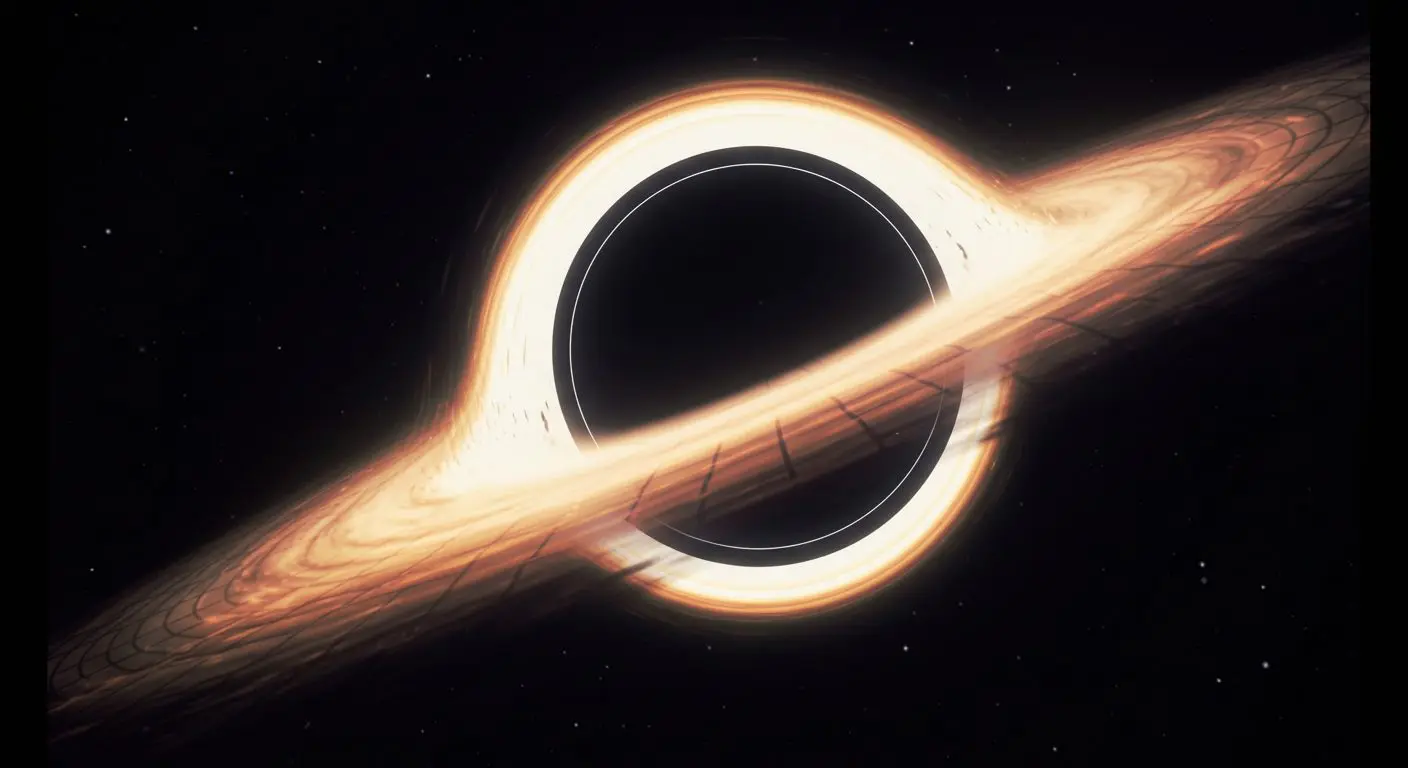
The interplay between gravity and light takes centre stage in new research exploring how black holes distort and scatter light when surrounded by complex environments, offering fresh insights into these enigmatic objects. Jonibek Khasanov, Mirzabek Alloqulov, and Pankaj Sheoran, along with colleagues, investigate black hole spacetimes immersed in both anisotropic fluids and plasma, conditions believed to exist around real black holes. Their work reveals how these surrounding materials affect the path of light, influencing gravitational lensing and the scattering of waves, and ultimately impacting the images we might capture. This research provides a comprehensive theoretical framework connecting the properties of matter around black holes with observable phenomena, paving the way for more accurate interpretations of data from telescopes like the Event Horizon Telescope and GRAVITY, and offering a powerful tool for understanding the universe’s most extreme objects.
Black Holes, Lensing and Gravitational Waves
This extensive collection of research focuses on black hole physics, gravitational lensing, and related areas in astrophysics and general relativity. Researchers are actively investigating how to interpret observations and test theoretical predictions about these enigmatic objects, covering fundamental properties, how gravity bends light, and the characteristic vibrations emitted after a disturbance. A significant portion of the work centers on understanding black hole behavior, exploring solutions to Einstein’s equations and analyzing the signals they produce. The collection also includes investigations into alternative theories of gravity and their potential impact on black hole properties, applying these concepts to understand accretion disks, jets, and the formation and evolution of black holes in various astrophysical environments. This comprehensive collection is a valuable resource for anyone working in black hole physics and gravitational lensing, offering a detailed overview of current research and future directions.
Anisotropic Black Holes and Plasma Environments
Researchers have developed a detailed theoretical framework to investigate black holes surrounded by anisotropic fluids and embedded within plasma environments, motivated by recent advances in black hole imaging and precision measurements of strong gravity. The team analyzed the background spacetime and matter content, ensuring physically realistic energy conditions, and studied how light travels around these black holes, calculating deflection angles and image magnifications under weak gravitational lensing, considering both uniform and non-uniform plasma distributions. To understand wave behavior, scientists analyzed the stability of the spacetime using established methods, focusing on axial perturbations, and investigated how scalar waves scatter around the black hole, solving the wave equation in the curved background with plasma, revealing how anisotropy and plasma affect interference patterns. Using approximations, the team computed differential scattering cross-sections, allowing for a precise understanding of how the surrounding matter influences wave propagation and scattering. By combining these observational datasets, scientists aim to refine our understanding of black hole properties and the nature of surrounding matter, establishing a firm basis for future comparisons with high-resolution astrophysical data.
Anisotropic Fluids Alter Black Hole Spacetime
Researchers investigated black hole spacetimes surrounded by anisotropic fluid and embedded in plasma, motivated by recent advances in black hole imaging and precision measurements. The team explored light propagation, wave dynamics, and observational signatures within these complex geometries, beginning with analysis of the horizon structure and verifying associated energy conditions, demonstrating that anisotropic fluids can significantly influence black hole properties and observational characteristics. The study reveals that incorporating anisotropic fluids introduces deviations from standard black hole geometry while maintaining spherical symmetry, allowing for interpolation between various physical regimes. Gravitational lensing emerges as a key observational signature, with researchers demonstrating that anisotropic fluids modify deflection angles and lensing magnification, further altered by the presence of plasma, both uniform and non-uniform, which introduces frequency-dependent refraction and alters deflection angles and image brightness.
Wave phenomena, specifically the scattering of scalar waves, provide additional insights into black hole physics, with the presence of anisotropic matter and plasma altering the effective potential experienced by these waves, modifying the scattering cross-section and interference patterns. Utilizing approximations, scientists computed these observables and identified regimes where anisotropy or plasma effects become significant, with implications for interpreting signals from pulsars and gravitational wave echoes. The study demonstrates that the inclusion of anisotropic fluid modifies the spacetime structure while still satisfying fundamental energy conditions, with photon trajectories and black hole shadow radii increasing with higher anisotropy, and further affected by the density of surrounding plasma. The team investigated gravitational lensing, finding that the anisotropic fluid enhances deflection angles and magnification, with plasma environments having a significant impact on these effects. Dynamical stability analysis, using gravitational perturbations, confirms the linear stability of the spacetime for physically relevant parameters, and parameter estimation using data from Sgr A* and M87* constrains the black hole mass and anisotropy parameters, supporting a radiation-like fluid environment near these black holes. The authors acknowledge limitations stemming from parameter degeneracies, highlighting the need for improved observational precision from next-generation instruments to further refine these constraints and probe the nature of matter in strong gravity regimes, with future research benefiting from these upgraded observations.
🗞 Lensing Stability and Scattering Phenomena in Anisotropic Black Hole Spacetimes in Plasma
🧠 ArXiv: https://arxiv.org/abs/2508.21519