

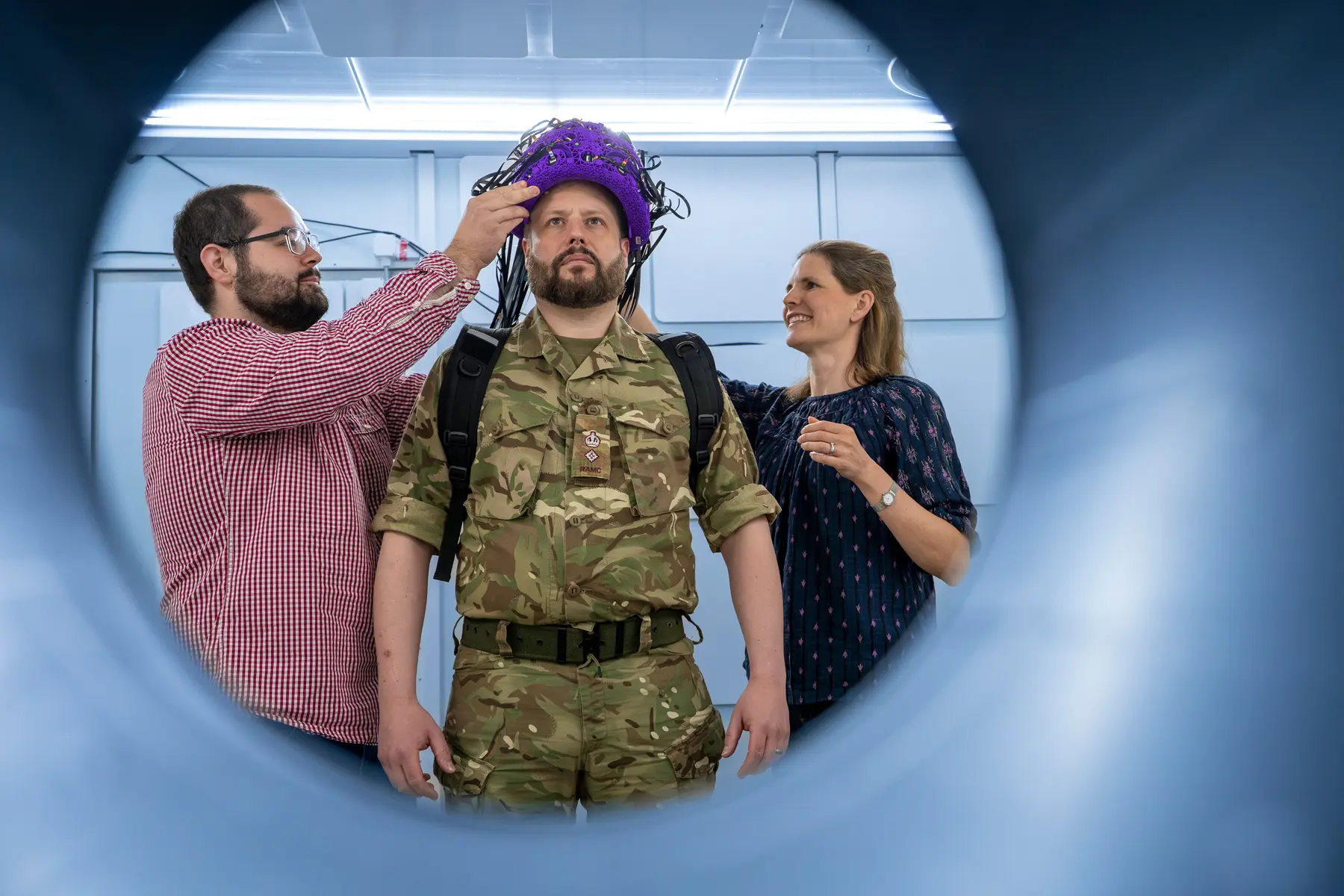
Scientists from the University of Nottingham, including Professor Matthew Brookes and in collaboration with the Universities of Birmingham and Cerca Magnetics, are developing the world’s first fully mobile magnetoencephalography (MEG) brain scanner. This system will measure the effects of blast exposure on military personnel in real time at training sites, utilizing transformational quantum technology to capture subtle and fleeting changes in brain function—effects often disappearing within 24-48 hours. Funded with over £3 million from the Ministry of Defence, this mobile laboratory aims to improve protections for service personnel by enabling evidence-based decision-making regarding safe working practices and potentially benefitting research into conditions like dementia and epilepsy.
Mobile MEG Scanner Development & Capabilities
Scientists at the University of Nottingham are developing the world’s first fully mobile magnetoencephalography (MEG) brain scanner. This innovative system, backed by over £3 million from the Ministry of Defence, will measure the effects of blast exposure on military personnel in real-time at training sites and field hospitals. Utilizing a quantum technology called OPM-MEG, the scanner offers unprecedented precision and sensitivity in measuring electrical brain function, capturing fleeting changes often missed by conventional laboratory scanners.
The mobile-MEG system aims to address a critical defense challenge: subtle brain function changes caused by repeated blast exposure. Researchers will investigate multiple weapon types and track recovery patterns, establishing evidence-based exposure limits and identifying personnel at greatest risk. The scanner will allow for rapid scans, providing objective assessment of brain function and informing decisions about safe return to duty – a capability expected to be operational by March 31, 2026.
This project leverages a decade of development in OPM-MEG technology, supported by the UK National Quantum Technologies Programme. The system’s portability—a departure from historically confined laboratory scanners—will revolutionize brain imaging, potentially extending its use beyond military applications to fields like sports concussion, dementia, and epilepsy research. Construction will be a collaborative effort involving companies from the UK and US, alongside the University of Nottingham.
Tracking Blast Exposure Effects on Brain Function
Scientists at the University of Nottingham are developing a mobile magnetoencephalography (MEG) scanner to measure the effects of blast exposure on military personnel in real-time. This quantum technology-based system will deploy to military sites, field hospitals, and rehabilitation centers, enabling researchers to observe brain function within minutes of blast exposure and track recovery. The £3 million project aims to provide evidence-based decision-making to protect service members from potentially harmful effects, addressing a critical gap in understanding subtle brain changes.
This new mobile-MEG system is designed to capture fleeting changes in brain function—effects that often disappear within 24-48 hours—which have previously been impossible to detect with conventional laboratory scanners. By investigating multiple weapon types and tracking recovery patterns, the research will establish evidence-based exposure limits and identify personnel at greatest risk. The system utilizes OPM-MEG technology, non-invasively measuring electrical brain function with unprecedented precision and sensitivity.
Expected to be operational by March 31, 2026, the scanner’s data will help determine safe working practices for blast exposure. The project isn’t limited to military applications; it also has implications for research into sports concussion, dementia, and epilepsy. This breakthrough cements the UK’s leadership in brain imaging and defense science, demonstrating the potential of quantum technology to benefit both military personnel and broader society.
Quantum Technology & System Specifications
The University of Nottingham is developing a mobile magnetoencephalography (MEG) brain scanner—a first-of-its-kind system—to measure the impact of blast exposure on military personnel in real-time. This quantum technology, underpinned by a decade of research and £3 million in funding, will deploy directly to training sites and hospitals. Crucially, the system aims to capture fleeting changes in brain function—those disappearing within 24-48 hours—that previously went undetected, enabling better understanding of blast impacts.
This mobile MEG scanner utilizes OPM-MEG technology, a quantum method for non-invasively measuring electrical brain activity with unprecedented precision. The system will enable researchers to quantify the effects of blasts from specific weaponry in the hours and days following exposure, tracking recovery patterns over time. By providing a time-stamped, accurate picture of brain activity, the scanner will inform evidence-based policies regarding safe working practices and exposure limits for military personnel.
Expected to be operational by March 31, 2026, the project extends beyond military applications. The advancement of mobile MEG technology promises benefits for research into conditions like dementia, epilepsy, and sports concussion. The University of Nottingham anticipates the system—developed with partners including Cerca Magnetics, Magnetic Shields Limited and QuSpin—will revolutionize brain imaging, paving the way for wider deployment outside traditional laboratory settings.
For the first time we will be able to build a time-stamped, accurate picture of exactly what happens to the brain in the minutes and hours after blast exposure and track recovery over time.
Lt Col James Mitchell
Broader Applications Beyond Military Use
The mobile magnetoencephalography (MEG) scanner, developed by University of Nottingham spin-out Cerca Magnetics, has implications extending far beyond military applications. Researchers anticipate the technology will significantly benefit research into sports concussion, dementia, and epilepsy. This mobile capability, lifting limitations of traditional laboratory-based scanners, opens possibilities for deployment outside hospitals to assess neurological conditions or at sports grounds following head injuries, potentially revolutionizing these fields.
This new generation of MEG utilizes OPM-MEG – a quantum technology measuring electrical brain function with unprecedented precision. The system’s ability to rapidly scan and objectively assess changes in brain function is expected to inform decisions regarding safe return to duty for military personnel, but also offers a means to quantify and understand neurological impacts in civilian contexts. The project aims to deliver transformative insights into brain health risks and establish evidence-based safety limits applicable beyond military use.
Funded by over £3 million from the Ministry of Defence and supported by the UK National Quantum Technologies Programme, the mobile-MEG system is expected to be operational by March 31, 2026. This advancement builds upon a decade of pioneering work in OPM-MEG technology led by Professor Matthew Brookes and aims to provide a deeper understanding of brain activity in response to various stimuli—knowledge applicable to a wide range of neurological studies and treatments.


