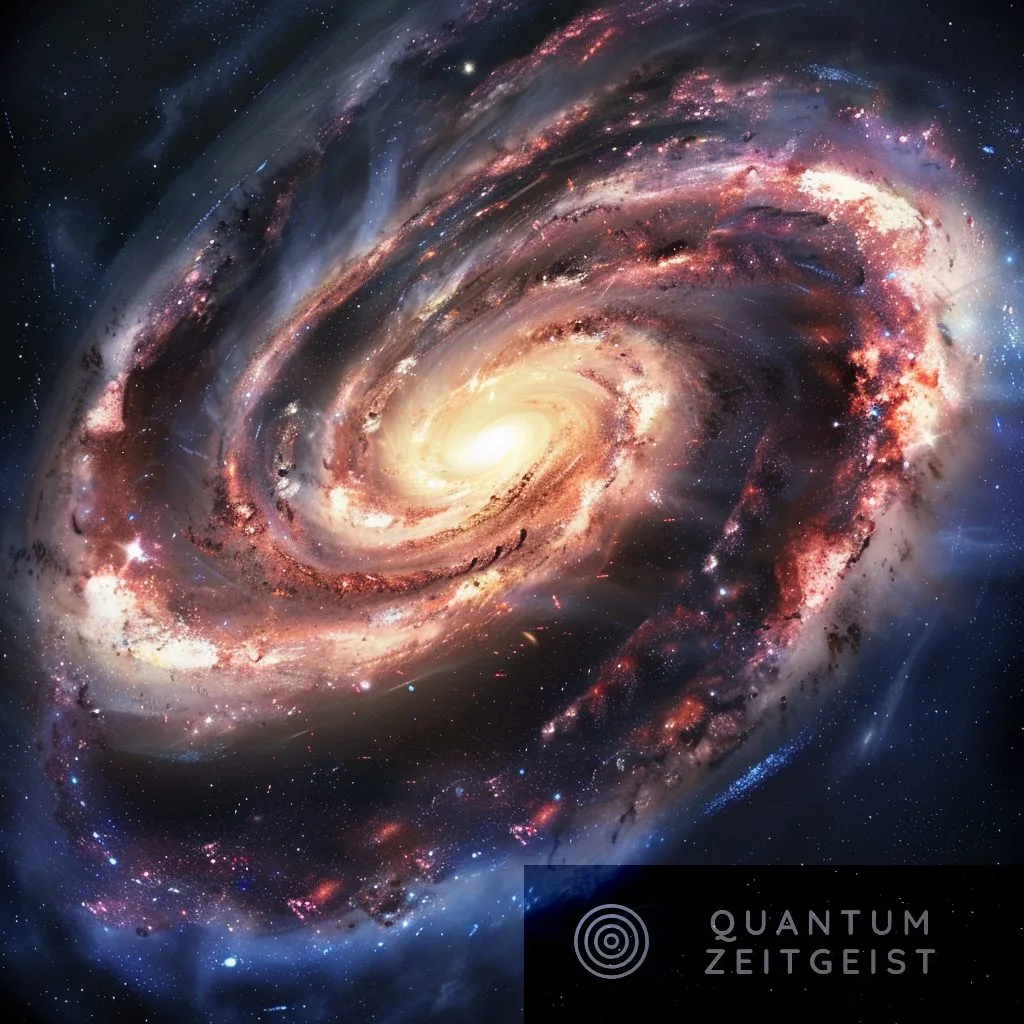
Scientists from the University of Missouri, led by graduate student Vicki Kuhn, have discovered that spiral galaxies were more common in the early universe than previously thought. Using images from NASA’s James Webb Space Telescope, they found that nearly 30% of galaxies had a spiral structure about 2 billion years after the universe formed. This suggests that galaxy formation happened more rapidly than previously believed. The findings could help scientists better understand how spiral galaxies, like the Milky Way, formed over time. The study was co-authored by Yicheng Guo, an associate professor in Mizzou’s Department of Physics and Astronomy.
Unraveling the Early Universe: More Spiral Galaxies Than Previously Thought
Scientists from the University of Missouri have made a significant discovery about the early universe, revealing that spiral galaxies were more prevalent than previously believed. This new insight could help scientists develop a better understanding of how spiral galaxies, such as our own Milky Way, formed over time.
The study, led by Vicki Kuhn, a graduate student in Mizzou’s Department of Physics and Astronomy, found that spiral galaxies were already prevalent as early as 2 billion years after the universe formed. This contradicts the previous belief that most spiral galaxies developed around 6 to 7 billion years after the universe’s formation. “This means galaxy formation happened more rapidly than we previously thought,” said Yicheng Guo, an associate professor in Mizzou’s Department of Physics and Astronomy and co-author on the study.
The Importance of Spiral Galaxies in Understanding the Universe
Understanding when spiral galaxies formed in the universe is a crucial question in astronomy as it helps us understand the evolution and history of the cosmos. “Many theoretical ideas exist about how spiral arms are formed, but the formation mechanisms can vary amongst different types of spiral galaxies. This new information helps us better match the physical properties of galaxies with theories — creating a more comprehensive cosmic timeline,” said Kuhn.
Spiral arms are a fundamental feature used by astronomers to categorize galaxies and understand how they form over time. The cosmic epoch when spiral arms first appeared contains essential clues to the evolution of disk galaxies.
The Role of the James Webb Space Telescope in the Discovery
The scientists used recent images from NASA’s James Webb Space Telescope (JWST) to make their discovery. They found that nearly 30% of galaxies have a spiral structure about 2 billion years after the universe formed. This discovery provides a significant update to the universe’s origin story as previously told using data from NASA’s Hubble Space Telescope.
“Using advanced instruments such as JWST allows us to study more distant galaxies with greater detail than ever before,” Guo said. “Even though we still have many questions about the universe’s past, analyzing this data helps us uncover additional clues and deepens our understanding of the physics that shaped the nature of our universe.”
The Implications of the Study
The study, titled “JWST Reveals a Surprisingly High Fraction of Galaxies Being Spiral-like at 0.5 ≤ z ≤ 4,” was published in The Astrophysical Journal Letters. The researchers found that the observed spiral fraction decreases from 48% at z ∼ 0.75 to 8% at z ∼ 2.75. These fractions are higher than the fractions observed with the Hubble Space Telescope. They even detected possible spiral-like features at redshifts z > 3.
This fraction is surprisingly high and implies that the formation of spiral arms, as well as disks, was earlier in the Universe. This discovery not only provides a significant update to our understanding of the universe’s origin but also opens up new avenues for further research into the formation and evolution of galaxies.
External Link: Click Here For More