


MIT researchers have demonstrated a significant advancement in quantum computing by achieving strong nonlinear light-matter coupling through a quarton coupler within a superconducting circuit. This breakthrough utilizes a novel device to enhance interactions between qubits and photons, potentially enabling quantum operations and readouts at unprecedented speeds—up to 10 times faster than previous methods. The enhanced coupling strength is crucial for overcoming current limitations in quantum computing, paving the way for fault-tolerant systems capable of reliable large-scale computations.
Introducing the Quarton Coupler
The quarton coupler represents a novel advancement in quantum computing architecture, designed as a specialized device within superconducting circuits to enhance interactions between qubits. This coupler facilitates strong nonlinear light-matter coupling, a critical factor for executing most quantum algorithms efficiently. By increasing the current through the coupler, researchers achieve a more robust nonlinear interaction, which is pivotal for improving quantum processing capabilities.
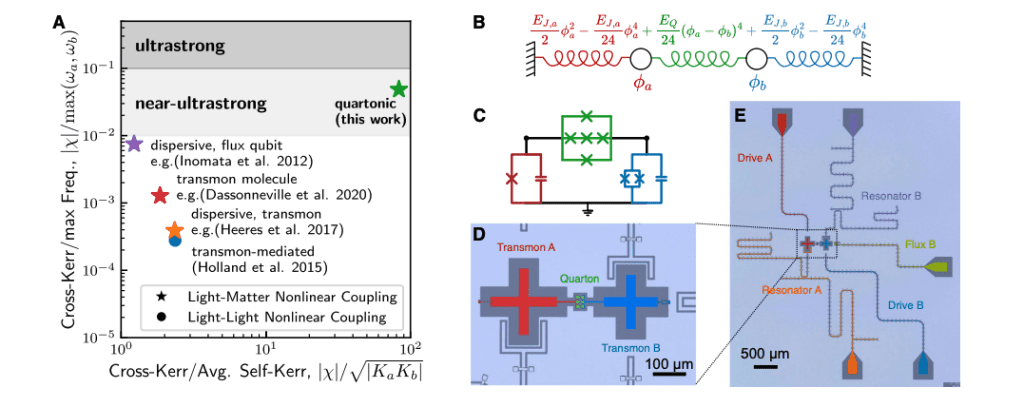
In practical terms, the quarton coupler connects two superconducting qubits on a chip, where one functions as a resonator and the other stores quantum information. This setup enables efficient transfer of quantum states via microwave light, significantly accelerating readout processes. Such enhancements are vital because they allow for more rounds of error correction within the limited coherence time of qubits, thereby reducing overall computational errors and advancing the reliability of quantum systems.
Achieving Faster Readout in Quantum Systems
The quarton coupler enables a significant improvement in the interaction between superconducting qubits and microwave light, facilitating faster readout processes in quantum systems. By connecting two qubits on a chip—one acting as a resonator and the other storing quantum information—the coupler enhances the transfer of quantum states through photons, reducing readout times compared to previous architectures.
This advancement is particularly important for maintaining the integrity of quantum computations, as shorter readout times allow for more efficient error correction within the limited coherence time of qubits. The coupler’s role in strengthening interactions leads to lower error rates, supporting scalable quantum systems.
Toward Fault-Tolerant Quantum Computers
The quarton coupler enhances interactions between qubits and microwave photons, crucial for efficient communication in quantum computers. By facilitating strong nonlinear light-matter coupling, it enables better control over quantum states, essential for error correction and maintaining coherence. In the described architecture, one qubit acts as a resonator, mediating interaction between stored information and photons, allowing faster state transfer and reduced readout times.
This reduction is significant as it provides more time for error correction within limited coherence periods, crucial for computation integrity. The coupler’s potential to improve interaction strength and speed could be a substantial advancement in achieving reliable large-scale quantum computing through improved error correction capabilities.
More information
External Link: Click Here For More


