

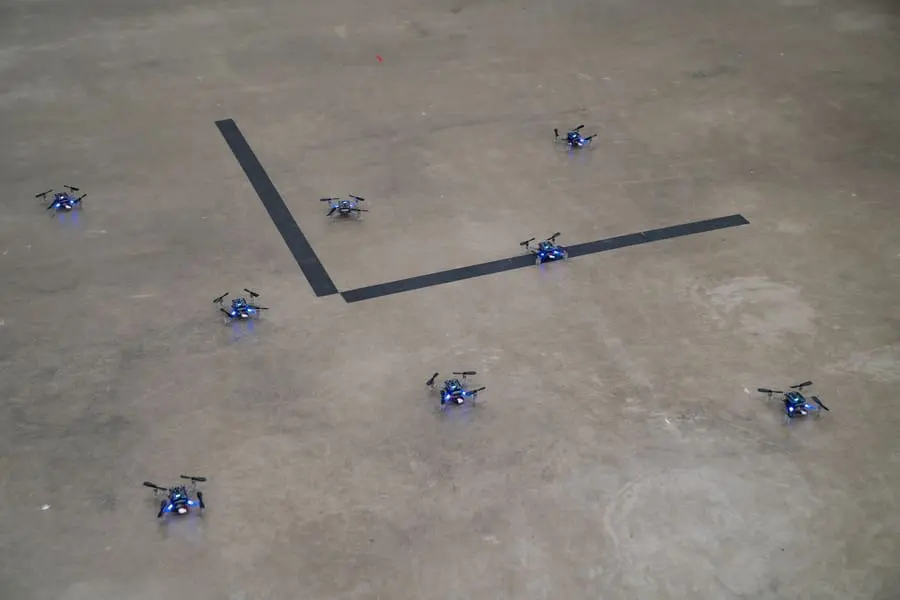
As the complexity of multiagent systems continues to grow, with applications ranging from drone shows to self-driving cars, ensuring the safety of these coordinated networks has become a pressing concern. A team of engineers at MIT has developed a novel training method, known as Graph Control Barrier Function (GCBF+), which enables multiagent systems to operate safely in crowded environments by continually mapping their safety margins and adapting to changing situations.
By training a few agents to maneuver safely, the researchers have demonstrated that their method can be efficiently scaled up to any number of agents, providing a reliable shield against potential hazards and collisions. This innovative approach has been successfully tested on a system of palm-sized drones, which could navigate and land safely in complex scenarios. It holds promise for a wide range of applications, from warehouse robotics to autonomous vehicles, where safety is paramount.
Introduction to Multiagent Systems and Safety Concerns
The increasing popularity of multiagent systems, such as drone shows, warehouse robots, and autonomous driving vehicles, has raised significant safety concerns. These systems consist of multiple agents that interact with each other and their environment, making it challenging to ensure their safe operation. The risk of collisions or other accidents can have severe consequences, highlighting the need for adequate safety protocols. Researchers at MIT have developed a novel approach to address these safety concerns, which involves training a small number of agents to maneuver safely and efficiently scaling this method to any number of agents in the system.
Understanding Safety Margins and Barrier Functions
The MIT team’s approach focuses on calculating safety margins, or boundaries beyond which an agent might be unsafe. These safety margins can change moment to moment as the agent moves among other agents that are themselves moving within the system. The researchers utilize a mathematical concept called barrier functions, which calculate a sort of safety barrier around each agent. By considering only the agents within an individual’s sensing radius, the team can efficiently compute these safety zones and ensure safe navigation. This local approach is similar to how humans intuitively navigate their surroundings, taking into account only those in their immediate neighborhood.
The Graph Control Barrier Function (GCBF+) Method
The GCBF+ method developed by the MIT team calculates the safety zones of just a handful of agents, which can then be applied to any number of agents in the system. This approach involves simulating a controller, or set of instructions, for how an agent and a few similar agents should move around. The researchers run simulations of multiple agents moving along certain trajectories, recording whether and how they collide or interact. By updating the controller based on these simulations, the team can program actual agents to continually map their safety zone and move within it to accomplish their task.
Demonstrating GCBF+ with Quadrotor Drones
The MIT team demonstrated the effectiveness of GCBF+ using a system of eight Crazyflies, lightweight quadrotor drones. They tasked the drones with flying and switching positions in midair, which would result in collisions if they took the straightest path. However, after training with the GCBF+ method, the drones were able to make real-time adjustments to maneuver around each other, keeping within their respective safety zones, and successfully switch positions on the fly. The team also tasked the drones with flying around and landing on specific Turtlebots, wheeled robots that drove continuously in a large circle. The Crazyflies were able to avoid colliding with each other as they made their landings.
Potential Applications of GCBF+
The GCBF+ method has significant potential for application in various multiagent systems, including collision avoidance systems in drone shows, warehouse robots, autonomous driving vehicles, and drone delivery systems. By ensuring the safe operation of these systems, the MIT team’s approach can help prevent accidents and improve overall efficiency. The researchers envision a future where their method is widely adopted, enabling the development of more complex and dynamic multiagent systems that can operate safely and effectively in a variety of environments.
External Link: Click Here For More


