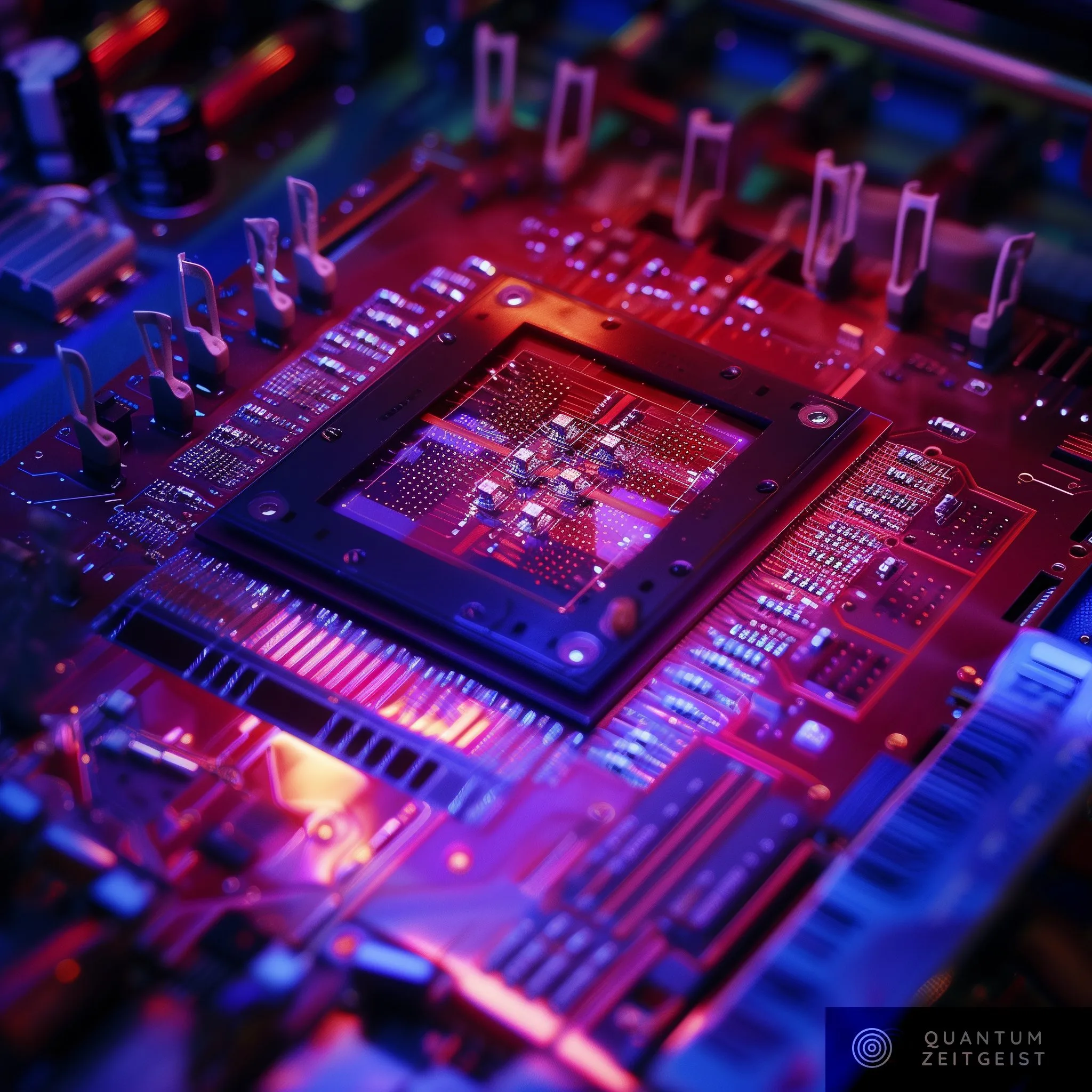
Researchers at MIT and MITRE have developed a scalable, modular hardware platform for quantum computing. The “quantum-system-on-chip” (QSoC) integrates thousands of interconnected qubits onto a customized integrated circuit, allowing for precise control and tuning. The team used diamond color centers as qubits due to their scalability advantages and compatibility with modern semiconductor fabrication processes. The QSoC architecture could enable large-scale quantum computing through a new protocol of “entanglement multiplexing”. The research was led by Linsen Li, an electrical engineering and computer science graduate student at MIT, and included collaborators from Cornell University, the Delft Institute of Technology, the U.S. Army Research Laboratory, and the MITRE Corporation.
Quantum-System-on-Chip: A Leap Towards Practical Quantum Computing
Quantum computers, with their potential to solve complex problems that would take the most powerful supercomputers decades to crack, have been a subject of intense research. The key to this immense computational power lies in the quantum bits or qubits, the fundamental building blocks of quantum computers. However, creating and controlling millions of interconnected qubits in a hardware architecture is a formidable challenge that scientists worldwide are striving to overcome.
Researchers at MIT and MITRE have made a significant stride towards this goal by demonstrating a scalable, modular hardware platform that integrates thousands of interconnected qubits onto a customized integrated circuit. This quantum-system-on-chip (QSoC) architecture allows the researchers to precisely tune and control a dense array of qubits. The architecture also proposes a new protocol of “entanglement multiplexing” for large-scale quantum computing, which could be a game-changer in the field.
Diamond Microchiplets: The Choice of Qubits
While there are many types of qubits, the researchers chose to use diamond color centers due to their scalability advantages. These diamond color centers are “artificial atoms” that carry quantum information. They are compatible with modern semiconductor fabrication processes, compact, and have relatively long coherence times, which refers to the amount of time a qubit’s state remains stable.
Moreover, diamond color centers have photonic interfaces, allowing them to be remotely entangled, or connected, with other qubits that aren’t adjacent to them. This feature is particularly beneficial for large-scale quantum computing, where communication across thousands of qubits is necessary.
Lock-and-Release Fabrication: A Novel Approach
To build the QSoC, the researchers developed a fabrication process to transfer diamond color center “microchiplets” onto a CMOS backplane at a large scale. They started by fabricating an array of diamond color center microchiplets from a solid block of diamond. They also designed and fabricated nanoscale optical antennas that enable more efficient collection of the photons emitted by these color center qubits in free space.
The researchers then designed and mapped out the chip from the semiconductor foundry. Working in the MIT.nano cleanroom, they post-processed a CMOS chip to add microscale sockets that match up with the diamond microchiplet array. They built an in-house transfer setup in the lab and applied a lock-and-release process to integrate the two layers by locking the diamond microchiplets into the sockets on the CMOS chip.
Scaling Up the System
The researchers demonstrated a 500-micron by 500-micron area transfer for an array with 1,024 diamond nanoantennas, but they could use larger diamond arrays and a larger CMOS chip to further scale up the system. In fact, they found that with more qubits, tuning the frequencies actually requires less voltage for this architecture.
The team tested many nanostructures before they determined the ideal microchiplet array for the lock-and-release process. However, making quantum microchiplets is no easy task, and the process took years to perfect.
Characterizing the System and Future Prospects
Alongside their QSoC, the researchers developed an approach to characterize the system and measure its performance on a large scale. They built a custom cryo-optical metrology setup and demonstrated an entire chip with over 4,000 qubits that could be tuned to the same frequency while maintaining their spin and optical properties.
In the future, the researchers could boost the performance of their system by refining the materials they used to make qubits or developing more precise control processes. They could also apply this architecture to other solid-state quantum systems. This work represents a significant step towards practical quantum computing, bringing us closer to harnessing the immense computational power of quantum systems.
External Link: Click Here For More