

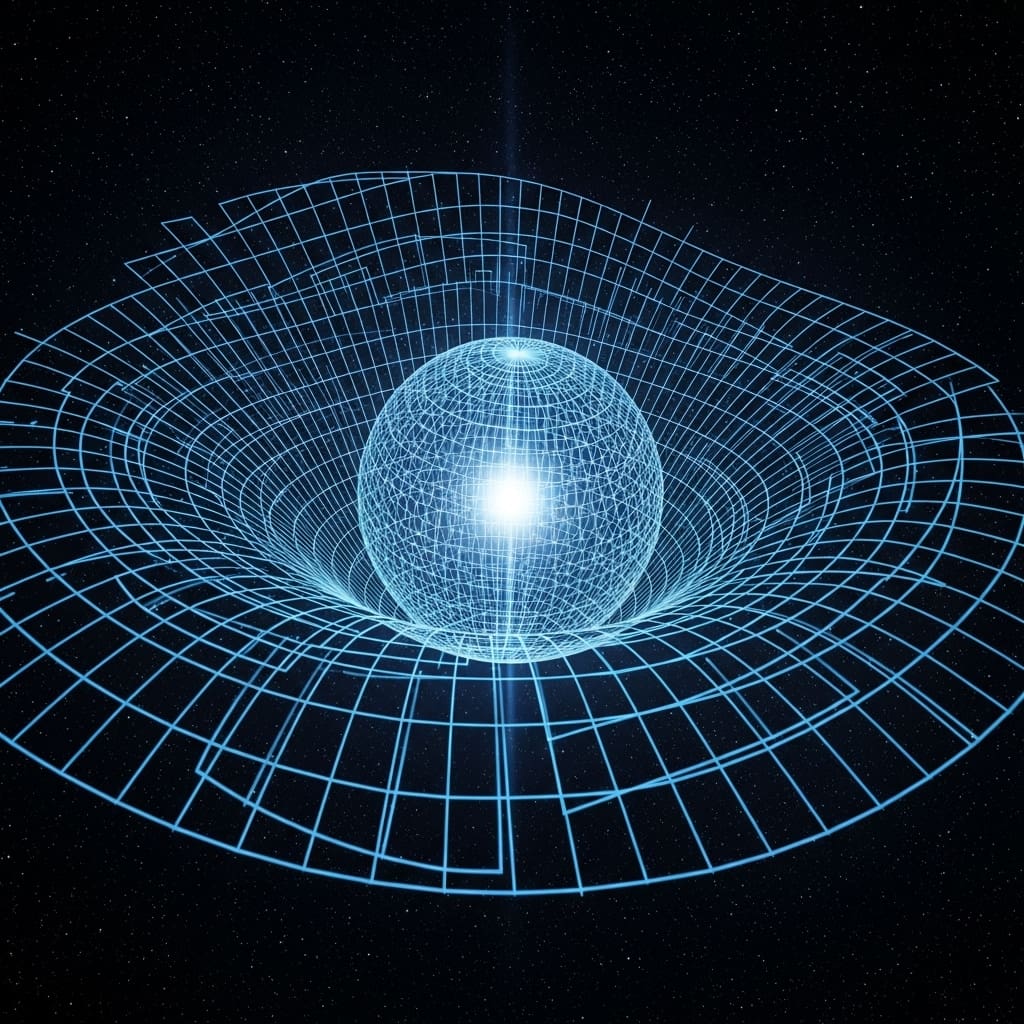
The fundamental nature of spacetime, and whether it possesses a smallest possible length, remains a central question in physics. Valeria Rossi, Sergio Luigi Cacciatori, and Alessandro Pesci, from the University of Insubria and the National Institute for Nuclear Physics, investigate this question by exploring the connection between entropy and the geometry of spacetime. Their work establishes that gravity may emerge from the statistical behaviour of a discrete, underlying structure, suggesting a minimum length scale inherent to spacetime itself. This research demonstrates how such a structure, independent of specific fluctuations, can give rise to the equations governing gravity through a principle of variation, offering new insights into the very fabric of the universe.
This work establishes that a minimum length scale is a general feature predicted by theories attempting to reconcile gravity with quantum mechanics. Researchers demonstrate that considering gravitational effects modifies the Heisenberg uncertainty principle, introducing a term that linearly increases indeterminacy in position with momentum, ultimately setting a lower limit to measurable length. Experiments reveal that attempts to probe spacetime at extremely small scales encounter inherent limitations, suggesting an atomic-like structure to spacetime itself.
The team developed a framework utilizing a bitensor, the q-metric, which incorporates a zero-point length, L, representing this minimum separation. Calculations using this q-metric demonstrate that, in the limit of coinciding points and vanishing minimum length, the resulting expression corresponds directly to the entropy functional used in thermodynamic theories of emergent gravity. This breakthrough delivers a crucial link between the existence of a minimum length and the thermodynamic properties of spacetime, suggesting gravity isn’t a fundamental force but rather a consequence of maximizing entropy at the microscopic level. The team’s calculations show that the q-Ricci scalar, derived from the q-metric, transforms into the entropy functional in specific limits, confirming this connection. This research provides a foundation for exploring the phenomenology of a minimum length scenario using established tools of differential geometry, while accounting for quantum gravity effects. Measurements confirm that the framework successfully connects the discrete structure of spacetime with the emergence of gravity as a collective phenomenon.
Foundations of General Relativity and Black Hole Physics
Research into gravity and general relativity has established foundational principles and explored modern developments in the field. Early work on Riemannian geometry and optical observations laid the groundwork for understanding spacetime curvature, while investigations into induced gravity and quantum fluctuations in curved spacetime have expanded our understanding of alternative gravity theories. Central to black hole physics is the concept of black hole entropy, with researchers establishing its connection to particle creation and the Noether charge. Further studies have explored the holographic principle and signature change events, pushing the boundaries of spacetime understanding.
Investigations into black hole thermodynamics have revealed crucial insights into their entropy and area, while quantum gravity approaches, such as loop quantum gravity and dimensional reduction, attempt to reconcile general relativity with quantum mechanics. Alternative gravity theories and modifications of general relativity continue to be explored, alongside investigations into cosmological transitions and Lanczos-Lovelock gravity. Researchers are also actively studying signatures of quantum gravity and exotic phenomena, such as oscillations in extreme mass-ratio inspiral gravitational wave phase correction, to probe the fundamental nature of spacetime.
Entropy and Emergent Gravity via q-Metric
This research presents a framework, utilising a ‘q-metric’, that explores the connection between a minimum length scale in spacetime and the emergence of gravity from thermodynamic principles. The work demonstrates how incorporating a fundamental length limit into calculations of spacetime geometry does not simply reproduce standard gravitational descriptions, but instead yields an entropy functional central to theories where gravity arises from statistical behaviour. This suggests that gravity may not be a fundamental force requiring quantisation, but rather an emergent phenomenon reflecting the collective behaviour of microscopic constituents of spacetime, evolving to maximise entropy. The team successfully constructed a mathematical framework that allows calculations within a continuous geometric setting while incorporating the effects of a minimum length scale.
By examining the behaviour of a modified Ricci scalar within this framework, they found a direct link to entropy functionals used in thermodynamic theories of gravity, supporting the idea of gravity as an emergent property. The authors acknowledge that this work focuses on the phenomenology of a minimum length scenario and does not represent a complete theory of quantum gravity. Future research, they suggest, could explore the implications of this framework for cosmology and black hole physics, and investigate the specific nature of the microscopic degrees of freedom responsible for the emergent gravitational behaviour.
👉 More information
🗞 Minimum spacetime length and the thermodynamics of spacetime
🧠 ArXiv: https://arxiv.org/abs/2511.22403


