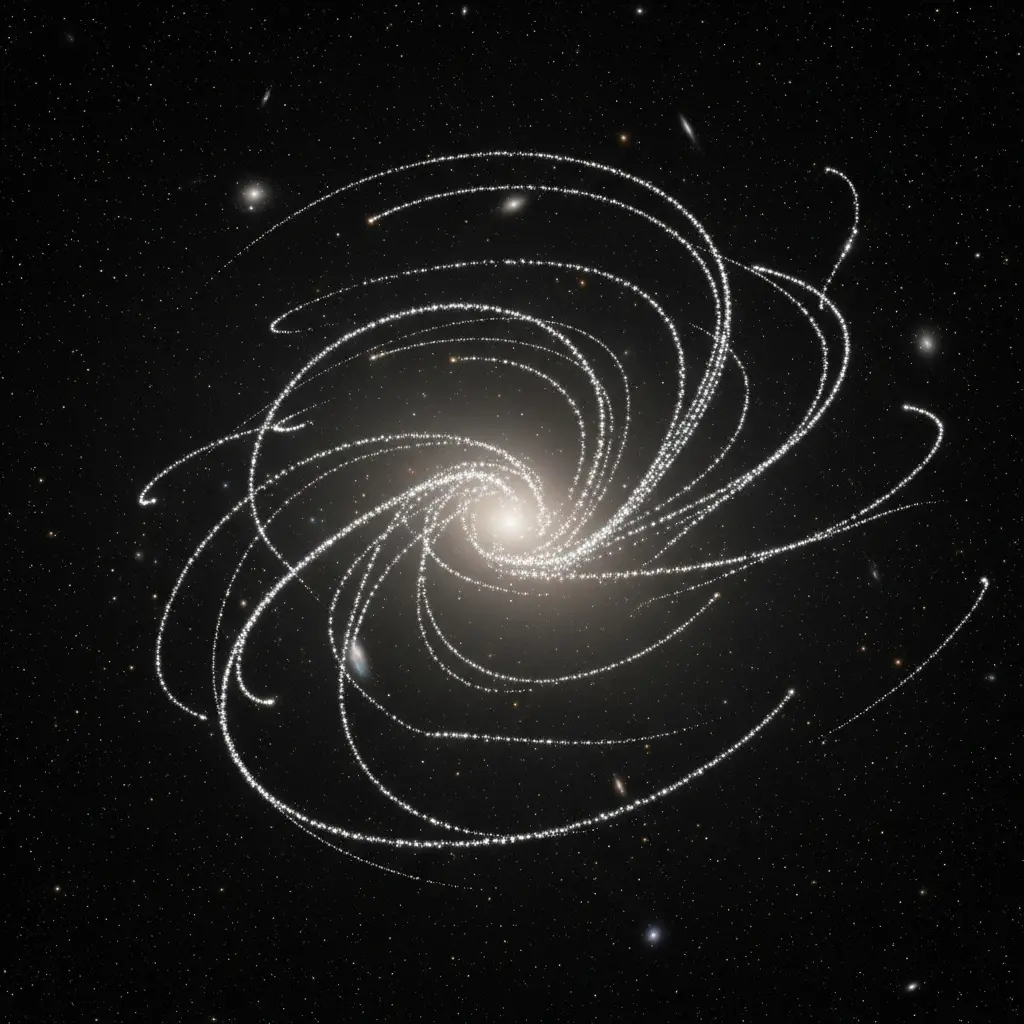
Scientists have definitively proven the Milky Way underwent a significant merger just 1.5 billion years after the Big Bang, pushing back the timeline of our galaxy’s formation. Davide Massari, from Osservatorio di Astrofisica e Scienza dello Spazio di Bologna, alongside Chiara Zerbinati and Cristiano Fanelli from Dipartimento di Fisica e Astronomia, Universit`a degli Studi di Bologna, et al., demonstrate this through detailed analysis of globular cluster populations. Their research identifies three distinct age and metallicity sequences, revealing a previously contentious early merger event with a stellar mass comparable to the Gaia-Enceladus system. This unambiguous identification of a third major merger , dubbed Low-energy-Kraken-Heracles, or LKH , resolves ongoing debates and provides crucial insight into the Milky Way’s complex and dynamic history.
While previous claims suggested at least one further significant merger occurred before this time, supporting evidence remained indirect and contentious. This new research demonstrates that the population of globular clusters surrounding the Galaxy reveals three distinct age-metallicity sequences. One sequence is linked to the merger with Gaia-Enceladus 10 billion years ago, another to the progenitor of the Milky Way itself, and a third intermediate sequence indicates at least one merger that took place a mere 1.5 billion years after the Big Bang.
Analyzing Globular Cluster Age Sequences and Debris
Analyzing Globular Cluster Age Sequences and Debris
This breakthrough was enabled by exquisite data from the Hubble Space Telescope and sophisticated analytical techniques allowing for very precise relative age determination of globular clusters. The newly identified sequence reveals this merger involved an object with a Stellar mass comparable to Gaia-Enceladus, approximately 5×10⁸ M⊙, depositing most of its mass within the inner 6 kpc of the Milky Way. The unambiguous identification of this third merger event within the inner Galaxy resolves earlier debates, and the researchers have named the progenitor system Low-energy-Kraken-Heracles, or LKH, in recognition of prior work. According to the currently favoured cosmological framework, large galaxies such as the Milky Way have grown over time, at least partially through mergers with smaller systems.
Knowledge of the events contributing to the assembly of our Galaxy has greatly improved with the advent of the Gaia mission and large spectroscopic surveys like APOGEE and GALAH. The most recent merger, still ongoing, involves the Sagittarius dwarf galaxy, which fell in around 6 billion years ago. Prior to this, the most significant merger known was with the Gaia-Sausage-Enceladus dwarf galaxy, ending approximately 10 billion years ago. As we look further back in time, the mass of our Galaxy was smaller and more comparable to the merging building blocks. This, combined with short evolutionary timescales, makes it difficult to distinguish the properties of the infant Milky Way from those of the merging systems, both dynamically and chemically. The research establishes that the very short mixing timescales, driven by chaos in the inner Galaxy, imply that some of the dynamical memory has been erased.
Globular cluster ages reveal Milky Way mergers happened
Traces Galaxy Mergers Back Through Deep Time
Scientists have definitively traced the merger history of our Galaxy back to a redshift of 2, corresponding to 10 billion years ago. While previous studies suggested at least one earlier significant merger, conclusive evidence remained elusive. This research demonstrates the existence of three distinct age-metallicity sequences within the Galaxy’s globular cluster population, identifying one sequence linked to the Gaia-Enceladus merger 10 billion years ago, another to the progenitor of the Milky Way, and a third intermediate sequence resulting from a merger occurring just 1.5 billion years after the Big Bang. This breakthrough was enabled by utilising exquisite data from the Hubble Space Telescope and employing a highly sophisticated analytical approach for precise relative age determination of globular clusters.
Tracing Deep Merger History Back to Cosmic Dawn
Modeling Observations to Determine Progenitor Systems
The study focused on 17 globular clusters located in the inner Galaxy, anticipating the concentration of debris from the earliest accretion events. Researchers obtained observations of these clusters with the Hubble Space Telescope using the F606W and F814W optical bands, with 15 already dynamically associated with the “Low-energy” group in prior investigations. A newly developed analytical technique allowed the team to determine extremely precise relative globular cluster ages, achieving typical errors of only a few hundred million years. This increased precision stemmed from minimising systematic errors, previously caused by inconsistent datasets and methodologies, alongside a more refined treatment of each cluster’s photometry.
Bayesian Modeling for Determining Progenitor Systems
Expanding upon previous work, the analysis incorporated a total of 39 globular clusters with homogeneous age determinations. To robustly determine the number of progenitor systems responsible for the observed chrono-dynamical data, scientists fitted a Bayesian model with multiple components, each representing a distinct progenitor system, using the dynamic nested sampling package dynesty. Each progenitor was assumed to follow an age-metallicity relation, modelled using a simple chemical evolution model. The researchers calculated Jacobi energy, vertical action, and circularity for each cluster, utilising a Galactic mass model that included a rotating bar and averaging over 200 orbits to account for orbital uncertainties.
The distribution of clusters was modelled as a mixture of K Student-t distributions, where K represents the number of progenitors. This statistical approach enabled the identification of distinct chrono-dynamical groups while appropriately accounting for observational uncertainties and model evidence. By adopting flat priors on the AMR characteristic parameters, the team estimated the Bayesian evidence for cases with 2, 3, and 4 progenitors. The analysis revealed that the three-progenitor case provided the highest evidence, with the two-progenitor case decisively disfavoured and the four-progenitor case strongly and moderately disfavoured, according to established statistical scales. The unambiguous identification of this third merger event, named Low-energy-Kraken-Heracles or LKH, resolves previous debates and provides a more complete understanding of the Galaxy’s formation history.
Globular clusters reveal early galactic merger history through
Scientists have definitively traced the merger history of our Galaxy back to a redshift of 2, corresponding to 10 billion years ago. While previous research suggested at least one additional significant merger prior to this point, evidence remained indirect and debated. This study demonstrates the existence of three distinct age-metallicity sequences within the population of globular clusters surrounding the Galaxy. One sequence aligns with the well-established Gaia-Enceladus merger from 10 billion years ago, another with the progenitor of the Milky Way itself, and a third intermediate sequence indicates a merger occurring approximately 1.5 billion years after the Big Bang.
This discovery was enabled by precise analysis of Hubble data, allowing for accurate relative age determination of globular clusters. The newly identified sequence suggests this earlier merger involved an object with a stellar mass comparable to Gaia-Enceladus, depositing much of its mass within the inner 6 kiloparsecs of the Milky Way. Researchers have named this progenitor system Low-energy-Kraken-Heracles, or LKH, acknowledging prior investigations. The unambiguous identification of this third merger event resolves previous debates and establishes a more complete picture of the Galaxy’s formative years.
The findings establish that the age-metallicity relationship (AMR) is currently the most effective method for distinguishing the main progenitor of the Galaxy, the building block that experienced the highest rate of evolution, in the metal-poor regime. Cosmological simulations support these conclusions, typically predicting between one and four significant mergers in the history of a Milky Way-like galaxy, and the Auriga simulations remarkably reproduce the three AMRs identified in this work. The authors acknowledge a limitation in the precision of current age measurements, particularly for stars beyond globular clusters.
🗞 Proof that the Milky Way experienced a significant merger only 1.5 billion years after the Big Bang
🧠 ArXiv: https://arxiv.org/abs/2601.18896