Secure communication technologies are increasingly vital in a world demanding data protection, and researchers are continually seeking methods to enhance security and range. Claudia De Lazzari, Tecla Gabbrielli, Natalia Bruno, and colleagues at QTI s. r. l. and the CNR Istituto Nazionale di Ottica investigate free-space quantum key distribution, a method for creating encryption keys using the properties of light. Their work explores the benefits of extending this technology into the mid-infrared spectrum, beyond the conventional near-infrared wavelengths, and demonstrates that a mid-infrared system outperforms existing configurations, particularly in challenging weather conditions. This advance promises more robust and reliable secure communication links, offering significant advantages for applications where data security is paramount and atmospheric interference is a concern.
Mid-Infrared Free-Space Optical Communication System
This research details a comprehensive exploration of free-space optical (FSO) communication, focusing on the advantages of using mid-infrared (mid-IR) wavelengths compared to traditional near-infrared wavelengths. The investigation examines the potential for improved performance in adverse weather conditions, such as fog and rain, and proposes a system design utilizing mid-IR quantum cascade lasers and sensitive superconducting nanowire single-photon detectors. The study covers theoretical modeling, system design considerations, and performance analysis, providing a thorough understanding of this emerging technology. The research highlights that mid-IR wavelengths experience reduced scattering from atmospheric particles compared to near-IR wavelengths, leading to improved link availability and range in challenging weather.
Detailed performance analysis, including calculations of link budget and bit error rate, was conducted using simulations and modeling to evaluate performance under various atmospheric conditions. This demonstrates that mid-IR FSO links exhibit significantly improved performance in fog and rain compared to near-IR links, offering a more reliable communication solution. The research team also investigated techniques for mitigating the effects of atmospheric turbulence, such as adaptive optics and diversity techniques, to further enhance system performance. This detailed analysis provides a comprehensive understanding of the trade-offs involved in designing and implementing mid-IR FSO systems, paving the way for future advancements in this field.
Mid-Infrared Single-Photon Quantum Key Distribution
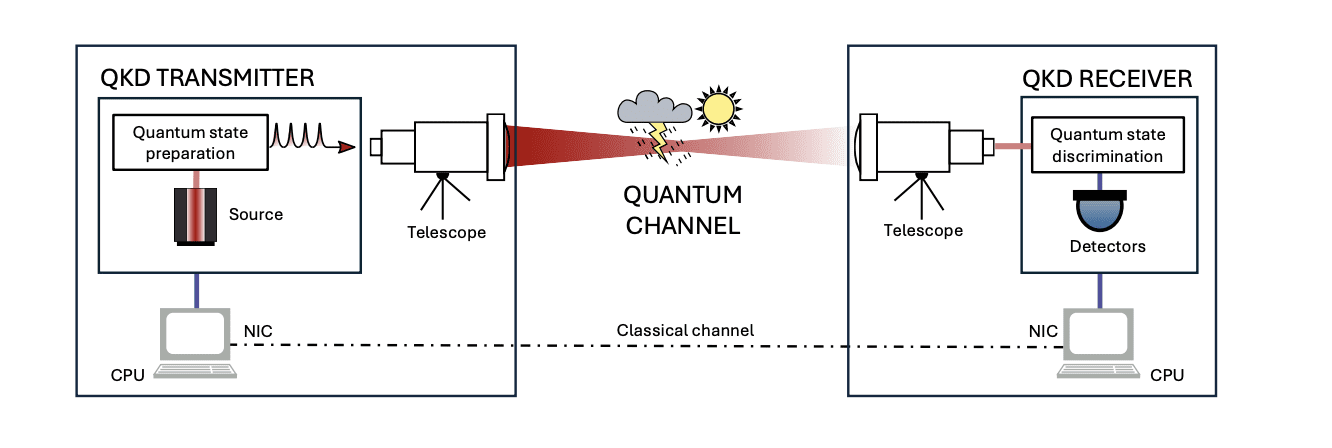
Researchers are exploring free-space quantum key distribution (QKD) using mid-infrared wavelengths, a departure from conventional near-infrared systems. This approach aims to improve performance in adverse weather conditions, a significant challenge for free-space optical links. The methodology centers on transmitting information encoded on the quantum states of light, ensuring secure communication based on the fundamental laws of physics. This innovative approach promises to enhance the security and reliability of quantum communication networks. The core of the system relies on a modified version of the BB84 protocol, a well-established method for QKD.
Researchers prepare quantum states using phase-randomized laser pulses, carefully attenuating them to approximate single-photon transmission. These states are encoded using time-bin encoding, where information is carried by the timing of the light pulses, and distributed across multiple bases to enhance security. This allows for the creation of a secure key through the exchange of quantum signals, followed by classical communication to refine and verify the key’s integrity. A key innovation lies in the use of a decoy-state method, which introduces additional light pulses of varying intensity alongside the signal pulses.
This technique is crucial for detecting potential eavesdropping attempts, as any interference with the quantum states would disrupt the expected signal characteristics. The team employed a rigorous mathematical framework to calculate the secure key rate, a measure of the length of the final secure key relative to the time taken to exchange the initial quantum signals. This comprehensive approach allows for a thorough evaluation of the system’s performance and security.
Mid-infrared light enhances free-space quantum key distribution
Researchers are investigating free-space quantum key distribution (QKD) using mid-infrared light, exploring the potential for more secure communication, particularly in challenging weather conditions where near-infrared signals struggle to propagate effectively. The team demonstrates that a QKD link operating with mid-infrared light outperforms conventional near-infrared systems under various atmospheric conditions, offering a significant advantage in adverse meteorological scenarios. This research highlights the promise of mid-infrared technology for building more robust and reliable quantum communication networks. The research focuses on time-bin encoding, where information is encoded in the timing of photons, and utilizes weak coherent states to transmit the quantum information.
The system employs single-photon detectors to measure the arrival times of photons, and the secure key rate is used to evaluate performance. Importantly, the study calculates the secure key rate per pulse, removing dependence on the speed of state preparation and therefore the limitations of current mid-infrared modulator technology. While high-speed modulators remain a challenge in the mid-infrared, sources like Quantum Cascade Lasers and Interband Cascade Lasers offer promising alternatives. These semiconductor devices can generate high-coherence radiation and are capable of fast modulation, with some demonstrations achieving data rates exceeding 10 Gbit/s in classical communication experiments. The team highlights the potential for these sources to be integrated into future non-classical light emitters, leveraging their unique properties for multiplexing and advanced communication protocols. This research demonstrates the feasibility of mid-infrared QKD and suggests a path toward more robust and secure communication systems.
Mid-infrared boosts free-space quantum communication
This research demonstrates the potential of employing mid-infrared wavelengths in free-space quantum key distribution (QKD) systems, offering advantages over traditional near-infrared approaches, particularly in challenging weather conditions. Simulations reveal that a mid-infrared QKD link exhibits improved performance and greater resilience to atmospheric losses, suggesting its suitability for extending the range and reliability of secure communication networks. This work highlights the promise of mid-infrared technology for establishing longer-distance and more robust free-space quantum communication. The authors acknowledge that current mid-infrared detector technology lags behind its near-infrared counterpart, representing a key limitation to full implementation.
However, this work establishes clear performance targets to stimulate further development in this area. Future research directions include integrating mid-infrared and near-infrared radiation within a multi-wavelength framework, creating adaptable quantum networks capable of dynamically switching between wavelengths to optimise performance and ensure continuous communication, even under varying environmental conditions. This integration aims to build scalable, weather-resilient quantum networks suitable for both metropolitan and intercity links.
👉 More information
🗞 Free-space time-bin encoded quantum key distribution from near- to mid-infrared wavelengths
🧠 ArXiv: https://arxiv.org/abs/2508.13008