

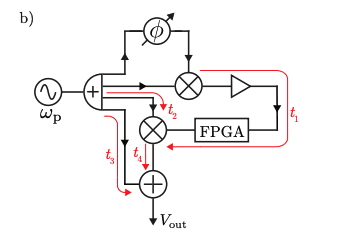
Researchers demonstrated a feedback cancellation technique using a field-programmable gate array to reduce amplitude noise in microwave generators by 13 dB. Application to a microwave optomechanics experiment reduced cavity heating by 3.5 and lowered minimum oscillator occupation by 2, improving system sensitivity.
Precise control of microwave signals is fundamental to a growing range of experiments, from fundamental investigations of quantum systems to advanced sensing technologies. However, inherent fluctuations in the amplitude of these signals introduce unwanted noise, limiting sensitivity and potentially damaging delicate experimental setups. Researchers are now detailing a novel technique to actively suppress this amplitude noise using a feedback system implemented on a field-programmable gate array (FPGA). This allows for the reproduction and subsequent destructive interference of the offending noise, effectively ‘cancelling’ it from the original signal. The work, detailed in a new publication, is led by Joe Depellette, Ewa Rej, Matthew Herbst, Richa Cutting, and Mika A. Sillanpää from the QTF Centre of Excellence, Department of Applied Physics, Aalto University, in collaboration with Yulong Liu from the Beijing Academy of Quantum Information Sciences, and is titled ‘Amplitude Noise Cancellation of Microwave Tones’.
Active Cancellation of Generator Noise Enhances Microwave System Precision
Precise control of microwave systems requires effective mitigation of generator noise. Researchers have now demonstrated a novel technique for actively cancelling amplitude noise, a limitation becoming increasingly prominent as phase noise decreases. They employ a field-programmable gate array (FPGA) to reproduce and subtract unwanted amplitude noise, achieving a 13 dB reduction in noise power at a 2 MHz offset from a 4 GHz carrier. This programmability allows for precise tuning of both frequency offset and cancellation bandwidth, offering adaptability to various experimental conditions and enhancing the precision of measurements in delicate quantum systems.
The team tackled amplitude noise by developing a feedback system utilising an FPGA, which actively reproduces the generator noise with adjustable gain and time delay. This achieves destructive interference, reducing noise and delivering the 13 dB reduction in noise power at a 2 MHz offset from a 4 GHz microwave tone. The versatility of this technique extends to tuning both frequency offset and bandwidth of the cancelled noise, allowing for optimisation across a range of experimental conditions and broadening the toolkit of noise cancellation methods.
Researchers validated the method’s practical application by integrating the noise cancellation system into a microwave optomechanics experiment investigating sideband cooling of a 0.5 mm silicon nitride membrane resonator. Results demonstrate a 3.5-fold reduction in externally induced cavity heating, directly attributable to the suppressed amplitude noise, and consequently, the minimum achievable oscillator occupation decreases by a factor of two. This indicates enhanced control and sensitivity in the optomechanical system.
The development expands the toolkit of noise cancellation techniques, addressing a growing challenge in microwave systems where amplitude noise increasingly limits sensitivity and introduces unwanted heating. As phase noise performances continue to improve, amplitude noise becomes the dominant source of limitation, making this active cancellation method a valuable asset for precision measurements in diverse fields. This approach offers a complementary solution, particularly relevant in scenarios where amplitude fluctuations dominate the overall noise floor.
Validation of this amplitude noise cancellation within the microwave optomechanics experiment revealed a 3.5-fold reduction in externally induced cavity heating of the 0.5 mm silicon nitride membrane resonator. This translates directly to improved experimental sensitivity, evidenced by a factor of two decrease in the minimum achievable oscillator occupation, and highlights the technique’s ability to mitigate a significant source of thermal noise. These results enhance the precision of measurements in delicate quantum systems, establishing a robust and adaptable method for controlling generator noise.
The demonstrated improvements in optomechanical experiments suggest broader applicability to fields such as precision sensing, timekeeping, and fundamental studies of macroscopic quantum phenomena.
👉 More information
🗞 Amplitude Noise Cancellation of Microwave Tones
🧠 DOI: https://doi.org/10.48550/arXiv.2506.01465


