Quantum computers promise revolutionary computational power, but their delicate quantum states are easily disrupted, limiting the duration of calculations, and researchers are constantly seeking ways to extend these crucial coherence times. Andrei Lunin, Mustafa Bal, and Akshay Murthy, along with colleagues at the Superconducting Quantum Materials and Systems Center and Fermi National Accelerator Laboratory, investigate a key source of this disruption, energy loss at the surface of superconducting qubits. Their work focuses on understanding how microwave energy dissipates across the qubit’s structure, specifically examining losses within the ultrathin films that form its core components, and proposes a new method for estimating these losses with unprecedented accuracy. By pinpointing the factors limiting qubit performance at the nanoscale, this research provides vital insights for designing more stable and powerful quantum processors.
Dielectric Loss Limits Qubit Performance
Researchers have developed detailed electromagnetic models of superconducting qubits, known as transmons, to pinpoint the origins of energy loss and improve their performance as building blocks for quantum computers. These qubits rely on maintaining delicate quantum states for computation, and any energy loss limits how long computations can run before errors occur. The team’s work focuses on understanding and minimizing dielectric losses within the materials comprising the qubit, specifically the thin oxide layers that form on the superconducting metal. These simulations reveal that electric fields concentrate at the sharp edges and corners of the qubit’s structure, leading to increased energy loss in the surrounding oxide layers.
By meticulously modeling the geometry of these features, including rounded corners and sidewall slopes, the team could accurately predict where and how these losses occur. This level of detail is crucial because the qubit operates at frequencies where even nanometer-scale imperfections significantly impact performance. A key finding is the development of a method to estimate the energy participation ratio (EPR) in these ultrathin oxide layers. The EPR quantifies how much energy is stored within the lossy oxide compared to the rest of the qubit, allowing researchers to directly assess the impact of material imperfections.
The team demonstrated that the accuracy of EPR calculations depends critically on the fineness of the simulation mesh and the order of the mathematical functions used to approximate the electromagnetic fields. Using finer meshes and higher-order functions leads to more reliable results, ensuring that the simulations accurately capture the complex electromagnetic behavior. Furthermore, the simulations confirm that power loss in the oxide layers is strongly linked to the concentration of electric fields at sharp edges. The team validated their models by comparing the simulated electric field behavior with analytical approximations, demonstrating a strong agreement between the two approaches. This validation reinforces the accuracy of the simulations and provides confidence in their ability to predict and minimize energy loss in real-world qubits. By understanding these loss mechanisms, researchers can now focus on optimizing materials and designs to create more stable and reliable quantum computers.
Dielectric Loss Limits Qubit Coherence
This research investigates the primary sources of decoherence in transmon qubits, which are essential components of modern quantum computing platforms. The study confirms that dielectric losses within the natural oxide layer on the surface of the superconducting material represent a major limitation to qubit coherence, effectively shortening the usable lifetime of quantum information. To address the challenges posed by the ultra-thin nature of this oxide layer, the team developed a numerical method to model microwave surface losses, allowing for accurate estimation of energy participation ratios at the nanometer scale. The results demonstrate that transmon designs incorporating larger distances between contact pads and those utilizing substrate etching exhibit improved performance, aligning with experimental observations.
By accurately modeling dielectric losses, this work provides valuable insights into optimizing qubit design and mitigating decoherence. The authors acknowledge the limitations of their analysis, specifically noting that the etching behavior was examined for only one transmon variant, and future work could expand this analysis to other designs. This research contributes to a deeper understanding of qubit limitations and offers a pathway toward enhancing the coherence and reliability of quantum computations.
Transmon Modeling, Oxide Layer and Josephson Junction
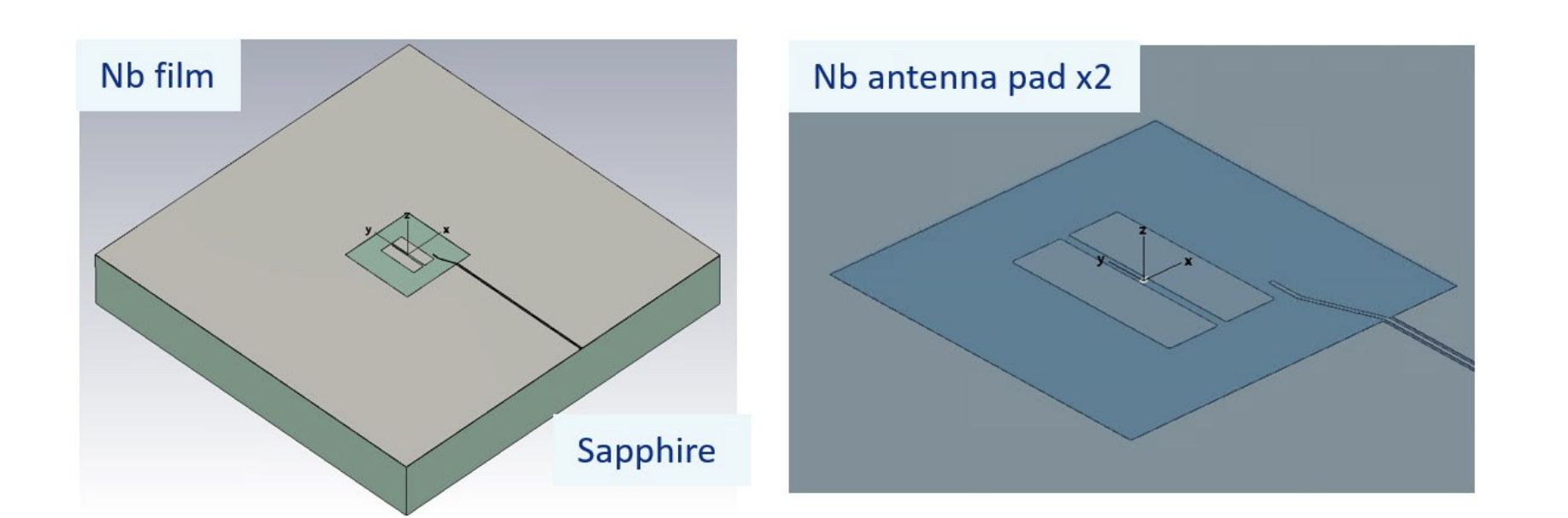
Researchers proposed an idealized model of an oxide layer with a given thickness and its interface with the substrate, based on scanning electron microscopy (SEM) observations. The model incorporates features like rounded corners, sidewall slopes, and potential trenches formed by substrate etching. The two antenna pads are connected by aluminum conductors with a Josephson junction (JJ) connection between them, which is represented as a lumped element with a given inductance. The model incorporates a detailed representation of the niobium antennas and the aluminum conductor, including separate oxide layers.
To improve the accuracy of the simulations, the qubit symmetry planes were used to minimize the simulation domain, and a moving mesh concept was implemented. This technique allows virtual objects to be reassigned to different materials, such as oxide or vacuum, while maintaining a fixed geometry and mesh. The transmon model, with the lumped inductance representing the JJ junction and perfect electrical boundary conditions, was simulated using specialized software to determine the qubit’s eigenfrequency. The results show the distribution of normalized electric and magnetic fields over the niobium antenna surface and surrounding volume.
The electric field concentrates at the edges and corners of the antenna pads. Detailed views of the mesh refinement along critical elements and the electric field on the niobium film surface and in cross-section further illustrate this concentration. The simulations confirm that electric field concentration at sharp edges drives energy loss. This validation reinforces the accuracy of the simulations and provides confidence in their ability to predict and minimize energy loss in real-world qubits. By understanding these loss mechanisms, researchers can now focus on optimizing materials and designs to create more stable and reliable quantum computers.
🗞 Analysis of RF Surface Loss in a Planar 2D Qubit
🧠 DOI: https://doi.org/10.48550/arXiv.2507.18672