Microsoft is supercharging quantum programming with a major update to its Quantum Development Kit (QDK), announced January 22, 2026. The QDK now fully integrates with GitHub Copilot, promising to dramatically simplify the creation of quantum applications – from code generation to testing and execution. This move arrives as the field shifts toward reliable “logical qubits,” requiring simultaneous advances in both hardware and software. “We are very excited about the launch of Microsoft’s QDK for chemistry,” said Guillermo García-Pérez, Chief Scientific Officer and Co-founder at Algorithmiq, “We believe the modular design of the platform will be a true game changer for quantum chemistry, enabling scalability, flexibility, and widespread adoption across the community.” The open-source QDK, compatible with languages like Q#, also boasts new domain libraries for crucial areas like error correction and chemistry, accelerating progress towards fault-tolerant quantum machines.
Microsoft QDK Simplifies Quantum Application Development
The pursuit of reliable quantum computation has shifted focus from error-prone physical qubits to the era of logical qubits, necessitating advancements in both hardware and software, according to Microsoft. To address this, the company is expanding the capabilities of its Quantum Development Kit (QDK), an open-source toolkit designed to streamline the creation of quantum applications. The QDK provides developers with a comprehensive suite of tools—including simulators and a modern programming experience—to build and execute quantum code both locally and on actual quantum hardware. Beyond core functionality, Microsoft’s QDK now integrates with VS Code and GitHub Copilot, accelerating development workflows.
These tools aim to reduce the expertise required for researchers tackling complex quantum chemistry or designing error correction codes needed for stable logical qubits. A significant addition is the QDK for chemistry, designed by chemists to enhance accessibility for quantum application development in their field. The QDK’s versatility extends to error correction, offering open-source modules for characterizing, validating, and debugging encoded quantum programs. Microsoft emphasizes the interoperability of the QDK, noting its compatibility with popular quantum programming languages like Q#, OpenQASM, Qiskit, and Cirq, alongside support for systems like WSL and Docker for reproducibility.
Matthias Troyer, Technical Fellow and Corporate Vice President of Quantum at Microsoft, leads the architecture behind these advancements, building on a foundation of computational physics expertise.
QDK for Chemistry Enables Complex Molecular Modeling
The advancement arrives as the field moves beyond error-prone physical qubits, focusing instead on the development of reliable “logical qubits.” This new suite of tools isn’t simply about quantum algorithms; it’s about a holistic approach, integrating classical data preparation, circuit optimization, and post-processing of quantum data, delivering what Microsoft describes as an “end-to-end solution for quantum chemistry.”
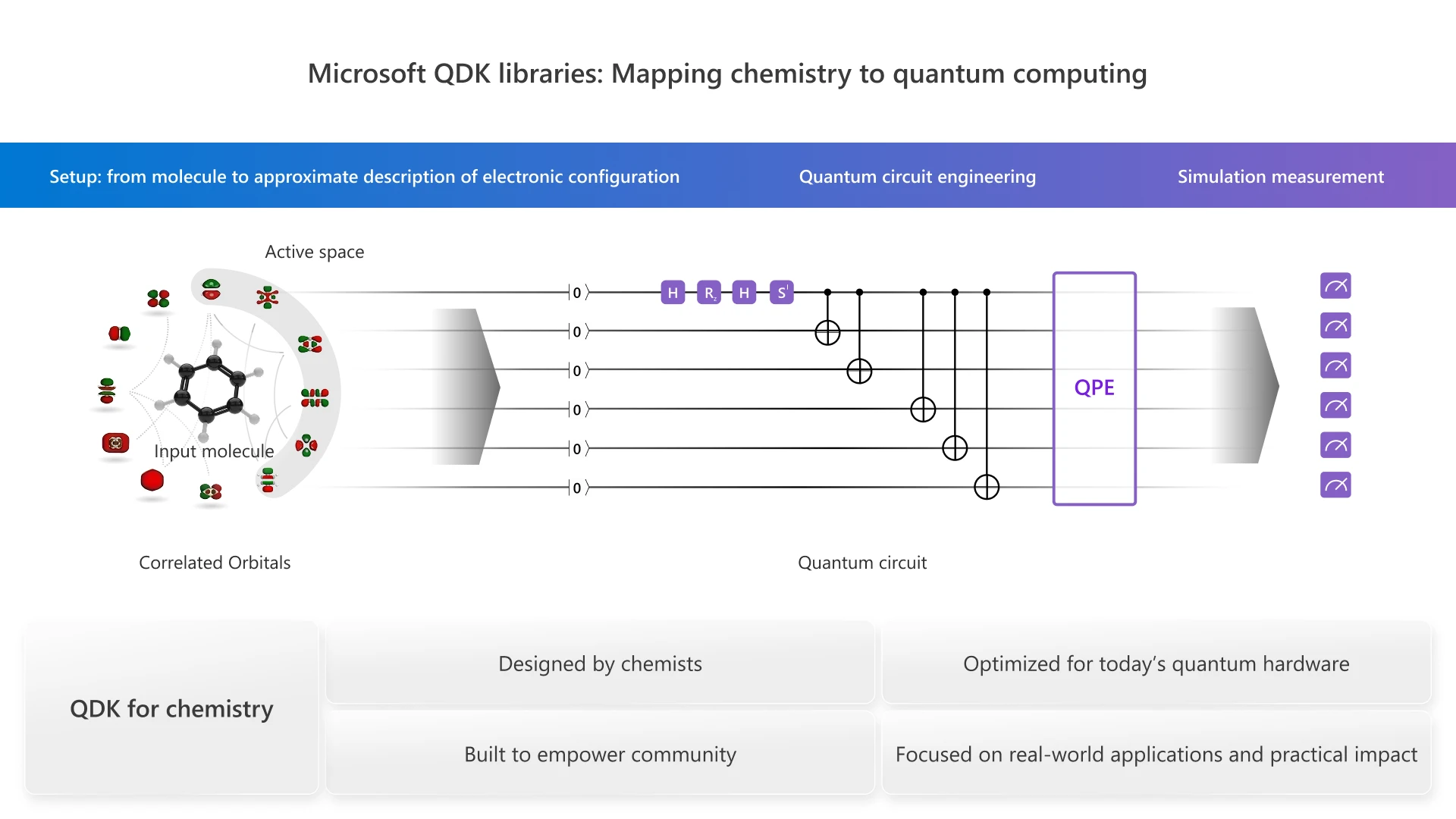
The QDK for chemistry aims to empower researchers by streamlining workflows previously demanding considerable expertise. It delivers efficient classical preprocessing methods that reduce problem size without sacrificing “essential chemical accuracy,” alongside chemistry-aware quantum algorithms that can shrink circuit complexity – reducing gate counts “from thousands to single digits for certain problems.” This isn’t merely a software upgrade, but a shift in accessibility, designed by chemists to make quantum development for chemistry applications more intuitive. Automated workflows, including Hamiltonian generation and active space selection, accelerate the journey “from problem definition to quantum execution.” Native VS Code extensions facilitate real-time molecular and circuit visualization, enabling iterative refinement of quantum applications. Crucially, Microsoft emphasizes adaptability; the QDK for chemistry is built with “plug-and-play integration” that supports simulations with any chemistry code, quantum language, or algorithmic package, ensuring it remains relevant as quantum algorithms evolve.
The field of quantum computing has advanced beyond the level of error-prone physical qubits to an era of reliable quantum computation with logical qubits.
Matthias Troyer
QDK Error Correction Tools Support Logical Qubit Creation
The company is making available tools previously used for internal research, now accessible to the wider quantum community through the open-source QDK. These additions address a critical need: building reliable quantum machines requires simultaneous advances in both quantum hardware and software. Researchers will benefit from customizable encoding and decoding strategies designed to align with specific runtime targets, alongside notebook samples for common use cases. Microsoft asserts that by correcting errors in high-quality physical qubits, “our platform enables the reliable computation needed to realize groundbreaking use cases of quantum computing.” This isn’t simply about theoretical advancement; the QDK aims to deliver practical tools for a field rapidly approaching real-world application. The QDK’s versatility is further enhanced by its integration with popular programming languages and frameworks, including Q#, OpenQASM, Qiskit, and Cirq. This interoperability, coupled with support for VS Code and GitHub Copilot, drastically simplifies development workflows. “We aim to empower quantum development, with the tools and environments researchers already use—such as VS Code and Python—enhanced with built-in visualization, circuit introspection, and AI-assisted coding capabilities.”
Magne Quantum Computer Co-Design with Atom Computing
Microsoft is collaborating with Atom Computing on a groundbreaking initiative: the co-design of Magne, touted as “the world’s most powerful quantum computer.” This partnership extends beyond simple hardware integration, aiming for a synergistic development of both the quantum system and the software tools needed to harness its potential. The defining features of Magne will be unveiled at the Discover Magne event on January 26, 2026, in Copenhagen, Denmark, hosted by QuNorth, a Nordic quantum initiative. This co-design approach leverages Microsoft’s Quantum Development Kit (QDK) alongside Atom Computing’s neutral-atom qubits, creating a platform built for scalability and reliability.
Microsoft’s platform combines an advanced qubit-virtualization system with quantum processing units (QPUs) from industry-leading hardware providers to create logical qubits—a crucial step toward fault-tolerant quantum computation. An innovative quantum operating system manages device control and monitoring, integrating seamlessly with Azure, and a quantum engine orchestrates hardware and error correction. Beyond the hardware itself, Microsoft is proactively addressing the need for a skilled workforce to utilize Magne.
The company will provide necessary skilling to ensure Nordic developers can “unlock the full potential of Magne once deployed.” This training program, developed in partnership with qBraid and a cohort of academic and industry partners, focuses on application engineers and error correction researchers, aiming to establish the Nordic region as a leader in reliable quantum computing innovation. The collaboration isn’t simply about building a powerful machine, but fostering an ecosystem around it.