Research demonstrates enhanced quantum error correction through the geometric rotation of a four-dimensional self-correcting memory. The resultant architecture achieves single-shot error correction with reduced qubit requirements and low-depth operations, yielding a logical error rate of less than one per qubit at a given physical error rate. A complete set of Clifford gates facilitates universal fault-tolerant computation.
Quantum computation promises to revolutionise fields from materials science to medicine, yet realising this potential demands overcoming the inherent fragility of quantum information. Errors accumulate rapidly in quantum systems due to environmental noise, necessitating robust error correction schemes. Researchers are increasingly focused on topological codes, which encode information in the global properties of a system, making them intrinsically resilient to local disturbances.
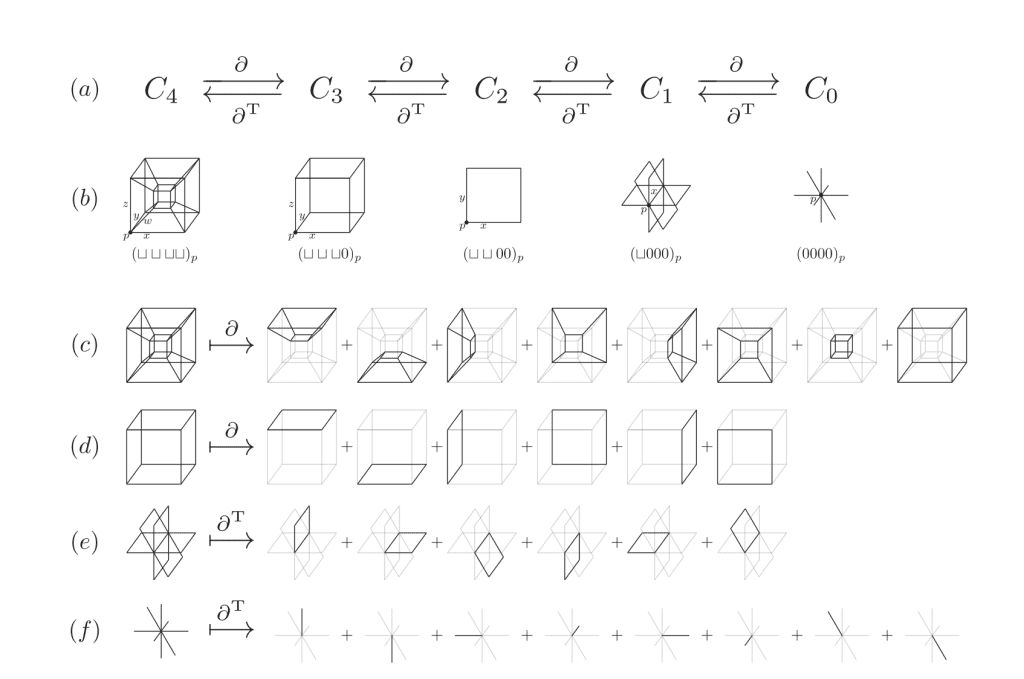
A team from Microsoft Quantum, comprising David Aasen, Matthew Hastings, Vadym Kliuchnikov, Juan M. Bello-Rivas, Adam Paetznick, Rui Chao, Ben W. Reichardt, Matt Zanner, Marcus P. da Silva, Zhenghan Wang, and Krysta M. Svore, detail a novel approach to topological error correction in their work, ‘A Topologically Fault-Tolerant Quantum Computer with Four Dimensional Geometric Codes’.
They explore the application of four-dimensional geometric codes, specifically a rotated version of self-correcting memory, to enhance performance and reduce the resource requirements for building a practical, fault-tolerant quantum computer. Their design incorporates a complete set of logical Clifford operations, enabling universal fault-tolerant computation, and demonstrates significant reductions in qubit count and circuit depth, potentially accelerating the path towards scalable quantum technologies.
Advancements in quantum error correction proceed through optimised code design and a reduction in resource requirements, representing a notable progression towards practical, fault-tolerant quantum computation. Researchers currently demonstrate substantial improvements in the implementation of surface codes, with a particular focus on minimising qubit overhead and circuit depth, and establish a foundation for building scalable quantum systems.
Surface codes, possessing inherent resilience to local noise, form a cornerstone of quantum error correction. These codes protect quantum information by encoding a logical qubit, the fundamental unit of quantum information, across multiple physical qubits. This redundancy allows the detection and correction of errors without collapsing the fragile quantum state. Surface codes also underpin the theoretical understanding of phases of matter, providing a robust framework for protecting quantum information.
The [[96,6,8]] four-dimensional Hadamard lattice code, specifically, exhibits low-weight-6 stabilisers and depth-8 syndrome extraction circuits. Stabilisers are operators used to detect errors, and a low weight indicates a more straightforward, more efficient error detection process. The code achieves a high pseudo-threshold, a measure of the code’s ability to withstand noise. It demonstrates a logical error rate per qubit per round of correction, assuming a physical error rate under a standard noise model.
The study presents a constructive and efficient method for Clifford gate synthesis, which is crucial for complex computations, and leverages diagonal channel ejection and injection techniques, alongside optimised gate decomposition and multi-target gates, to minimise operational complexity. Simulations confirm the possibility of achieving constant-depth operations across a range of parameters, representing a step towards practical scalability, and highlight a trade-off between code distance, qubit count, and circuit depth, providing insights for hardware development. Code distance refers to the number of physical qubits required to protect a logical qubit, and a higher distance generally implies better error correction capabilities.
Researchers systematically compare the performance of two-dimensional and four-dimensional toric codes, revealing advantages in qubit efficiency for the rotated four-dimensional implementation. Toric codes are a specific type of surface code arranged in a torus shape. Analysis of the Hermite normal form, determinant, and distance parameters provides a rigorous characterisation of the code’s error-correcting capabilities and establishes a framework for evaluating robustness and scalability. The Hermite normal form is a matrix representation used to analyse the properties of the code, while the determinant and distance parameters quantify its error-correcting capacity.
The research highlights the efficacy of diagonal channel ejection and injection techniques for implementing transversal gates, minimising overhead, and demonstrates efficient protocols for multi-target CNOT gates and fan-out operations, streamlining the computational process. Transversal gates operate on individual qubits within the encoded logical qubit, thereby avoiding the need to decode and re-encode the information, which reduces complexity. CNOT (controlled-NOT) gates are fundamental quantum logic gates, and fan-out operations duplicate quantum information. Efficient implementation of these operations is crucial for building complex quantum algorithms.
👉 More information
🗞 A Topologically Fault-Tolerant Quantum Computer with Four Dimensional Geometric Codes
🧠 DOI: https://doi.org/10.48550/arXiv.2506.15130