

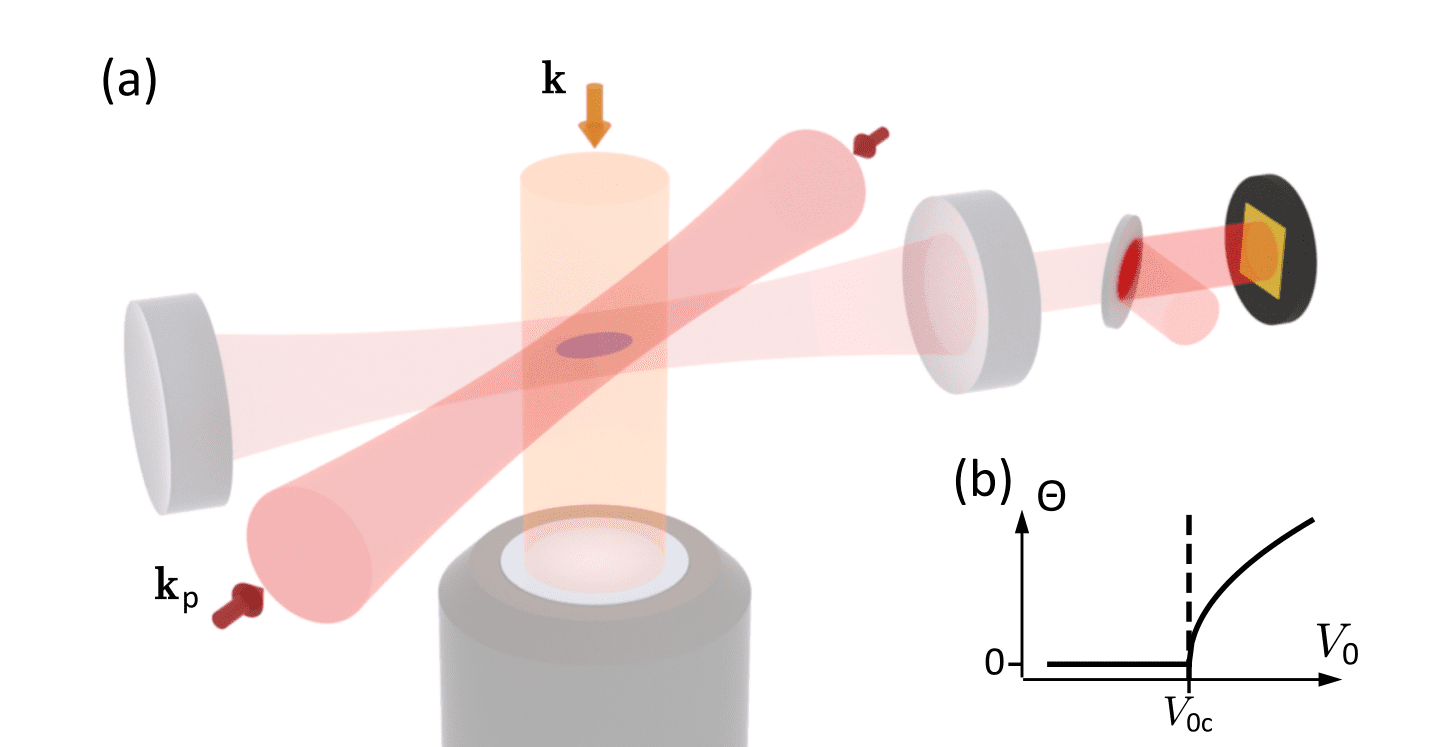
The emergence of ordered states in ultracold gases represents a significant frontier in quantum physics, and recent work by Tabea Bühler, Aurélien Fabre, and Gaia Bolognini, all from Ecole Polytechnique Fédérale de Lausanne, alongside Zeyang Xue, Timo Zwettler, and Giulia Del Pace from the University of Florence, reveals unprecedented detail in this area. The team achieves high-resolution imaging of density-wave ordering, created by interactions within a specially designed cavity, in a unitary Fermi gas. This breakthrough allows scientists to observe long-range spatial correlations as these density waves form, both when the system changes slowly and after a rapid disturbance, and the observed patterns directly reflect the structure of the cavity itself. Crucially, the researchers can now connect atomic behaviour with the properties of light within the cavity, opening new avenues for understanding and controlling quantum systems, and potentially enabling precise local control and detailed correlation measurements in complex gases.
Cavity Imaging Reveals Ultracold Gas Density Waves
Researchers have demonstrated high-resolution imaging of density-wave ordering within an ultracold gas, achieved through interactions mediated by an optical cavity. The team observed long-range spatial correlations as these density waves formed, both during gradual preparation and immediately following rapid changes to the system. These patterns persist for several seconds, limited by the gas’s lifetime within the cavity, and their amplitude depends sensitively on the cavity’s properties and the initial atomic density. These results provide direct evidence for the emergence of spatially ordered phases in strongly interacting quantum gases and open new avenues for exploring many-body physics with tailored interactions.
Following a rapid change in conditions, the system exhibits patterned atomic behaviour controlled by the cavity’s structure. Single-shot microscopic images, combined with real-time monitoring of cavity photons, allow investigation of fluctuations in the ordered state as a function of time.
Detailed Experimental Setup and Data Analysis
Experiments varying the interaction strength of the atomic gas and the properties of the optical cavity demonstrate the robustness of observed correlations between atoms and photons across a range of conditions. Analysis of these correlations over longer timescales identifies deviations from a simple relationship, which the researchers attribute to factors such as the finite thickness of the atomic cloud and atomic movement.
Detailed analysis of the spatial structure of the density waves confirms that they are spatially coherent and extend across the entire atomic cloud. Experiments tuning the system to couple to different modes of the optical cavity demonstrate that self-organization is not limited to a specific mode, but can occur in multiple modes.
The research demonstrates a fundamental connection between atomic and photonic degrees of freedom, and the spatial coherence of the density waves indicates long-range order. The versatility of the self-organization phenomenon suggests it is a general property of the system.
Cavity Control Reveals Fermi Gas Order
Researchers have achieved high-resolution imaging of density-wave ordering within a unitary Fermi gas, a feat accomplished through interactions mediated by an optical cavity. The team observed long-range spatial correlations as these density waves formed, both during gradual preparation and immediately following a rapid change in conditions. Crucially, the researchers were able to simultaneously capture microscopic images of the atoms and monitor the photons within the cavity, allowing them to directly examine the relationship between atomic and photonic properties.
This work demonstrates a new capability for investigating atom-field correlations and testing fundamental principles of cavity-induced interactions, representing a significant advance in the field. The ability to directly image these density-wave orders opens possibilities for exploring more complex phenomena, such as magnetization patterns in spin-imbalanced Fermi gases and the behaviour of pairing in systems with long-range interactions. Future work will focus on improving the imaging resolution and combining this technique with radio-frequency spectroscopy to gain further insights into the behaviour of paired atoms. Spatially engineered light beams could also be used to create new phases of matter.
👉 More information
🗞 Microscopy of cavity-induced density-wave ordering in ultracold gases
🧠 ArXiv: https://arxiv.org/abs/2511.08510


