Scientists collaborating on the MicroBooNE experiment have further constrained the possibility of a sterile neutrino as an explanation for anomalies observed in previous neutrino studies. The international collaboration at the U.S. Department of Energy’s Fermi National Accelerator Laboratory utilized one detector and two neutrino beams to investigate neutrino behavior, ruling out the single sterile neutrino model with 95% certainty. This result, published in Nature, addresses inconsistencies with the Standard Model of particle physics, specifically observations from the Liquid Scintillator Neutrino Detector (LSND) and Fermilab’s MiniBooNE experiment, which suggested unexpected muon neutrino oscillations.
MicroBooNE Experiment & Sterile Neutrino Search
The MicroBooNE experiment has ruled out the possibility of a single sterile neutrino as an explanation for anomalies observed in previous experiments like LSND and MiniBooNE. Using data collected from 2015 to 2021, and combining observations from both the Booster Neutrino Beam (BNB) and NuMI, MicroBooNE achieved 95% certainty in excluding the favored region where a single sterile neutrino might exist. This result utilizes 60% of the experiment’s total data, with analysis of the remainder underway.
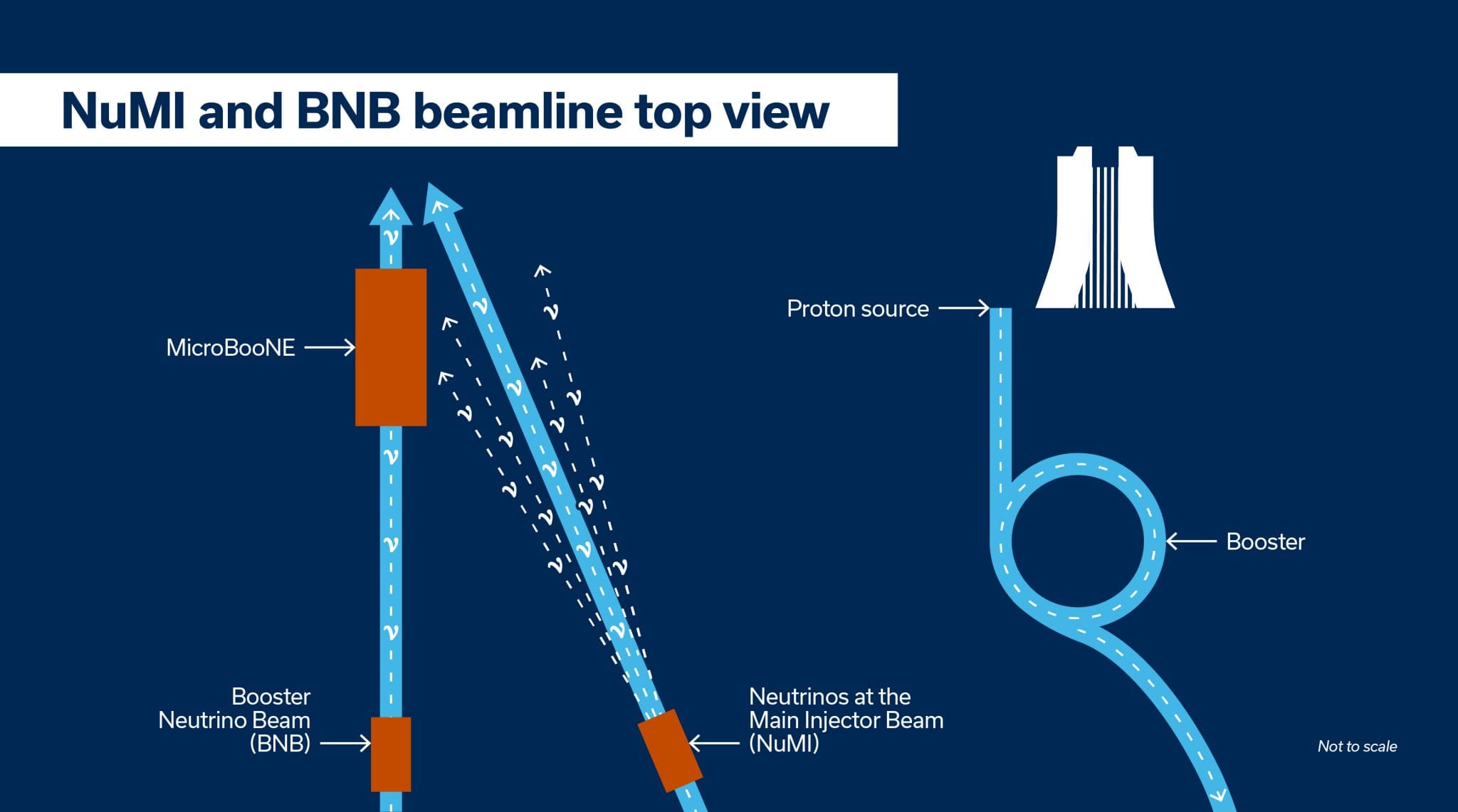
MicroBooNE’s approach was unique, being the first experiment to search for sterile neutrinos using one detector and two beams simultaneously. This method helped reduce uncertainties and allowed the collaboration to confidently exclude nearly the entire favored region for a single sterile neutrino. The experiment, a liquid-argon time projection chamber, is located 70 meters from where MiniBooNE originally measured the anomaly, providing a focused search for this potential explanation.
Despite ruling out one explanation for the observed anomalies, the mystery of unexpected neutrino behavior remains. The international collaboration, comprised of 193 scientists from 40 institutions, is continuing the search for new physics beyond the Standard Model. This result is expected to spur further creative investigations within the neutrino physics community, with other experiments like the Short-Baseline Neutrino Program also contributing to the effort.
Evidence for Anomalies & Prior Experiments
MicroBooNE investigated anomalies previously observed by the Liquid Scintillator Neutrino Detector (LSND) in 1995 and Fermilab’s MiniBooNE experiment. These earlier experiments suggested muon neutrinos were oscillating into electron neutrinos at rates inconsistent with the Standard Model, potentially indicating the existence of a fourth, “sterile” neutrino. MicroBooNE aimed to verify these results, focusing on the possibility of a single sterile neutrino as an explanation for the observed discrepancies in neutrino behavior.
MicroBooNE ruled out the single sterile neutrino explanation with 95% certainty by utilizing one detector and two neutrino beams – the Booster Neutrino Beam (BNB) and NuMI. This dual-beam approach reduced uncertainties, enabling the experiment to exclude nearly the entire favored region where a single sterile neutrino might exist. Data collection spanned from 2015 to 2021, and this result is based on only 60% of the total dataset collected, leaving room for further analysis.
Despite ruling out this specific explanation, the mystery of the LSND and MiniBooNE anomalies remains. The MicroBooNE collaboration, consisting of 193 scientists from 40 institutions, is continuing to analyze the remaining data. Other experiments, such as those within the Short-Baseline Neutrino Program (SBND and ICARUS), are also pursuing the search for new physics to explain these discrepancies, encouraging further creative exploration within the neutrino physics community.
“They saw flavor change on a length scale that is just not consistent with there only being three neutrinos,” explained Justin Evans, professor at the University of Manchester and co-spokesperson for MicroBooNE. “And the most popular explanation over the past 30 years to explain the anomaly is that there’s a sterile neutrino.”
Justin Evans, professor at the University of Manchester and co-spokesperson for MicroBooNE
The Standard Model & New Physics
The MicroBooNE experiment has significantly narrowed the search for new physics by ruling out a single sterile neutrino as an explanation for anomalies observed in previous experiments like LSND and MiniBooNE. These earlier results suggested muon neutrinos were oscillating into electron neutrinos at a rate inconsistent with the Standard Model—the current best theory explaining how the universe works. MicroBooNE used one detector and two neutrino beams to exclude the region where this single sterile neutrino might exist with 95% certainty.
The Standard Model, while successful, is known to be incomplete as it doesn’t account for phenomena like dark matter, dark energy, or gravity. Physicists are therefore actively searching for “new physics” to expand our understanding. MicroBooNE’s approach—observing neutrinos from both the Booster Neutrino Beam (BNB) and NuMI—reduced uncertainties and allowed for a more precise exclusion of the favored region for a single sterile neutrino. The experiment collected data from 2015 to 2021 and has analyzed 60% of its total dataset.
Despite ruling out one potential explanation, the mystery surrounding the anomalies observed by LSND and MiniBooNE remains. Other experiments, like those within the Short-Baseline Neutrino Program (SBND and ICARUS), are continuing the search with multi-detector approaches. This MicroBooNE result will spur further creativity in the neutrino physics community to explore alternative explanations and seek out new physics beyond the Standard Model.
MicroBooNE’s Methodology & Data Collection
MicroBooNE utilized a unique methodology by observing neutrinos from two beams – the Booster Neutrino Beam (BNB) and NuMI – with a single liquid-argon time projection chamber detector. Data collection spanned from 2015 to 2021, and this approach reduced uncertainties in their results. Importantly, the analysis presented used only 60% of the total collected data, leaving room for further investigation.
The experiment specifically sought to disprove the existence of a single sterile neutrino as an explanation for anomalies observed in previous experiments like LSND and MiniBooNE. By combining data from two beams, MicroBooNE was able to exclude nearly the entire favored region where a single sterile neutrino might be “hiding.” This method allowed the collaboration to rule out this explanation with 95% certainty.
MicroBooNE’s contribution extends beyond this specific search. The collaboration is also providing valuable insights into how neutrinos interact within liquid argon, which is critical information for future liquid-argon time projection chamber experiments like the Deep Underground Neutrino Experiment. The experiment involves 193 scientists from 40 institutions across six countries.
Source: https://www.fnal.gov/