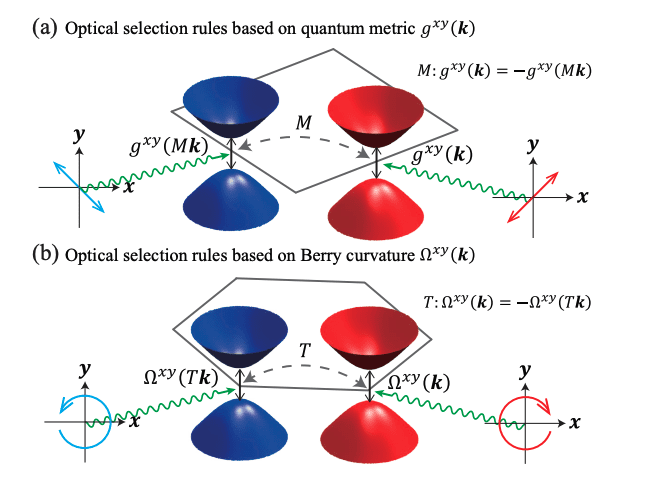
Optical selection rules govern which transitions occur when light interacts with materials, fundamentally influencing the design of advanced optoelectronic devices and the control of exciton states. Yongpan Li and Cheng-Cheng Liu, both from the Centre for Quantum Physics at the Beijing Institute of Technology, lead a team that challenges conventional understanding of these rules, demonstrating the crucial role of the material’s metric, a measure of how distances are distorted, in determining how light interacts with solids. The researchers reveal a direct link between this metric and the strength of light polarization, establishing rules that can lock specific polarizations to distinct ‘valleys’ within a material’s electronic structure. This discovery provides a new framework for engineering materials with tailored optical properties, potentially unlocking innovative applications in valley-based spintronics and optoelectronics.
Quantum Geometry Dictates Optical Selection Rules
Optical selection rules govern how atoms and solids absorb light, depending on their electronic structure. Recent research linked orbital angular momentum to Berry curvature, establishing rules for circularly polarized light. This work extends these ideas to include linearly polarized light, demonstrating that the quantum metric, which describes the geometric properties of electronic bands, also dictates light absorption. The research establishes quantum metric-based optical selection rules for linearly polarized light, directly linking the quantum metric to the strength of optical absorption. In materials with mirror symmetry, electrons couple exclusively to linear polarization aligned parallel or perpendicular to the mirror plane.
When connected by symmetry, orthogonal linear polarizations selectively excite distinct valleys, extending the geometric understanding of optical selection rules beyond Berry curvature. The research revisits Berry curvature-based optical selection rules for circularly polarized light, demonstrating a link between Berry curvature and the strength of optical absorption for left- and right-circularly polarized light. Complete selectivity emerges in valleys possessing rotational symmetry, leading to valley-contrasted optical selection rules where one valley selectively absorbs left circularly polarized light and the other, right circularly polarized light. The researchers derive quantum metric-based optical selection rules for linearly polarized light, expressing the strength of optical absorption in terms of the quantum metric tensor.
These strengths determine the degree of linear polarization, influenced by symmetries connecting different points in the material’s electronic structure. Mirror symmetry plays a crucial role, as the quantum metric acquires an opposite value at a mirrored point, dictating opposite degrees of linear polarization in connected valleys. The research finds that linearly polarized light is exclusively allowed in optical transitions at the mirror-invariant plane of a mirror symmetry. The quantum metric tensor is positive semi-definite and symmetric, leading to a range of possible polarization values. Specific mirror symmetry imposes a selection rule, where linearly polarized light polarized along specific directions is exclusively allowed in optical transitions at the mirror-invariant plane.
Wannier Interpolation and Quantum Metric Calculation
Computational methods are implemented using standard software packages, beginning with optimization of the crystal structure until the forces on the atoms are minimal. A model is then constructed to simplify the calculations. The mathematical representations of the velocity operator are calculated using established methods. Subsequently, the quantum metric tensors are calculated using these velocity representations, detailed in established literature.
Polarization Selectivity in Mirror-Symmetric Valleys
The research demonstrates that valleys exhibiting mirror symmetry and a non-zero quantum metric exhibit complete selectivity for linearly polarized light, as the electronic bands respond differently to polarization under specific conditions. This complete polarization selectivity is not observed in valleys with multiple bands. Investigations into model systems reveal these principles in action. One model, characterized by a unique arrangement, possesses valleys exhibiting spin-valley locking, influenced by four mirror symmetries. Calculations at specific points demonstrate that optical transitions at one valley exclusively absorb light polarized along specific axes, while another valley selectively responds to a different polarization.
Numerical calculations confirm that the degree of linear polarization reaches its maximum value along mirror-invariant lines. Another model also exhibits this polarization selectivity, with calculations at specific points revealing a similar relationship between polarization and valley position. The degree of linear polarization reaches its maximum value under specific conditions related to spin-orbit coupling. Material realization of these principles is demonstrated in a specific material, which exhibits a unique magnetic arrangement. The crystal structure features opposite magnetic moments on the atoms. Due to the weak spin-orbit coupling in this material, its valleys are locked to opposite spins and related by mirror symmetries, resulting in opposite degrees of linear polarization around the two valleys. This valley-contrasted optical selection provides a pathway for generating fully spin-polarized currents, where linearly polarized light selectively excites electrons in specific valleys, leading to current with defined spin.
Quantum Metric Controls Light-Matter Interactions
This research establishes a new understanding of how materials interact with light, demonstrating that the geometry of the material’s electronic structure, specifically the quantum metric, plays a crucial role in optical selection rules alongside Berry curvature. The findings reveal a direct correspondence between the quantum metric and the strength of light polarization, enabling control over which regions of specific electronic properties are excited by light. The team validated this theory through calculations on model systems, confirming the universality of the metric-based optical selection rules. This discovery expands the geometric picture governing light-matter interactions and opens new avenues for designing materials for spintronics and valleytronics, fields focused on harnessing electron spin and valley properties for advanced technologies. The authors acknowledge that achieving complete control over circular polarization selectivity typically requires specific symmetries, and their metric-based approach offers a pathway to achieve this even in materials lacking those symmetries.
👉 More information
🗞 Quantum metric-based optical selection rules
🧠 DOI: https://doi.org/10.48550/arXiv.2507.09260